News
Nigerian court freezes Jeremiah Useni’s controversial London property once claimed by Ozekhome

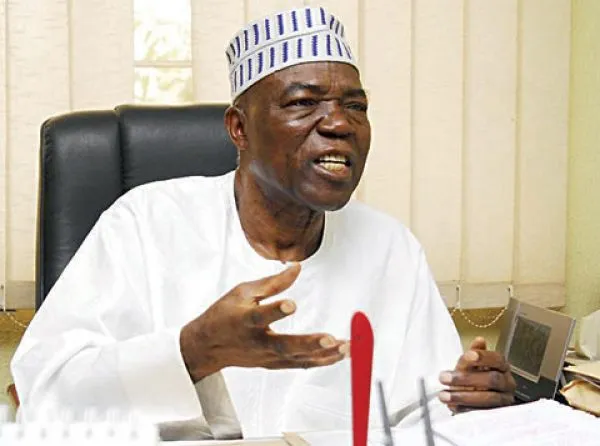
The Federal High Court in Abuja on Friday froze a London property linked to the late Jeremiah Useni, a Nigerian military-era Minister of Federal Capital Territory (FCT).
Judge Binta Nyako issued the order freezing the property for 14 days, following an ex-parte application by Nigeria’s Code of Conduct Bureau (CCB).
She ordered that within the 14-day period, the CCB must advertise the court order in a newspaper to invite whoever is interested in the property to come forward to prove legitimate acquisition, a lawyer who witnessed the proceedings told PREMIUM TIMES on Friday.
The property, located at 79 Randall Avenue, London, caught the attention of the Nigerian government following audacious but futile efforts of senior lawyer Mike Ozekhome to claim it.

CCB ultimately seeks to secure a final forfeiture of the property in favour of the Nigerian government, in a complicated legal process expected to later extend to London courts.
If no interested party shows up in court to lay claim to the property or can prove legitimate acquisition of the asset, then the court will make an order of its final forfeiture to the federal government. The Nigerian government will then file the forfeiture order in London to continue the legal process of taking over ownership of the property.
But a successful proof of entitlement to the property by an interested party may mean an end to the government’s takeover efforts.
Shady acquisition
CCB is concerned with the enforcement of Nigeria’s Code of Conduct for Public Officers, including scrutinising assets declared and those actually owned by public officers.
The agency took aim at the London property following a recent London tribunal’s judgement exposing the shady trajectory of the property from when it was first purchased by Mr Useni in 1993, while he was the FCT minister.
In its judgement delivered on 11 September, the First-tier Tribunal (Property Chamber), London, United Kingdom, declared that Mr Useni acquired the property with a false name in 1993.
The Nigerian government casts the falsehood as a breach of the code of conduct regarding assets declaration, justifying the forfeiture of the property in issue.
In its first step aimed at securing the forfeiture of the property, the CCB filed an ex parte application seeking the freeze of the property.
Being an ex parte application, no adverse parties were served the request or present in court on Friday.
The judge granted the request.
How shady acquisition was exposed in London
In recent years, the property became a subject of a bitter dispute after Mr Ozekhome, a Senior Advocate of Nigeria (SAN), applied in 2021 for the transfer of the ownership of the property to himself.
Mr Ozekhome’s claim set off a messy court drama when a party, later found to be a ghost personality, “Ms Tali Shani,” represented by Westfields Solicitors in the UK, equally claimed ownership of the property.
Mr Ozekhome had in August 2021 claimed the property was a gift from a man who presented himself as Tali Shani, said to be the property’s owner, in appreciation for legal services.
He relied on a man who presented himself as Tali Shani, a Nigerian businessman said to have owned the UK property since 1993.
The man, who produced a Nigerian passport, claimed to have bought the property at age 20 with money from family cattle businesses, and later transferred it to Mr Ozekhome out of gratitude for legal services.
In contrast, Ms Tali Shani, later found to be non-existent, insisted she bought the house in her “hey days” and accused Mr Ozekhome of trying to seize it using impostors.
Ms Tali Shani never appeared before the tribunal, despite multiple adjournments. In 2024, her lawyers filed medical letters claiming she was too ill to testify, and eventually reported that she had died in October 2024, attaching a death certificate from Nigeria.
Investigations later revealed that documents submitted by both sides — including identity cards, utility bills, and a National Identification Number — were forged.
Judge Ewan Paton ruled that neither Mr Ozekhome nor the supposed woman named Ms Tani Shani was the true owner of the property at 79 Randall Avenue.
The judge found that the house was secretly bought in 1993 by the late Mr Useni, the dictator Sani Abacha regime’s FCT minister, using a false identity.
Mr Useni, who died in France in January 2025, was a very influential member of the Abacha government and was even in contention to be head of state following Abacha’s death in June 1998.
The tribunal examined conflicting testimonies, including evidence from Nigerian police and identity authorities, as well as oral testimony from Mr Useni himself before his death.
Before his death, Mr Useni appeared before the court through a video link in 2024. Contrary to Mr Ozekhome’s defence, Mr Useni told the court plainly: “I owned it. I bought the property. It is my property.”
He admitted registering the house in another person’s name but denied ever knowing a “Ms Tali Shani.”
Documents before the tribunal confirmed that the 1993 purchase was made under the false name Philips Bincan, and that Mr Useni had a pattern of using false or “coded” names, such as “Tim Shani,” for bank accounts and companies — a practice already established by the Royal Court of Jersey in 2022.
The court held that the similarity of names and timing strongly supported the finding that Mr Useni deliberately used the false name “Tali Shani” to register the property.
The tribunal found Mr Useni’s evidence consistent with purchase records, unlike the shifting accounts of the Shanis or Mr Ozekhome.
The court also ruled that since “Mr Tali Shani” had no legal title to transfer the London property to Mr Ozekhome, the chief land registrar must cancel Mr Ozekhome’s application to be registered as proprietor.
Finally, the court held that since Mr Useni is deceased, ownership now rests with whoever obtains probate of his English assets.
“General Useni is now deceased, so on my findings, his title and interest in this property would vest in such persons as obtained a grant of probate or administration in respect of his English assets. Although not strictly bound by my findings (since they were not parties to the case), it is a matter for any such persons, on their own advice, what, if any, steps they take in this regard,” the judge said.
Investigation back home
The London court judgement’s revelation triggered a backlash back home, with many Nigerians condemning the roles Mr Ozekhome and other Nigerians played in the saga.
In September, about three weeks after the judgement was delivered, the Attorney-General of the Federation (AGF) and Minister of Justice, Lateef Fagbemi, announced launching a probe into the matter.
Speaking at a Supreme Court event with the Chief Justice of Nigeria (CJN) Kudirat Kekere-Ekun in attendance, Mr Fagbemi described the London case as a development that had had an impact on the legal sector.
“It is for this reason that my office has now taken the unusual step of verifying the authenticity of this and often complaints with a view to referring them to the appropriate disciplinary bodies,” Mr Fagbemi said.
He delivered the remarks at the ceremony marking the beginning of the Supreme Court’s new 2025/2026 legal year and conferment of the prestigious rank of Senior Advocates of Nigeria (SAN) on 57 lawyers.
Mr Fagbemi said on Monday that the London case “stands out in recent memory” and “bears sadly” on the integrity of the Nigerian legal profession.
“It bears sadly on the high esteem and integrity that our noble profession commands as a sine qua non for our collective commitment and investment in the legal brand. I am referring to the recent decision (11th September 2025) of an English property tribunal, by Judge Ewan Paton.
“It will be remiss of me not to bring such an egregious development to the attention of my lords, in the hope that it is addressed frontally against the backdrop of the hallowed rules that guard and define the finest traditions by which our nobility should be measured,” he said.
He appealed for “the cooperation of the Nigerian Bar Association and the Body of Senior Advocates” in his efforts at verifying the authenticity of the complaints and referring the erring ones to the necessary disciplinary bodies.
(Premium Times)
-

 Metro17 hours ago
FULL LIST: Ex-Oyo gov Alao-Akala’s properties in Nigeria, UK, US subject of family dispute
-
Metro17 hours ago
I’m heartbroken my husband was killed over plantain – Widow
-
News17 hours ago
DHQ allays fear as US deploys drones to Nigeria
-
Business12 hours ago
Nigeria’s petrol price surges 39.5%, second highest globally
-
News18 hours ago
Police arrest 11 more suspects over ‘sexual assault’ during festival in Delta
-
News17 hours ago
Tinubu Could Have Stopped In Borno Before Going To London – Akande
-
News18 hours ago
IED ‘planted for troops’ kills eight bandits in Niger state
-
News17 hours ago
Demand surges for anti-HIV injection