News
Tinubu’s ambassadorial list exposes Nigeria’s foreign policy challenges

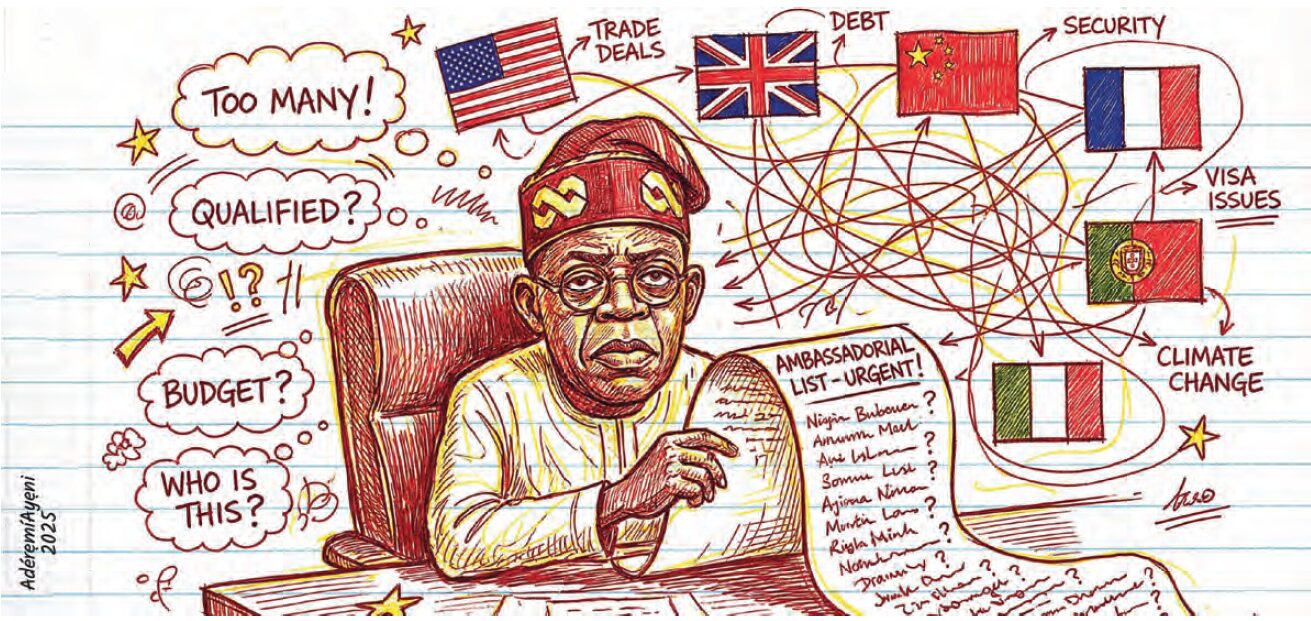
Nigeria’s new ambassadorial nominations have forced the country to confront an uncomfortable truth about its foreign policy. For more than two years, strategic missions in Washington, London, Beijing, Pretoria and Abu Dhabi operated without formally appointed ambassadors. Senior career diplomats served as Chargés d’Affaires ad interim, keeping operations functional but lacking the political authority required for high-level negotiations, crisis engagement and strategic influence.
The absence became visible in moments when Nigeria needed a clear voice. The visa and investment tensions with the United Arab Emirates lingered without decisive leadership, and Nigeria lacked senior representation during sensitive exchanges following Donald Trump’s comments about Africa. These gaps were not clerical oversights; they signalled a deeper fracture in Nigeria’s foreign-policy machinery.
The new ambassadorial list has therefore generated debate, not only because it fills a long-standing vacuum but because it raises the question of what Nigeria now expects from its diplomacy. The nominations include political figures such as Reno Omokri, Femi Fani-Kayode and former INEC Chairman Mahmood Yakubu. Yakubu’s selection has attracted criticism from sections of the public and the opposition PDP, who still accuse him of manipulating the 2023 elections in favour of the current administration. This has intensified perceptions that some postings may reflect political reward more than competence. In a country of more than 200 million people, ambassadorial appointments should strengthen national capacity, not deepen uncertainty. Diplomacy is too strategic to be governed by patronage.
The consequences of prolonged leadership gaps were substantial. In 2023, Nigeria lacked substantive representation in Abu Dhabi during key trade and investment negotiations, delaying decisions that affected businesses, remittances and diaspora welfare. In London, Washington and Beijing, coordination on regional security, technology partnerships and climate-finance initiatives slowed, weakening Nigeria’s visibility in multilateral forums. Career diplomats did what they could, but without the political authority of substantive ambassadors, they could not commit or negotiate decisively. Diplomacy depends on presence and authority; Nigeria had neither for over two years.

But personnel gaps are only one part of the problem. Nigeria’s foreign-policy framework has become directionless. The older concentric-circles doctrine, prioritising West Africa, Africa, then global engagement, has faded, leaving missions without shared strategic goals. The government’s declared foreign-policy pillars – diaspora, development, demography and democracy (the Four Ds) – remain largely rhetorical. Most embassies have no operational guidance or reporting structure linking their activities to these priorities. Without coherence, even skilled diplomats cannot deliver results.
Nigeria could learn from emerging powers that align diplomatic deployment directly with national strategy. India assigns envoys according to trade and technology priorities. Brazil evaluates ambassadors using investment, export and citizen-service indicators. Turkey integrates diplomacy with national-security planning, enabling embassies to negotiate energy, defence and intelligence cooperation with clarity. These states improved their global relevance by strengthening foreign-service systems. Nigeria has not undertaken similar reforms.
The weakness is not lack of talent. Nigeria has experienced diplomats, scholars and technocrats capable of projecting national interests. The problem lies in institutional culture, where political loyalty often outweighs professional expertise. Effective ambassadors must possess negotiation skill, geopolitical understanding and administrative competence. Deploying politically exposed or untested individuals to sensitive missions limits Nigeria’s influence at a moment of intense global competition.
The Ministry of Foreign Affairs reflects this structural fatigue. Communication between headquarters and embassies is uneven. Policy directives lack consistency. Reporting formats differ widely, and digital tools for economic diplomacy, diaspora engagement and crisis response are inadequate. These gaps become obvious during emergencies – delays in assisting Nigerians facing detention, discrimination or conflict abroad, slow responses to foreign investment inquiries and inconsistent coordination with ECOWAS, the Gulf and Sahel actors. A foreign-policy system that cannot respond quickly cannot protect national interests.
This ambassadorial transition presents an opportunity for reset. The Senate’s confirmation process must move beyond courtesy and ability to recite the National Anthem and then take a bow. It must interrogate competence, experience and nominees’ understanding of Nigeria’s geopolitical priorities. Postings should reflect national needs – economic, security, diaspora and demographic – not political networks. The Ministry must translate the Four Ds into actionable plans with performance metrics, quarterly reporting and digital monitoring tools.
Long-term reform requires redesigning Nigeria’s diplomatic pipeline. Modern diplomacy demands expertise in cybersecurity, maritime governance, energy transition, climate finance and global supply chains. Training programmes must reflect these realities, and recruitment must allow specialists, academics and technocrats to join transparently. Diplomacy today is multidisciplinary; Nigeria cannot rely solely on generalists.
Accountability must also be institutional. Missions need clear performance indicators tied to investment mobilisation, diaspora welfare, regional leadership and strategic partnerships. Parliament must strengthen oversight to ensure missions operate according to national priorities and resources are used effectively.
Nigeria has a record of diplomatic achievement, from ECOWAS peacekeeping to anti-apartheid mobilisation and early global governance influence. That legacy is fading, not because the country lacks talent, but because institutions have weakened and political decisions increasingly override strategy.
Nigeria can rebuild a credible and modern foreign policy system anchored in merit and clarity, or it can persist with reactive diplomacy and weakening institutions. The direction it chooses will shape its regional and global relevance for years. With strategic appointments, firm oversight and accountable leadership, the country can turn institutional weakness into genuine diplomatic renewal. (BusinessDay)
-

 News20 hours ago
Lebanese-Nigerian Businessman Nidal Karameh, Mikano And Orca Mall Owner, Linked To Greek Island Drug Seizure – Report
-
News20 hours ago
Shanties and drug peddling… inside filthy settlements springing up along Lagos-Calabar coastal highway
-
Opinion5 hours ago
Gun-blazing Wike ń f’ikú ṣeré
-
Sports5 hours ago
AFCON final ref dropped as FIFA picks World Cup officials
-
News5 hours ago
US Cancels All Visa Appointments After Ordering Staff To Leave Abuja
-
Business20 hours ago
Vandalism: Telcos count losses as 656 generators, batteries stolen in 2025
-
News5 hours ago
US Advisory: Nigeria Remains Stable, Says FG
-
News4 hours ago
‘Unforgettable and irreplaceable’ — Tinubu mourns soldiers killed in Borno terrorist attack