Business
How Otedola’s exit from energy mirrors Elumelu’s bold entry

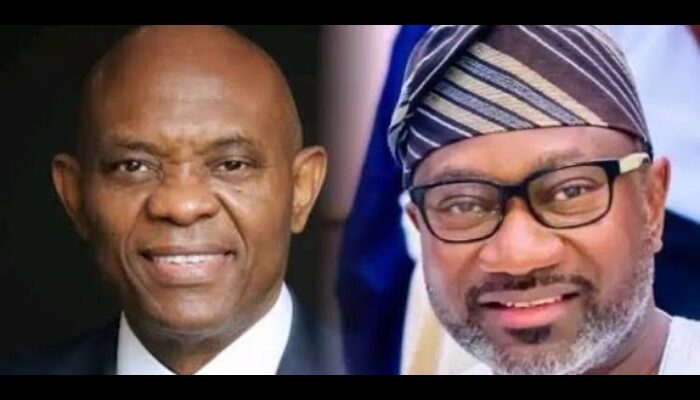
Two of the country’s most prominent billionaires have executed near-mirror strategic pivots over the past decade, with Femi Otedola exiting energy for banking while Tony Elumelu charged in the opposite direction, in a striking reversal of fortunes that encapsulate Nigeria’s evolving corporate landscape.
Elumelu’s $496 million acquisition of a commanding 20 percent stake in Seplat Energy announced December 31 and Otedola’s exit from Geregu Power completed December 29 mark inflexion points in divergent decade-long strategies that have reshaped Nigeria’s energy and financial sectors.
Banking magnate turns energy baron
Elumelu’s journey into energy began long before his retirement as United Bank for Africa’s managing director in 2010. But the real transformation accelerated in January 2021 when his Heirs Holdings, through affiliate TNOG Oil and Gas, acquired a 45 percent stake in OML 17 from Shell, Total, and ENI for $1.1 billion, one of Africa’s largest oil and gas financings in over a decade.

The move signalled Elumelu’s intent to build what he called ‘Africa’s first integrated energy multinational.’ Within 100 days of taking operational control, production doubled from 28,000 to over 50,000 barrels per day. By October 2024, OML 17 was producing 51,000 barrels daily alongside 120 million cubic feet of gas, with reserves exceeding 1.5 billion barrels of oil and 2.5 trillion cubic feet of gas.
The Seplat acquisition, financed by African Export-Import Bank and Africa Finance Corporation, now positions Heirs Energies as the largest shareholder in a company with 2P reserves of 1.043 billion barrels of oil equivalent and working interest production of 135.6 thousand barrels of oil equivalent per day. The transaction elevates Heirs Energies, which only began operations in 2021, into the upper echelon of Nigeria’s indigenous oil producers.
“This acquisition reflects our strong belief in Africa’s ability to own, develop, and responsibly manage its strategic resources,” Elumelu said, articulating his decade-long philosophy of ‘Africapitalism,’ the belief that African private capital should control the continent’s resources.
The strategy represents a calculated bet on indigenous ownership amid the retreat of international oil majors. Shell, ExxonMobil, and Chevron have steadily reduced their onshore Nigerian operations due to security concerns, regulatory uncertainty, and aging infrastructure, creating opportunities for local players.
Energy titan pivots to First Bank
While Elumelu moved deeper into hydrocarbons, Otedola charted the opposite course. Having built his fortune in energy through Zenon Petroleum and later Forte Oil (which dominated Nigeria’s downstream sector before being sold and rebranded as Ardova in 2020), Otedola turned his attention to Nigeria’s oldest bank.
In October 2021, Otedola emerged as FBN Holdings’ largest shareholder with a 5.07 percent stake, surpassing longtime power broker Oba Otudeko. The move ended years of boardroom turmoil at First Bank and signaled a new chapter for the institution plagued by non-performing loans exceeding N1 trillion.
Otedola’s accumulation continued methodically. By June 2024, his stake had grown to 7.01 percent. In July 2025, he executed a massive off-market transaction, acquiring approximately 40 percent of FBN Holdings through 17 negotiated trades worth over N324 billion at N31 per share.
By December 2025, his stake stood at 17.56 percent following a N14.82 billion share purchase.
In January 2024, Otedola assumed the chairmanship of FBN Holdings and moved swiftly to impose discipline. Among his first directives: ending the use of private jets for executive travel at bank expense, a symbolic but potent message of fiscal prudence.
He tightened oversight, set clearer accountability measures, and streamlined operations, including the November 2025 sale of FBNQuest Merchant Bank to EverQuest Acquisition.
The results have been mixed but are improving. While net profit stood at N450.87 billion in the first nine months of 2025 due to higher impairment charges, gross earnings climbed from N1.84 trillion to N2.55 trillion. Total assets grew to N26.37 trillion by September 2025, while retained earnings increased to N1.53 trillion.
The December 29 exit from Geregu Power, achieved through MA’AM Energy’s acquisition of a 95 percent stake in Amperion Power Distribution, which controls 77 percent of Geregu, effectively closes Otedola’s direct involvement in the power sector he entered during Nigeria’s 2013 privatisation. The move triggered a complete board overhaul, with nine directors resigning, including Otedola as chairman.
Contrasting philosophies, converging challenges
The divergent paths reflect fundamentally different assessments of Nigeria’s risk-reward profile across sectors. Elumelu sees energy as central to Africa’s development, betting that indigenous players can succeed where international majors stumbled. His integrated strategy links upstream production with Transcorp’s 2,000 MW power generation capacity, creating a vertically integrated energy value chain.
Otedola’s pivot suggests a calculation that banking, despite Nigeria’s perennial credit challenges, offers more manageable risks than the operational complexities, security issues, and policy uncertainties plaguing Nigeria’s energy sector.
His estimated net worth has declined from $2.5 billion in 2022 to $1.7 billion in 2025, partly due to naira devaluation and power sector headwinds, factors that may have influenced his strategic reorientation.
Yet, both face substantial obstacles. Elumelu must navigate security risks in the Niger Delta, fluctuating global oil prices, and the energy transition’s long-term implications. His expansion comes as international institutions increasingly restrict fossil fuel financing, though African lenders’ backing of the Seplat deal demonstrates regional financial capacity.
Otedola confronts First Bank’s legacy issues, including the N1 trillion non-performing loan portfolio and the Central Bank of Nigeria (CBN)’s recapitalisation mandate requiring banks to meet a N500 billion minimum capital base. His turnaround effort unfolds against Nigeria’s challenging macroeconomic backdrop of double-digit inflation and currency volatility.
Indigenous ownership ascendant
Despite different trajectories, both billionaires embody a broader trend: the Africanisation of Nigeria’s strategic sectors. International oil companies’ retreat and foreign investors’ caution have created space for indigenous capital to acquire prime assets at relative discounts.
Heirs Holdings’ portfolio valuation has surged from N250 billion in 2010 to N11 trillion by 2024, serving over 45 million customers through subsidiaries operating globally. Under Otedola’s leadership, FBN Holdings’ market capitalisation has crossed N1.3 trillion, restoring some investor confidence after years of governance lapses. (BusinessDay)
-

 News23 hours ago
Bauchi Shuts Cattle Markets In 4 LGAs Over Security Concerns
-
 Politics20 hours ago
How My former deputy plotted to take my seat – Gov. Yusuf
-
World News23 hours ago
Trump Accuses Iran Of ‘Dishonorable’ Conduct In Strait Of Hormuz, Warns Against Charging Tankers
-
News20 hours ago
Troops Kill 10 Terrorists, Rescue Kidnap Victims In Plateau Forest
-
News23 hours ago
Bandits Storm Ondo Poultry Farm, Kill Owner And Daughter During Kidnap Attempt
-
 Business18 hours ago
Taiwo Oyedele admits to errors in new tax laws, says corrective measures underway
-
Politics20 hours ago
Governorship aspirant steps down two minutes after declaration
-
Politics7 hours ago
Support Obafemi Hamzat as next Lagos governor – Faleke tells Lagosians