Business
Food Prices Drop: Farmers In Dilemma Over Loans, Hajj Payments

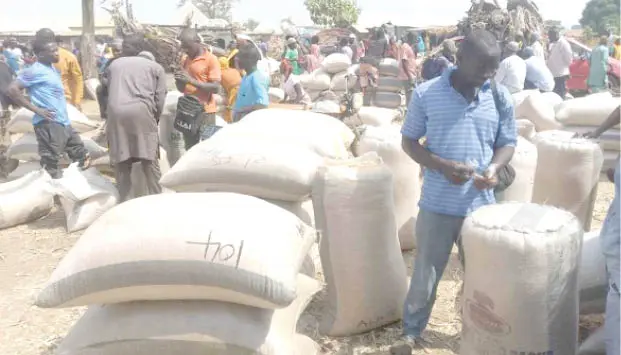
For farmers, especially those in rural areas of Niger State, this harvest season brings little joy. The season instead marks the beginning of a fresh struggle shaped by falling food prices and rising production costs, while government measures appear to favour consumers at the expense of local producers.
Many rural farmers say they feel forgotten in national economic planning. They argue that policies are often designed without considering the realities of farming communities, including poor infrastructure, lack of access to credit, limited storage facilities and weak market access.
Experts, however, warn that if the situation persists, many farmers may reduce production or abandon farming altogether, a development that could deepen food security challenges in the future.
Debt, broken aspirations

Several farmers told our correspondent that they are currently struggling to repay loans taken during the planting season as creditors have begun taking stringent measures, including arrests.
They noted that while the prices of farm produce continue to crash, the prices of the goods they need to purchase remain high.
Farmers told Weekend Trust that their primary hopes after harvest were to perform the hajj pilgrimage, build or renovate homes and buy motorcycles to ease movement to their farms. However, the continuous fall in prices has placed these aspirations beyond reach.
While lower food prices have put smiles on the faces of consumers, the situation is devastating for the producers.
High fuel prices have also increased transportation costs, eating deeply into their remaining profits.
Hajj, marriage plans stalled
In one village in Niger State, 17 farmers reportedly paid for hajj seats in 2025 through the sale of produce. However, not a single farmer from that same village has been able to pay this year despite a bumper harvest, according to Mallam Hussaini Abdullahi, a farmer in Gbako Local Government Area.
A staff member of the Niger State Pilgrims Welfare Board confirmed to Weekend Trust that significantly, fewer farmers have come forward to deposit money for the 2026 pilgrimage compared to 2025.
Mohammed Sani Idris Kodo, a farmer in Bosso Local Government, said the falling prices were already fueling rural-urban migration.
“Next farming season, many farmers will not be able to go to the field because farming is a business, and right now, farmers are running at a loss. A bag of paddy rice is between N30,000 and N40,000. How can you pay back loans?” He asked.
Female farmers in the region expressed similar frustrations.
Zara’u Usman from Bosso Local Government Area noted, “A mudu of millet is N350 but a bottle of palm oil is N2,000. How do we buy cloths and other necessities?”
Jamila Ibrahim added that she had hoped to buy a new mattress and renovate her room but expressed frustration. She said, “I wanted to buy a new bed and was told it cost N250,000. How is that possible when a bag of maize is now N20,000?”
In Beji, Abbas Audu shared that five of his siblings postponed their weddings. “We wanted to build rooms for the brides but the prices of zinc, nails and cement are too high. Those who built rooms have resorted to thatch for roofing because zinc is beyond our reach.”
The impact of imported food
Farmers blame government’s policies for their worsening condition, claiming that the decision to flood the market with imported food items to control inflation has hurt local producers.
Findings by Weekend Trust revealed that the impact of the falling prices is already manifesting in this year’s irrigation farming. Many farmers across the state have either refused to go to the fields this dry season or have significantly cut production.
Alhaji Mahmud Bala Egge, the secretary of the All Farmers Association (AFAN) in Wushishi Local Government Area, who cultivated 15 hectares of rice during last year’s dry season, is struggling to cultivate just one hectare this year, citing falling prices and the high cost of inputs.
Calls for value addition
Murtala Yusuf, chairman of the Grain Sellers Association at Gunu Market, lamented lack of fairness in government measures, saying, “I borrowed N100,000 when a bag of white beans was N100,000, but that bag is now worth N35,000. How do you cope?”
Experts are calling on the government to strike a balance. Prof Olalekan Busra Sakariyau, an agribusiness expert and Africa representative for Family and Care Farm, Germany, urged Nigeria to prioritise local production over imports.
“Importing foodstuff is not a sustainable strategy. If we add value through processing instead of selling raw materials, we will make a difference. Nigerian farmers must embrace smart farming and storage to survive these price crashes,” he said, noting that Nigeria lost 40 per cent of its food yearly, such as fruits in Kano and Benue due to lack of storage and processing.
-

 News22 hours ago
Bandits Abduct Couple On Farm In Kaduna
-
Sports22 hours ago
FIFA Clears Wrexham Goalkeeper Okonkwo To Represent Nigeria
-
 Politics22 hours ago
Your Actions Bad For Nigeria’s Democracy – Kwankwaso Tells Nafiu Bala
-
News22 hours ago
Army Dismisses Claims Of Discharged Soldier, Reaffirms Troops’ Safety, Welfare
-
Politics21 hours ago
Rice, Spaghetti Won’t Save You In 2027 – Atiku Tells Tinubu
-
News22 hours ago
Residents Flee As Bandits Kill 3, Injure Others In Niger
-
Metro22 hours ago
US-based Nigerian faces five-year jail over $5m money laundering
-
Metro21 hours ago
Bandits Kill Abuja Bizman, Daughter Despite N12m Ransom Payment