Politics
Tinubu clips Wike’s wings to save the Niger Delta’s prize

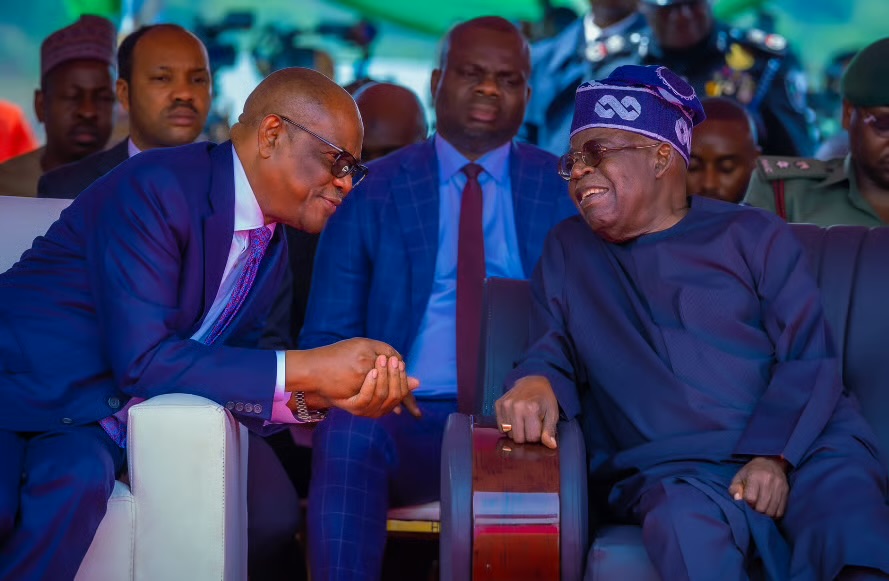
President Bola Tinubu has moved to cool one of Nigeria’s most combustible political feuds, summoning Nyesom Wike, the federal capital territory minister and former Rivers governor, and Siminalayi Fubara, the sitting governor, to a late-night meeting in Abuja that stretched into the early hours, according to several sources familiar with the talks.
The intervention comes as the temperature between the two men hit boiling point.
“Let me tell you – I don’t like ingrates” … “Nobody has the monopoly of causing violence” … “It is only an empty container that makes noise”; just a small sample of the verbal jousting flooding the newspapers in an election year.
The intervention matters because Rivers is not merely another state-level quarrel.

It is the Niger Delta’s commercial and political nerve centre, an oil-rich prize with deep pockets and a long record of turning elite disputes into wider problems.
With 2027 on the horizon, Tinubu has little to gain from a Rivers crisis that spirals into impeachment brinkmanship, legislative paralysis, or street tension – and a great deal to lose if the centre is dragged into another escalation.
For weeks, Tinubu had been criticised by allies and opponents alike for letting the stand-off between Wike and his former protégé run unchecked.
The feud has been simmering since Fubara took office in 2023, with Wike using the political structure he built as governor – especially his influence over lawmakers – to try to box in, and ultimately unseat, the man he installed as successor.
Getting control of Rivers State
At stake is control of Rivers’ governing machine: the state assembly, local government networks and the flow of patronage that comes with running one of Nigeria’s richest subnational budgets – ₦1.85trn in 2026. Port Harcourt is a strategic city in its own right.
But the real prize is the combination of money, mobilisation capacity and institutional leverage that a Rivers governor can deploy.
The latest flare-up came as Wike’s allies pushed the state towards an impeachment showdown, a tactic that would replace grinding factional warfare with a definitive, high-risk constitutional battle.
According to one senior politician briefed on the Abuja talks, Tinubu signalled clearly that he did not want to hear further threats of impeachment, framing the fight as a needless act of self-harm for Rivers and an avoidable headache for the federal government.
Another person familiar with the meeting said senior party figures were present and were exasperated by what they regard as Wike’s relentless attacks on Fubara.
Tinubu’s goal was de-escalation, not a clean victory for either camp.
The president, the sources said, urged both men to step back from the cliff edge, with an implicit warning that Rivers could not be allowed to become a theatre of permanent crisis.
Tinubu’s debt to Wike
Yet Tinubu’s balancing act is complicated by his debt to Wike.
The FCT minister has been one of the most effective cross-party allies Tinubu has had since the 2023 election cycle, having fallen out with his own party’s presidential candidate in 2022 and then using his influence in Rivers to benefit Tinubu’s campaign.
Wike remains formally tied to the People’s Democratic Party. Still, he has also been a useful disruptor inside it – and a skilled operator with reach into courts, institutions and the hard-edged mechanics of Nigerian politics.
That is why, even as Tinubu moved to restrain Wike’s assault on Fubara, several people familiar with the meeting said the president offered a face-saving concession.
Tinubu, they said, indicated that Wike would retain influence over the APC’s preparations for the coming state assembly by-elections in Rivers, specifically in Ahoada and Khana.
Is Fubara a disloyal successor?
Wike chose Fubara because he expected a loyal successor – a former accountant-general who seemed pliable.
Instead, he got an increasingly independent governor who has accused him of “godfatherism”, of refusing to let go, and of demanding large amounts of Rivers’ monthly allocation as the price of patronage.
Fubara’s camp portrays the struggle as a revolt against a political overlord.
Wike’s allies tell a different story: that Fubara owes his rise to Wike’s structure and is now trying to confiscate it.
“Take it from me, Fubara is in a very weak position and will not be reelected in 2027. Wike will control the process and choose the next governor,” says Lucky Loolo, a Wike loyalist, in a blunt attempt to project dominance in the aftermath of the Abuja talks.
A member of the Rivers Elders’ Council frames the contest as a clash between experience and naïveté.
Wike is “the best Rivers politician of his generation who has a legacy to protect. Wike controls the people who matter politically in this state, and Fubara is naïve if he thinks that he can beat Wike.”
This effort to claim victory is partly about keeping the machine disciplined.
In a patronage-heavy environment, perception can be power. If Wike looks weakened, lawmakers and local operators might drift.
If he looks intact, they are more likely to hold their line.
Has Wike gone too far?
But Tinubu’s willingness to step in suggests a different calculation: that Wike’s tactics have become too destabilising to indulge, at least in Rivers, even if the partnership remains useful nationally.
The president’s aim appears to be to protect his relationship with Fubara without discarding Wike, preserving the utility of both in the approach to 2027.
The presidency’s public messaging has added to the sense that the centre is prepared to clip Wike’s wings.
Daniel Bwala, one of Tinubu’s spokesmen, delivered unusually sharp criticism of the FCT minister on television last week.
Bwala reduced Wike’s contribution to Tinubu’s political fortunes to being merely “instrumental”, urged him to respect the rule of law, and signalled that he had already been adequately rewarded for his support.
In Nigerian politics, such a public dressing-down matters not because it ends an alliance, but because it reveals who is allowed to set fires and who is expected to put them out.
It also hints at the limits of Wike’s latitude inside a Tinubu administration that prizes control – and, increasingly, calm.
None of this resolves the underlying contradiction in Rivers. Fubara is the governor, with the constitutional authority of office and the benefit of sympathy among many Rivers residents who dislike overt godfatherism.
Yet Wike retains extensive loyalty networks built over the years, especially among lawmakers and local government chairmen who owe their rise to his patronage.
Fubara can be popular and still be isolated inside the institutions that decide whether a governor can govern.
The unanswered question is how far Tinubu is prepared to go if Wike tests the new red lines.
Nigerian presidents have many tools – from party discipline to the threat of anti-corruption scrutiny from the Economic and Financial Crimes Commission – to compel compliance from ambitious actors.
The question is whether Tinubu will use those tools against a partner he still needs for 2027.
-

 Business18 hours ago
No Plan To Increase Electricity Tariff – FG
-
Entertainment18 hours ago
Why I linked Isbae U with Obasanjo for his show interview — Charly Boy
-
 News18 hours ago
FG Inaugurates Panel Probing Miners’ Deaths
-
World News18 hours ago
White House Launches ‘Trump TV’ As US Media Protests Ban On CNN, Others
-
Business18 hours ago
BREAKING: CBN Cuts Interest Rate to 23%
-
Metro18 hours ago
Couple, Three Children Killed as Overhead Water Tank Collapses on Home in Enugu
-
Politics18 hours ago
Makinde challenges Tinubu to account for election promise to fix Nigeria’s electricity
-
World News18 hours ago
Memoir by Diana’s brother goes on sale after rocking UK monarchy