Business
Refiners battle crude shortage as Nigeria exports 306m barrels

As local oil refiners in Nigeria complain of persistent crude shortages, the country exported an estimated 306 million barrels of crude oil between January and October 2025, according to figures from the Central Bank of Nigeria.
The data reveal that while Nigeria produces substantial volumes of crude, the bulk of it is earmarked for export, leaving domestic refineries struggling to obtain adequate feedstock.
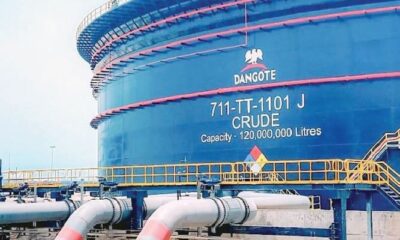
On several occasions, the Dangote Petroleum Refinery has complained of low crude supply despite the naira-for-crude deal, prompting it to source feedstock from the United States and even from neighbouring countries like Ghana and others.
Similarly, the Crude Oil Refiners Association of Nigeria lamented that some of its members’ modular refineries shut down intermittently due to a lack of crude oil.

Between January and October, the CBN data shows that Nigeria’s crude production amounted to roughly 443.5 million barrels, averaging about 1.45 million barrels per day over the period. The calculation of total production is derived directly from the CBN’s monthly figures, which are presented in million barrels per day.
To determine actual monthly production, the daily output was multiplied by the number of days in each month. For example, January’s production averaged 1.54 mbpd, and with 31 days in the month, the total production reached 47.74 million barrels.
February, with 28 days, saw daily production of 1.47 mbpd, translating into 41.16 million barrels for the month.
This method was applied consistently through October, taking into account the varying number of days per month.
Exports, on the other hand, remained closely aligned with production trends but consistently represented a significant proportion of total output.
January’s daily export averaged 1.09 mbpd, which over 31 days equals 33.79 million barrels shipped out. February exports of 1.02 mbpd over 28 days amounted to 28.56 million barrels, and the pattern continued through October.
Cumulatively, total exports over the 10 months reached approximately 306.7 million barrels, accounting for nearly 69 per cent of total production. This left roughly 137 million barrels available for the domestic market.
The monthly breakdown reveals both the production and export dynamics. Crude production started strong in January at 1.54 mbpd but declined to 1.40 mbpd in March before recovering modestly to 1.51 mbpd in June and July. The last three months of the period, August to October, saw production ease again, with September dipping to 1.39 mbpd and October stabilising at 1.40 mbpd.
Export volumes followed the same trend. Higher production months like June and July saw exports rise to 1.06 mbpd, while lower production months, such as March and September, recorded exports below 0.95 mbpd.
This imbalance between local consumption and exports exposes the tension among local refineries despite the domestic crude supply obligation. The Domestic Crude Supply Obligation is a Nigerian regulatory policy under the Petroleum Industry Act section 109, requiring upstream oil producers to allocate a portion of their crude production for local refining.
Enforced by the Nigerian Upstream Petroleum Regulatory Commission, the DCSO mandates that producers prioritise domestic demand over exports to strengthen national energy security, reduce reliance on imported products, and boost local refining capacity.
However, refiners said the DCSO implementation has been hampered by the ‘willing buyer, willing seller’ policy. While the country produces a significant quantity of crude, a majority of the output is directed to overseas markets. Domestic refiners, therefore, have to contend with limited allocations, forcing some plants to operate below capacity or delay operations.
It was observed that the shortfall does not stem from insufficient national production but from the seeming prioritisation of export revenue, which is seen as more lucrative due to dollar-denominated payments.
Speaking in an interview with The PUNCH, the National Publicity Secretary of the Crude Oil Refiners Association of Nigeria, Eche Idoko, decried the inability of local refineries to secure crude for production. Idoko said a modular refinery like Opac couldn’t get crude, and it stopped production for months.
According to Idoko, local refineries have the capacity to produce more than their current output, blaming the lack of enough feedstock for the current output. “We have the capacity to produce far more than what we are producing now. The challenge has always been inadequate feedstock,” he stated.
Idoko stated that some modular refineries like OPAC produce about 10 per cent of their capacities, while some shut down due to a lack of crude oil.
“A good example, the OPAC refinery has a 10,000-barrel capacity. It produces just about 1,000, and it’s not consistent. Sometimes, the refinery is shut down for months because of the unavailability of crude. The Dangote refinery was recently producing at 60 per cent of its total capacity due to the unavailability of feedstock.
“Aradel and Waltersmith still have to source crude outside their feedstock supply; Edo refinery still does not get enough crude. So, this speaks to the same issue from the beginning of last year. We kept saying that while we have enough installed capacity, we are not getting enough crude. And it will affect our output,” he said.
Idoko maintained that the ‘willing buyer, willing seller’ policy was intended to foster competitiveness and market efficiency. However, he said the policy, in practice, has created a significant challenge for domestic refiners who struggle to afford crude at international market prices.
He alleged, “Upstream producers prefer to sell to international buyers who pay dollar-denominated prices, while local refiners, constrained by domestic currency fluctuations and access to forex, often cannot compete.
“This market liberalisation paradoxically undermines the very goal of domestic refining self-sufficiency, as local refiners may be priced out of access to the crude they are legally entitled to receive.”
Last year, the NUPRC said it would not grant export permits to oil companies that fail to meet their domestic crude supply obligations, as part of efforts to strengthen energy security and support local refining operations.
It also disclosed that 11 crude oil cargoes offered to local refiners in a month were not taken up despite their repeated complaints about crude shortages. Using April as a reference, the commission said 48 barrels were made available for exports, out of which 21 were reserved for local refining, but only 10 were lifted by refiners.
The commission’s former chief executive, Gbenga Komolafe, noted that eight of the cargoes were rejected due to pricing differences and three because of crude grade preferences among the refiners.
The President of the Dangote refinery, Aliko Dangote, said in December that despite the naira-for-crude deal, he still imported crude from the US, Ghana, and other African countries, noting that the US alone supplied 100 million barrels in a year.
The CBN data and subsequent calculations paint a clear picture: Nigeria produces enough crude to meet both export and domestic refining needs, but the prioritisation of exports, combined with fluctuating prices and operational losses, has created persistent shortages for local refiners.
The 10-month period of 2025 demonstrates that the nation’s oil production and export strategy continues to favour foreign exchange earnings over domestic refining capacity, leaving refineries battling to access the crude they need to function effectively.
An energy expert, Professor Dayo Ayoade, appealed to the Federal Government to prioritise domestic refineries in crude allocation so as to boost the country’s local refining capacity. (Punch)
-

 Politics3 hours ago
Any PDP Member With Wike is an Enemy of Democracy – Makinde
-
News3 hours ago
IG Directs Police to Get to Root of GBV in Delta Community
-
News3 hours ago
Tinubu’s Ally To Handle N1.4trn Lagos Ports Project
-
Business3 hours ago
Fresh fuel import licences trigger Dangote export threat
-
Business3 hours ago
MTN Explains Record N1trn Investment, Persistent No Coverage Zones
-
Politics3 hours ago
APC to Retain Zoning Formula, National Executive, Say Progressive Governors
-
News23 hours ago
Since Tinubu’s Regime, His Ally, Gilbert Chagoury, Received Over ₦15.3 Trillion in Federal Contracts
-
News3 hours ago
State police: Govs submit proposal for N’Assembly review