News
Mokwa Flood: Where Did The Billions For Recovery Go?

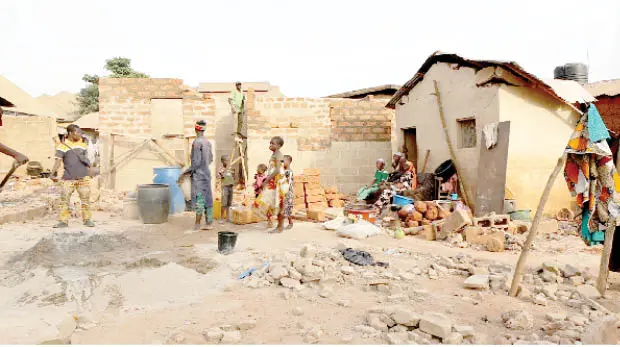
Ten months have passed since the 2025 Mokwa flood receded. While the initial promises of recovery echoed throughout the community, Mokwa currently faces significant challenges on its path to rebuilding structures. About N30 billion was pledged by both the federal and Niger State governments and well-meaning Nigerians to restore vital infrastructure, including bridges and roads, and to revitalise livelihoods in this strategic town.
However, an investigation by Weekend Trust reveals growing frustration among victims, many of who now doubt whether the promised resources would be used effectively.
During a visit to Mokwa in Niger State to assess the level of development promised in the aftermath of the disaster, Weekend Trust found that many victims have remained homeless and in deep distress. Three out of four bridges and drainage projects announced by the government are yet to receive any attention. Despite the repair of the major bridge connecting the North and South in Mokwa town, the situation has not improved. The gridlock and slow-moving traffic persist due to the high volume of trucks using the road, along with the potholes present on the route and the lack of alternative routes.
Weekend Trust reports that on June 4, 2025, President Bola Ahmed Tinubu directed the immediate release of N2 billion for the rebuilding of houses for victims. In August 2025, the president also approved the release of N16.7 billion for the urgent reconstruction of Mokwa bridges destroyed by flooding. This commitment was announced by the Minister of Information and National Orientation, Mohammed Idris, during a meeting in Abakaliki with the Minister of Works, Senator Dave Umahi.

Earlier, the acting governor of Niger State, Yakubu Garba, highlighted the challenges facing the community when Vice President Kashim Shetima visited Mokwa to express sympathy and gather firsthand information about the disaster. He informed the vice president that the flood had severely impacted education and socioeconomic activities by cutting off the bridges and roads that students and residents of Mokwa and surrounding villages relied on to reach schools, markets and farms.
“Currently, people from Raba village cannot come to Mokwa for economic activities until they travel round about 20km. We need a quick intervention. The state government cannot do these interventions alone. Secondly, students from the other side of the river can no longer come to Mokwa.
“Also, the rail here connects the North and South, but it has been cut. I expected the Federal Ministry of Transport to have come here to ascertain what happened to this rail line. Again, we don’t want the women that have been affected to languish in poverty after this disaster. We want the federal government to support the state in empowering these women so they have a stake so they can help themselves. We are already suffering from insecurity and we wouldn’t want these victims abandoned and become security threat,” he said.
Vice President Kashim Shettima responded to the community’s plight by announcing President Tinubu’s directive. He said the president had directed quick intervention on the drainage system to avert a repeat of the tragedy.
The vice president further said that as the chairman of the Niger Delta Power Holding Company, he would authorise the managing director of the company to make arrangements for a 15MVA transformer for Mokwa to immediately restore power supply to the town.
“I want to assure you that all the issues raised, including the collapsed bridges, would be totally addressed by the federal government in partnership with the Niger State Government and Mokwa Local Government.
“There are certain responsibilities that belong to the federal government. Certainly, the state government has some responsibilities; even local governments have a duty to serve their people.
“I want to assure you that whatever is needed to be done for you will be done. Mr President has directed immediate repairs of all the bridges that collapsed. All the drainages in Mokwa town would be constructed. Mr President has equally directed ministers of environment, and that of state for agriculture, Senator Sabi Abdullahi, who is a son of the soil, to ensure an immediate intervention in Mokwa town. For construction of the houses affected, Mr President has authorised the release of N2 billion to immediately commence reconstruction,” the vice president said.
Nearly one year after the flood disaster, there are still concerns over the unresolved issues in the town.
The traditional ruler of Mokwa (Ndalile Mokwa), Alhaji Muhammad Shaba Aliyu, expressed dissatisfaction with the federal government regarding its unfulfilled promises. He emphasized federal government’s failure to provide housing for the relocation of flood victims.
“The federal government promised us two things: first, they told Niger State to provide a land for the resettlement of those who are affected. Niger State has provided the land, I have provided the land through the state government, but nothing has been done. We did not see any development. There are some non-governmental organisations that came to see how far the project has gone so that they can make their contribution, but they went back because nothing has been done.
He further recalled that the vice president promised the community a 15MVA transformer but it had not yet been delivered.
“We shared light for every two hours, which is not good for all the appliances we are using. We are hoping to get the transformer he added.
In June 2025, just two months after the disaster, the governor of Niger State, Mohammed Umaru Bago, announced that the reconstruction of roads and bridges connecting Raba and other communities with Mokwa would begin. He promised a budget of N7 billion for the construction, stating that the contract had already been awarded.
He also announced a donation of N1 billion to victims pending when resettlement begins properly and directed the Ministry of Lands and Survey to issue a certificate of occupancy (C of O) to the federal government to facilitate immediate construction of resettlement homes.
Weekend Trust investigation shows that three out of four bridges are yet to receive any attention from the government and no housing structure has been constructed. The situation is particularly alarming regarding the bridge that was washed away in Rabba, a neighbouring community to Mokwa as a result of severe flooding. Since the disaster, the community has built a makeshift bridge using hardwood, which has been serving them since then.
Aliyu Usman, a member of Rabba community, shared that during heavy rains in August of last year, they were unable to use the bridge and had to rely on canoes to reach the other side. He mentioned that the wooden bridge has undergone multiple renovations to maintain its functionality. Usman expressed his concern as the rainy season approaches, hoping that the same level of water that destroyed the concrete bridge last year does not return. He emphasized the need for quick government intervention to address the issue.
The village head of Rabba, Umaru Tswako, an engineer, expressed gratitude for the government’s assistance in providing funds to maintain the wooden bridge. However, he noted that several attempts were recently been made to communicate with both local and state governments for further support, but the responses received have mostly been verbal.
“We are still pleading for the construction of the road and the bridge as the project has not yet been executed. We also urge the government to assist us with economic trees, and other resources that were destroyed, as compensation has not been paid. Many people are suffering from hunger because they relied on the economic trees that are no longer available as a result of the effect of the flood. The government has not looked at us with sympathy. Therefore, we are pleading with the government, both the three-tier of government to please consider us.”
While discussing reasons why the Rabba bridge project is yet to commence, he mentioned that the Ministry of Works, the state governor and several government officials visited the site in Rabba. He suggested that they would be better positioned to explain the reasons for the delay of the Bridge. He said socioeconomic activities in many communities had been seriously affected by the collapse of Raba bridge.
Alhaji Idris Mohammed, another resident who spoke with Weekend Trust, also underscored the importance of reconstructing Raba bridge because it connected many farming communities in Niger State around the River Niger, while some communities in Kwara State also used the bridge daily to access Mokwa’s busy market.
The Ndaleli Mokwa also expressed concerns regarding the state of the bridges and the railway track in Mokwa. He said that nothing had been done to improve the two bridges or the railway as was promised. As a result, there is currently no rail transport available from the South to North, which is the only route for transportation.
The culvert currently under construction, Ndaleli said, lacked the capacity to carry the volume of water coming upstream. He observed that the culvert was constructed too narrowly against the path created by the flood.
“I would like to take this opportunity to appeal to the government to widen the culvert that is under construction. Due to the high volume of water flowing along that path, the current culvert is inadequate and cannot manage the water effectively when the rain comes.”
On July 17, 2025, the Niger State governor, Mohammed Umaru Bago, represented by his deputy, Yakubu Garba, while receiving humanitarian support from Veritas University, Abuja, said the state government had begun proper documentation of victims, including collecting bank account details for disbursement of funds donated by governments and organisations.
He noted that although the accountant-general of the state was yet to disclose the total amount donated, each affected family was expected to receive not less than N1 million.
“Mokwa flood was a national disaster. We want to ensure transparency and accountability in the distribution of humanitarian supports. So, we have sent people for enumeration and when they came back, we sent another team for validation. So we have harmonised the data they collated. And already, NSEMA officials are on ground collecting bank account details of those affected and next of kin of those who died. Once we are sure of our record, we can then transmit the list to the bank and start issuing cheques.
“As soon as we give them the foods and money, we are going to close the IDP camps because when you live people in the camp, even when they have relatives to stay with, you are discouraging him from taking his own life into his own hands. The food we are going to give them will take them for sometime because each household cannot get below N1 million; and that is the intervention from the state government. That of the federal government is also coming,” he said.
Governor Bago added that families hosting displaced victims would also receive support.
Interacting with the victims, Weekend Trust learnt that their current condition is worsening – they are shortchanged and abandoned. Instead of receiving proper relocation and construction of new houses, they were given money to cover rents and some relief materials, with the hope that the government would eventually settle them.
One of the victims, Sadiya Abubakar, has a particularly troubling case as she did not receive any house rent assistance from the government, while others were compensated. Sadiya said she was living with her husband in a rented apartment when the incident occurred; and she lost all her belongings.
“We had just paid our house rent when the incident occurred. I had even borrowed money to cover the rent because the landlady demanded payment immediately. When the flood came, I almost lost my children. Fortunately, we managed to get some assistance,” she said.
Due to lack of housing, some victims have returned to the floodplain area to rebuild their homes, while others built makeshift shelters to continue their lives.
A Quranic teacher, Hassan Umar, who has a student population of over 800, lost six of his almajirai during the disaster. He said he had set up a temporary structure to continue teaching his students because he was not given any alternative. Asked about compensation, he said he received N500,000 for one of his houses. However, he did not receive anything for the other houses or for the six students who lost their lives.
According to information gathered from the victims, the state government provided each victim who lost his home and each tenant with N500,000 to help them find rental housing. Additionally, the government allocated N1 million to the families of each person who lost their lives.
Without sufficient funds and long-term planning by the government, the victims are faced with ongoing struggle of rebuilding their lives as the compensation received only addressed their immediate needs.
One victim, despite receiving N500,000, is unable to cover his hospital bill for eye treatment. He shared that during the disaster, he narrowly escaped death but sustained an injury to one of his eyes. He claims he cannot see with that eye.
Similarly, a 70-year-old Suleiman Isah, who was among the survivors whose house and all investments, including six shops, grinding machines, a car washing centre and a block industry, were washed away, said he was yet to receive compensation.
Isah told our correspondent that the disaster and failure of the government to compensate him had worsened his health condition because he could no longer afford hospital bills to manage his health challenge.
Weekend Trust gathered that the state accessed about $10 billion ecological fund from the World Bank to address environmental issues, especially gully erosion in towns, including Mokwa.
Isah blamed the government for not addressing ecological challenges in the town, which he believed caused the flood disaster.
“I have not been paid. Shop owners were promised N500,000 each. I have been sick. As I speak with you, I have been contemplating of the move to make to get my money. My carwash was washed away and I have not been compensated. Because of my health challenge, I have to move to Minna, the state capital for treatment at the IBB Specialist Hospital. My houses were washed away. My family has scarred in Mokwa because I don’t have a house of my own now.
“Even cash donations from financial institutions, individuals and organisations worth billions of naira did not get to us. The government promised to build new houses for us, but construction has not commenced.
“We don’t know our fate now. I have not been paid to rent a house to accommodate my family. My family is scattered because I don’t have a house of my own. Where is the N1 billion the governor said was allocated to us? The money the Niger State Government spent on compensation was not more than N300 million, but they claimed to have allocated N1 billion for compensation. And I can say this anywhere.
“Additionally, the 20 trucks of assorted grains, including rice, which the vice president promised us, did not get to us. All my business centres were destroyed; and I am battling with a health challenge. I don’t have anything doing now. We need help. I think day and night, but help is not forthcoming.
“It is unfortunate that government officials feed fat on the misfortune of poor citizens. We are helpless. Even the N1.5 million they promised house owners has not gotten to me. What can we do?” He lamented.
When Weekend Trust visited the proposed resettlement site, there was no visible development or any sign of building construction, but there was a signpost proposing resettlement for Mokwa flood victims.
The special adviser to the Niger State governor on special duties, who also doubles as the leader of the Niger State Response Centre, Dr Murtala Bagana, disclosed that 13,354 people were directly affected by the disaster, with 4,534 individuals displaced, 458 households impacted, 161 lives lost and 186 injured.
He said 265 buildings were severely damaged, two major roads washed away, while four key bridges collapsed.
Findings revealed that only 313 people received food items, 345 households were paid in the first batch of cash disbursement, and 228 people whose houses were destroyed were paid. Out of 207 victims, compensation for 110 has been paid.
Over 100 victims yet to be compensated
While Deputy Governor Yakubu Garba, the chairman of the Mokwa Flood Committee was unavailable for comment, the chairman of Mokwa Local Government, Jibrin Abdullahi Muregi, confirmed that names of over 100 victims yet to be compensated had been compiled and forwarded to the Deputy Governor’s Office.
He said resettlement of victims was to be undertaken by the federal government.
Over N5 billion donated
A donation tracker revealed that the Niger State Government received cheques worth N5 billion from individuals and financial institutions.
Among the donations received were N50 million from Senator Sani Musa (Niger East senatorial district), N20 million from Mohammed Idris Malagi (Minister of Information and National Orientation), N20 million from Peter Obi, N20 million from Jaiz Bank, among other contributions.
Victims are calling on the state government to account for the donated funds and explain why no permanent shelter has been provided. (Daily trust)
-

 News21 hours ago
Bandits Abduct Couple On Farm In Kaduna
-
Sports21 hours ago
FIFA Clears Wrexham Goalkeeper Okonkwo To Represent Nigeria
-
 Politics20 hours ago
Your Actions Bad For Nigeria’s Democracy – Kwankwaso Tells Nafiu Bala
-
News21 hours ago
Army Dismisses Claims Of Discharged Soldier, Reaffirms Troops’ Safety, Welfare
-
Politics20 hours ago
Rice, Spaghetti Won’t Save You In 2027 – Atiku Tells Tinubu
-
News21 hours ago
Residents Flee As Bandits Kill 3, Injure Others In Niger
-
Metro21 hours ago
US-based Nigerian faces five-year jail over $5m money laundering
-
Metro20 hours ago
Bandits Kill Abuja Bizman, Daughter Despite N12m Ransom Payment