• Experts fault policy design, cost-benefit analysis
• Old projects discontinued after 2023
• NRC earns paltry N17 billion in three years
• NASS silent on probe into project execution
About 10 years after the Federal Government commenced the national railway modernisation, the project remains marred by poor design, poor execution and vandalism.
Whereas the government continues to service about $3.38 billion of debt procured from foreign institutions to fund the projects, the promised seamless, cheaper and safer inter-state train commute remains an aspiration for millions of poor Nigerians.

The challenges have combined to stunt the project’s full implementation of the programme, while creating additional challenges to the government.
Amid muted progress, President Bola Tinubu’s commitment to continue the programme on a full scale remains uncertain. Besides the Nigerian Railway Corporation (NRC), other relevant government institutions, including the Ministry of Transport, mention the programme only in passing.
The National Assembly also seems to pay lip service to investigating the execution. Although the parliament set up a committee to investigate past loans tied to the projects, little has been heard about the committee’s meetings or its report, which was due on December 4, 2025.
When the late President Muhammadu Buhari embarked on a massive railway modernisation programme in 2015, the promise was bold, transformative and compelling.
The government intended to ensure that its rail transport was competitive with other countries’ and to migrate it from narrow to standard gauge, enabling faster, safer, cheaper freight distribution and seamless regional integration.
It was also the first time since the country’s Independence that it would attempt to expand the 3,500 km of rail handed over by its colonial masters.
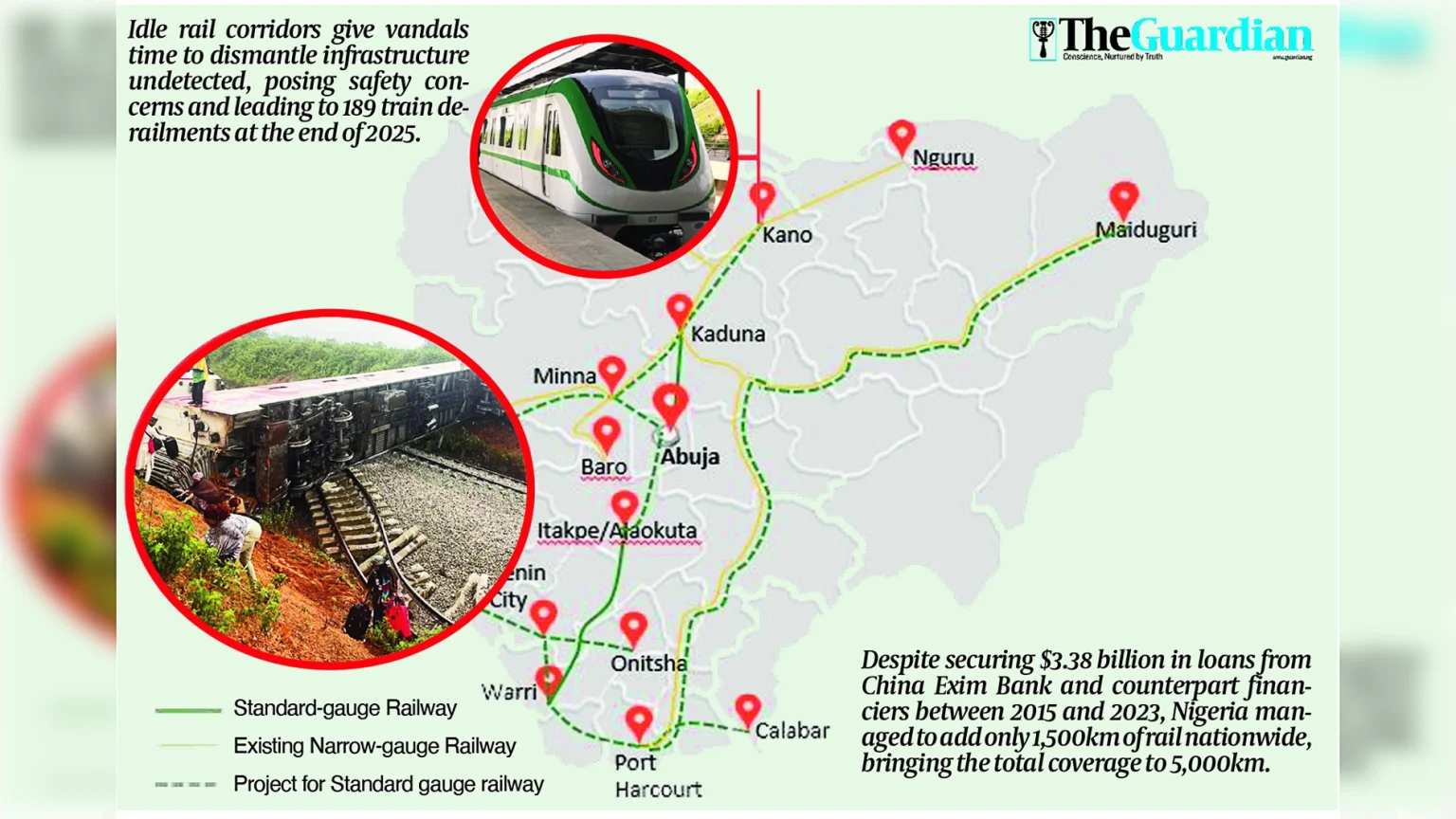
However, despite securing $3.38 billion in loans from China Exim Bank and counterpart financiers between 2015 and 2023, Nigeria managed to add only 1,500km of rail nationwide, bringing the total coverage to 5,000km.
Since President Tinubu’s administration came to power in 2023, there have been multiple unpleasant revelations about the programme, even as insecurity has hampered the performance of completed projects, such as the Abuja-Kaduna line.
These issues prompted the Senate President, Godswill Akpabio, to establish a 12-member ad hoc committee to investigate the projects carried out under the late Buhari’s administration, funded by Chinese loans.
Efforts to obtain an update from the committee, headed by Adams Oshiomhole, whose team was given four weeks to submit its findings, were unsuccessful.
As of press time, it was unclear whether the committee had submitted the report to the Senate as required. Messages sent to Oshiomhole on his mobile number went unanswered.
Statistics obtained from the NRC indicated that the corporation transported only about 2,182,388 passengers in 2023, while 929,553 passengers were moved in the first quarter of 2025 alone.
Regarding freight movement, the corporation moved 181,520 tons of goods in the first quarter of 2025. In 2023, it transported 317,244 tons of goods, as against 157,024 tons in 2022.
Regarding revenue generation, statistics from the National Bureau of Statistics (NBS) indicated that for the first half of 2024, the NRC earned about N5.37 billion from passengers, cargo, and other sources.
According to the report, in 2023, the NRC generated N6.07 billion from passenger tickets, cargo, and other sources, compared with N5.6 billion in 2022.
In all, it generated a total sum of N17.04 billion as revenue from 2022 to 2024. The 2025 figure has not been made public yet.
During the period, the NRC grossed N17.04 billion, and the corporation was allocated N59.6 billion, or 350 per cent of total revenue. In 2022, the corporation received a total budget allocation of N15.1 billion. The figure rose to N20.45 billion in 2023, and to N24.04 billion the following year.
In the past five years, the Federal Government has allocated a total of N132 billion to the NRC for personnel and overhead costs. In 2024 and 2025, it was allocated N39.18 billion and N34.2 billion, respectively.
These allocations were in addition to several billions of naira earmarked yearly by the Ministry of Transportation for the purchase of new trains and other major railway projects.
But industry experts questioned the NRC’s total capital expenditure over the period to justify its earnings over three years, saying the corporation may not have covered its operating costs.
No doubt, the mild improvement in rail infrastructure has changed mobility patterns on some routes. Still, it has also imposed a financial burden on citizens, with many questioning the justification for $3.38 billion in Chinese loans to be repaid over the next few decades.
Some of the projects included the Lagos–Ibadan standard gauge; Abuja–Kaduna line; Kaduna–Kano rail line; Warri–Itakpe rehabilitation and Kano-Maradi project in the Niger Republic, among others.
While some of the projects, such as the Abuja–Kaduna standard gauge rail line, the Lagos–Ibadan standard gauge railway (156 km segment and an extension), and the Itakpe–Ajaokuta–Warri standard gauge rail line, have had freight and passenger services completed, operational, and commissioned between 2016 and 2021, others are either abandoned or remain incomplete to date.
One of the partially completed phases is the Abuja light rail – Phase 1, which reopened in 2024 and is in operation, while the other phases remain inactive.
The government spent $1.2 billion on the Lagos–Ibadan standard-gauge project, $874 million on the Abuja–Kaduna line, $1.3 billion on the Kaduna–Kano rail line, and $823 million on the first phase of the Abuja light-rail network, while $121 million was spent on the completion and rehabilitation of the Itakpe–Ajaokuta–Warri (standard-gauge) line.
These were part of the $3.38 billion loan and the Federal Government’s counterpart funding.
Meanwhile, the Abuja–Itakpe–Baro–Warri was contracted to the China Railway Construction Corporation (CRCC) for $3.9 billion in 2019, but has yet to commence. At the time of filing this report, it is unclear whether the Federal Government has made a financial commitment to the contractor.
Besides, the Lagos–Kano rail line, which covers the wider modernisation, was signed for $2.3 billion; the Lagos–Calabar coastal line was signed in 2021 for $11.17 billion; and the Eastern corridor rehabilitation – Port Harcourt–Maiduguri and Port Harcourt–Aba – is being stalled despite plans to link the corridors.
They were part of the $3.38 billion loan initially secured from the China Exim Bank for rail modernisation.
Commenting on the issue, the Managing Director of Planet Projects Ltd, Abiodun Otunola, attributed Nigeria’s struggling railway system and the growing number of abandoned projects to faulty policies, misplaced priorities, and an unsustainable financing model adopted by previous administrations, particularly that of the late President Muhammadu Buhari.
Speaking with The Guardian, Otunola said Nigeria’s multibillion-dollar investments in passenger rail lines were flawed from inception because they failed to address the country’s real transportation needs and lacked a viable economic foundation.
According to him, the National Rail Policy under the former administration was modelled on rail systems in the United States, Europe, and China, despite Nigeria lacking the technical capacity, financial strength, and industrial base of those countries. He described the emphasis on connecting all 36 states with passenger rail lines through large foreign loans as illogical and unprecedented worldwide.
Otunola stressed that policymakers misunderstood Nigeria’s transportation challenge by prioritising passenger comfort and political optics over freight movement, which he described as the backbone of any sustainable rail system. He noted that passenger rail rarely generates significant profit anywhere in the world and that Nigeria’s largely low-income passengers could not pay fares high enough to cover operating costs.
By positioning expensive rail corridors primarily for passenger use, he said the government created projects that could never repay the billions borrowed to build them.
He said, “Former Minister of Transportation, Rotimi Amaechi, said the plan was to connect all 36 states using borrowed funds. There is no country anywhere in the world that does that. We copied Europe, America, and China without their money or technology.
“Look at the revenue from Abuja–Kaduna, Lagos–Ibadan, and others. It is minimal compared to the cost of construction and maintenance. I doubt we are even recovering operating costs.”
Otunola also criticised Nigeria’s heavy reliance on imported rail infrastructure, noting that about 80 per cent of components—such as sleepers and glass—could be produced locally. He said importing nearly all materials made projects unnecessarily expensive because of dollar payments and shipping costs.
He cited the now-abandoned $11 billion Lagos Coastal Rail Project as an example of a needless initiative, saying it competed directly with existing roads and was economically unjustified.
He further described projects such as Ibadan–Abuja, Kano–Maradi, and parts of the Lagos–Kano standard gauge as overly ambitious, poorly planned, and financially unrealistic for a fiscally constrained country.
Otunola noted that British-era rail alignments—designed primarily for freight, such as the Lagos–Kano narrow gauge and the Port Harcourt–Maiduguri line—remain the most economically viable routes despite their age.
He lamented that poor rail planning had increased the number of trucks on major roads, revealing that no fewer than 3,000 trucks enter Lagos daily, accelerating road deterioration and raising the cost of goods.
He also warned that dependence on imports exposes rail projects to currency fluctuations, deepening Nigeria’s debt burden.
While acknowledging progress made with borrowed funds—particularly the completion of the Abuja–Kaduna and Lagos–Ibadan lines—Otunola questioned whether the right projects and delivery models were chosen.
“Whether these were the projects we should have implemented, or whether the right models were used, is another discussion entirely,” he said.
On vandalism, he blamed the government for failing to secure rail infrastructure, noting that protecting corridors would cost about five per cent of total project value.
Also speaking, Dr George Banjo, a multi-modal transport expert, attributed the railway’s poor performance to decades of misplaced priorities, weak planning, poor financing, and a lack of understanding of rail economics.
Banjo said Nigeria’s rail model was flawed because authorities prioritised passenger services without providing the subsidies required to sustain them. He explained that while the U.S. focuses mainly on freight rail, Europe combines freight and passenger services—both supported by appropriate funding structures.
He noted that passenger rail operations globally rely on Public Service Obligation (PSO) funding, which Nigeria failed to provide.
“Historically, the NRC failed in passenger operations because it provided services at a loss without government PSO payments,” he said.
Banjo also criticised the NRC’s revenue disclosures, arguing that without transparency on operating costs—fuel, maintenance, manpower, and security—the system likely bleeds resources.
He questioned the $3.38 billion loan from China Exim Bank, saying the government never released a transparent cost-benefit analysis or a detailed breakdown of the projects tied to the borrowing.
“We don’t know the justification, analysis, or even whether the funds have been fully drawn down,” he said.
On the Kano–Maradi rail project, Banjo said its viability depended on whether it was freight-oriented, noting it could support regional trade with Niger and Chad if properly designed.
He attributed vandalism partly to underutilisation, arguing that idle rail corridors give vandals time to dismantle infrastructure undetected.
Transport analyst Yinka Aderibigbe said the abandonment of the 20-Year Nigerian Railway Modernisation Masterplan initiated in 2005 significantly contributed to the sector’s decline. He noted that faithful implementation would have completed the programme by 2025.
He added that moving railways from the exclusive to the concurrent legislative list improved flexibility and investor participation, ending the NRC’s monopoly as both operator and regulator.
Aderibigbe said the Federal Government should urgently reconstitute the committee overseeing the current masterplan and develop a new long-term plan covering 2025–2035 or beyond.
He expressed optimism about the NRC’s new management under Kayode Opeifa, who assumed office in February 2025 and introduced reforms, including amendments to the Railway Act, corridor rehabilitation, and cargo modernisation.
Aderibigbe said these initiatives could raise rail’s contribution to GDP from two per cent to seven per cent.
He disclosed that a Japanese firm recently proposed a $4 billion investment in Nigeria’s rail sector, underscoring its untapped potential.
“With a large low-income population, reactivating old lines and connecting unserved areas makes more sense than expanding roads or airports,” he said.
To move the sector forward, Aderibigbe called for adequate funding, improved security, and decisive action against vandalism.
Recently, the Managing Director of NRC, Kayode Opeifa, identified inadequate funding, low investment, vandalism, and revenue leakages as the major challenges confronting the corporation.
Opeifa stressed that railway development is highly capital-intensive and requires stronger collaboration among the Federal, State governments, and private-sector investors.
He said, “No developed country attained its status without an efficient railway transportation system. For us, the major challenge is funding. Railways are highly capital-intensive. State governments and private sector investors must play a part,” he said.
He dismissed concerns about manpower shortages, noting that the corporation was well-staffed with competent professionals.
According to him, the real constraint lies in funding and infrastructure investment, not human capacity.
Reaffirming his commitment to repositioning the NRC, Opeifa said his previous experience managing Abuja rail services and overseeing transportation in Lagos had equipped him with the expertise needed to restore the corporation to its former glory.
According to Opeifa, the corporation is optimising existing assets while working to expand capacity. Plans are also underway to transition to more electronic and electrical systems to reduce vandalism, eliminate revenue leakages, and complete ongoing modernisation and network linkages. (Guardian)