Metro
Court orders UNICAL to pay N55m to eight students over unaccredited engineering courses

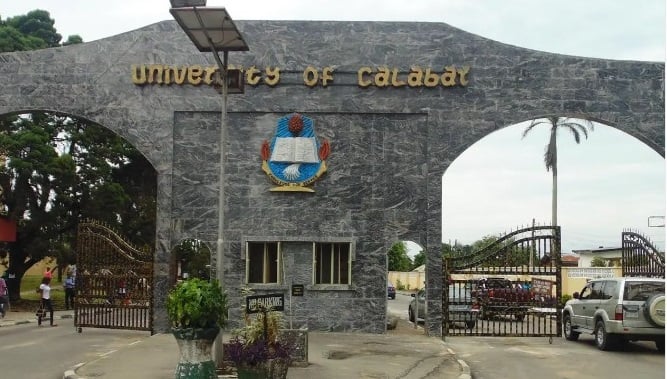
The federal high court in Calabar has ordered the University of Calabar to pay N55 million to eight ex-students admitted into the institution’s engineering programmes in 2021, which lacked accreditation.
In a judgment delivered by Rosemary Dugbo-Oghoghorie, the presiding judge, the court described the university’s conduct as “fraudulent, reckless, and deceitful”.
The judgment brought to an end a five-year legal dispute filed with suit number FHC/CA/CS/117/21 in 2021 by Idiong Godwin and seven other students, referred to as the “UNICAL 8”.
Defendants in the suit are: the University of Calabar, Florence Obi, its former vice Chancellor, and four other individuals.

The students approached the court after discovering that the engineering programmes, into which they had been admitted, lacked accreditation by the National Universities Commission (NUC) and the Council for the Regulation of Engineering in Nigeria (COREN).
According to the plaintiffs, the university presented the programmes as “fully operational” in its faculty handbooks and public representations.
The plaintiffs said that it was only after they had progressed to their third and fourth year, paid their fees, and completed examinations that the NUC, during a resource verification exercise, directed them to revert to 200 level because the courses were not accredited.
According to the students, some departments were later discontinued entirely, leaving them stranded academically.
In its defence, the university argued that accreditation follows a process and claimed the students were aware of the circumstances when they enrolled.
The institution also noted that the students acted of their own choice.
However, Dugbo-Oghoghorie rejected that argument and held that the university failed in its duty of care.
The court ruled that no institution should run an academic programme without prior approval from the NUC and that students ought to have been properly informed of the accreditation status before admission.
The judge further held that full accreditation for the programmes was only obtained in the 2024/2025 academic session, long after the affected students were expected to graduate.
Consequently, the court awarded N50 million in general damages and N5.2 million in special damages, citing the psychological distress and academic setback suffered by the plaintiffs.
The motion to halt programmes in the faculty of engineering was refused, as evidence before the court showed that accreditation has now been secured.
Also, the prayer to return the students to their former departments was also declined on the grounds that events had overtaken the request, particularly with the discontinuation of some departments.
Reacting to the judgment, Ozinko Ozinko, counsel to the students, praised them for challenging the institution, noting that although the compensation offers some relief, it cannot fully restore the years lost.
Ekpedeme Godwin, one of the plaintiffs, expressed satisfaction with the outcome, saying the students endured significant hardship and intimidation before seeking redress in court.
On his part, Jonas Abuo, counsel to the university, expressed appreciation to the court but declined to comment further. (The Cable)
-

 News17 hours ago
Nigerian Population Commission Faces Scrutiny Over N129.5billion Funds Released For Census That Never Held
-
News18 hours ago
Court dismisses cyberbullying charge against Sowore, releases passport
-
World News17 hours ago
Middle-East War: US Is Negotiating With Itself, Says Iranian Military Spokesperson
-
Business22 hours ago
BREAKING: Court nullifies CBN’s sack of Union Bank’s board, restores core shareholders
-
Politics18 hours ago
2023 Election: Obi shouldn’t have been allowed to contest – Justice Ayo Salami
-
Metro18 hours ago
Your selective outrage is troubling — Sowore fires back at NBA
-
Politics23 hours ago
2027: Obi–Kwankwaso talks rekindle fresh plot to unseat Tinubu
-
Metro17 hours ago
Supreme Court Ends 20-Year Legal Battle For 96 Teachers Unlawfully Redeployed By Benue Over ‘Non-Indigene’ Status