Business
The president’s muscle: How Tinubu’s tax reforms spare the Lagos transport cartels

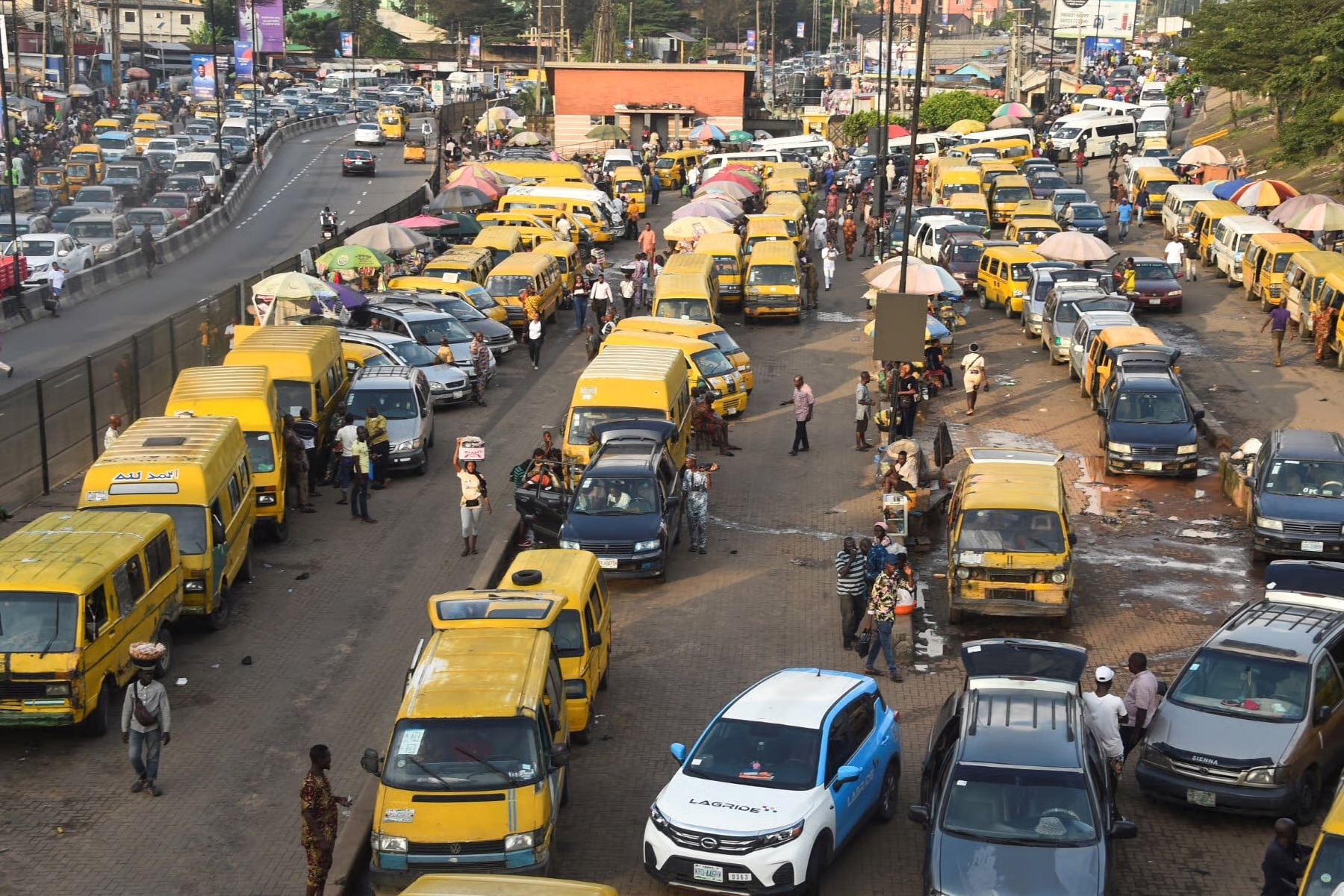
Under the blazing sun in Lagos, Nigeria’s commercial capital, the Ojodu Berger bus stop pulses with movement and noise. Shabbily dressed, sweaty bus conductors dart between beat-up yellow danfos (minibuses), hustling passengers at the crowded foot of the pedestrian bridge.
“Mowe, Ibafo. N700 [$0.50]! Mowe, Ibafo!” they say, calling out popular destinations for commuters, their voices competing with the revving engines and roadside traders hawking their wares.
A man in green trousers and a matching cap strides from bus to bus, tapping a cane against his palm. “Loading money? N1000!” he says in Yoruba and colloquial English.
“I’m charging N700, not N1000!” one conductor tells him, glancing around for more passengers.

“Why only N700?” the man says in response. “That’s not my problem – just pay me N1000!” He then moves on.
When a bus finally fills up with passengers, the man returns. His hand stretches out with quiet confidence. The conductor grumbles, retrieves a N1,000 note, and hands it over. Grumbling is all he can do. Argue too hard, and you risk a whipping – or a side mirror or wiper ripped off in a burst of impatience.
Scenes like this play out every day across Nigeria’s motor parks, particularly in Lagos, where drivers and conductors must pay multiple levies before they can operate. They highlight a key question hanging over President Bola Tinubu’s sweeping new tax reforms: can a state that struggles to collect revenue from the formal economy really dismantle an informal cash machine policed on the street?
The hidden economy of the motor park
For many Lagosians, danfos are the only realistic way to navigate a city built on traffic. But for drivers, each trip begins not with passengers, but with payments.
“Each day, to operate, a driver must pay a park fee ranging from N800 to N1,000, depending on the park and the route. Then each time you load passengers, you pay a loading fee – usually equivalent to one passenger’s fare. You pay at both the departure and destination parks. Each park has a different chairman,” says a minibus driver who identifies himself as IK.
The structure sounds like a functioning system of tickets and officials. But to drivers, it feels less like regulation and more like extraction. The National Union of Road Transport Workers (NURTW), founded in 1978, acts as the central gatekeeper. Yet, drivers struggle to identify benefits that match what they pay.
In Lagos, the union points to welfare support, citing recent N500,000 university scholarships for members’ children and N42m used to ‘empower’ 28 widows of deceased members. Drivers don’t deny these initiatives, but they heavily question the scale and the accounting.
A 2021 report by the International Centre for Investigative Reporting estimated that the informal transport levy ecosystem in Lagos generates up to N123.08bn annually for the NURTW. The motor park generates staggering revenues in a country that chronically struggles with fiscal resources. This substantial income explains why the facility has become more than simply a transportation center: it functions as a highly profitable political and financial asset.
Enoch Kanawa, former executive secretary of the Nigerian Association of Road Transport Owners (NARTO), is blunt about where the money goes. “The money does not go to the government – it goes to the union. A cabal shares the money. It is not properly accounted for, and a few people are flourishing in wealth. When a bus loads passengers, the union takes between 10% and 15% of the fares. That money ought to go to the government. In reality, substantial revenue is being left in the hands of non-state actors.”
A veteran Lagos transport journalist describes a strict chain of command. The operatives chasing buses on the tarmac are simply agents remitting funds higher up. He argues that the amounts involved are inseparable from the violence that often surrounds transport union leadership. “Whoever becomes the leader takes the lion’s share. That’s why leadership contests are frequently violent,” he tells The Africa Report.
MC Oluomo: the man at the centre
At the center of this ecosystem is Musiliu Akinsanya, better known as MC Oluomo, national president of the NURTW and a long-time loyalist of Tinubu. He rose as a motor-park strongman in Lagos and now leads the union nationally from Abuja.
Union leaders like MC Oluomo have become symbols of the sector’s staggering wealth – flaunting expensive convoys and educating their children abroad. Oluomo is unapologetic online when critics question his affluence despite his lack of formal education.
But in Lagos, the union’s influence isn’t merely economic; it is a vital political tool.
When motor-park unionism meets elections
Transport unions sit on the infrastructure of everyday life: thousands of drivers, hundreds of parks, and a ready-made network. In a political system that relies heavily on mobilisation and logistics, this network is invaluable. Union leaders can deliver crowds, coordinate movements, and project undeniable power.
In a video circulated last October, MC Oluomo claimed he spent N756m of his own money to support Tinubu’s 2023 presidential campaign.
“I campaigned for Asiwaju Bola Ahmed Tinubu because after God and my biological mother, it is only Asiwaju in my life. I spent N756m of my own money during the campaign. Nobody from Abuja gave me anything. We’re not resting. 2027 is around the corner, and we’re already working to ensure Asiwaju wins again.”
His prominence remains highly controversial. During the 2023 election, a video appeared to show him warning Igbo residents in Lagos to stay away from polling booths if they weren’t prepared to vote for Tinubu. He later denied threatening anyone, claiming his comments were a joke that was misrepresented.
For critics, the larger question remains: how can a union extracting daily cash from public transport also operate as a political machine – and what does that mean for the state’s capacity to ever reform the system?
Tinubu’s reforms: a loophole large enough for a danfo
Last year, Tinubu’s administration introduced tax reforms to overhaul Nigeria’s chaotic revenue collection. The new laws, effective 1 January, aim to eliminate nuisance levies imposed by ‘non-state actors’.
The Joint Revenue Board (JRB) vowed to eradicate illegal roadblocks and abolished road stickers issued by non-state actors. On the ground, however, drivers say absolutely nothing has changed.
“No driver can work without settling the unions,” IK says matter-of-factly.
A JRB technical team member offers an explanation that reveals the reform’s massive loophole: the government does not consider union collections to be taxes.
“Union dues fall outside government’s statutory oversight. Associations are allowed to collect dues agreed by their members,” he says.
While stopping people on government roads to collect money is technically prohibited, the official admits that if a union issues a sticker for paid dues, it falls completely outside government regulation.
If the reform targets ‘non-state actors’ but deliberately exempts union dues and their proof of payment, what will actually change in the motor parks?
Lagos: ‘not our problem’
In Lagos, officials are still studying the reforms’ implications. Wale Musa, permanent secretary at the Lagos State ministry of transportation, states that commercial operators must register and pay required government fees.
In 2022, Lagos introduced an N800 ‘consolidated’ informal transport levy, promising it would end multiple daily charges. In practice, the chaotic collections continued.
“Transport unions collect dues from their members, and that is not our problem as a government,” Musa says, adding that drivers facing illegal compulsion have the right to go to court.
Drivers argue this is entirely unrealistic. In a system enforced informally, resistance carries immediate consequences: vehicle damage, work disruption, or physical violence.
A National Industrial Court judge notes that while union dues aren’t taxes, they still impose a heavy burden. “The government needs to be clear on how the new tax regime helps commercial transporters,” he says.
Kanawa argues that this is fundamentally a governance failure. “The motor parks are supposed to be run by the government. But they have effectively left government control and are being operated by unions,” he says.
Business as usual, by design?
Tinubu’s tax reforms promise a state finally taking control of its revenue collection. But in the motor parks, the line between ‘tax’ and ‘dues’ is merely semantics. If drivers cannot operate without paying, and if collection is violently enforced at the point of movement, it functions as a tax in everything but name.
Back at Berger, another bus pulls up. The conductor shouts for passengers. The levy collector drifts closer, cane in hand. Cash changes hands quickly, almost automatically – the undisputed cost of doing business in Lagos.
On paper, the new tax regime is meant to end the era of nuisance levies. In practice, the system that feeds off the city’s transport arteries remains wholly intact. If the reform was designed to confront the motor-park economy head-on, it has yet to reach the tarmac.
-

 News21 hours ago
Vehicles Destroyed As CNG Bus Explodes At Kaduna Park
-
News22 hours ago
BREAKING: Tinubu Approves N3.3trn Plan To Tackle Electricity Crisis
-
Politics21 hours ago
ADC Dismisses David Mark’s Resignation Rumour
-
News21 hours ago
Troops Deal Major Blow To Bandits, Kill Warlord’s Son, Key Commanders
-
Politics14 hours ago
INEC puts voters revalidation plan on hold
-
Politics9 hours ago
Oyo 2027: Makinde moves to name successor
-
News18 hours ago
Suspected herders kill 17 in attack on Benue community
-
News21 hours ago
Easter: Hardship Can’t Last Forever – Shettima Tells Nigerians