Business
Nigeria’s oil gains bypass households as data gaps widen pain

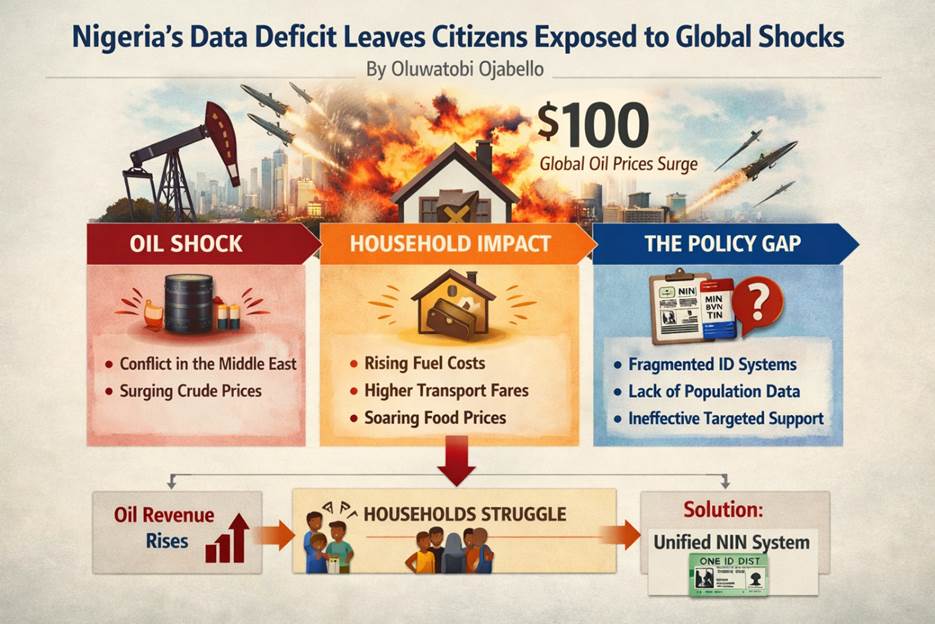
When global oil prices rise due to conflicts thousands of miles away, oil-producing countries are expected to benefit. In Nigeria, the net effect is often negative for households. Higher crude prices feed quickly into rising fuel costs, transport fares, and food prices, eroding purchasing power despite the country’s oil wealth. The problem is structural. Nigeria lacks the data systems required to identify and protect citizens most exposed to these shocks.
Recent tensions in the Middle East involving the United States, Israel, and Iran have pushed crude prices to $102 per barrel. In Nigeria, the transmission is immediate. Transport costs rise, food prices follow, and purchasing power weakens. Yet policy responses remain slow and poorly targeted, not only because of fiscal limits but because the state lacks the granular data needed to deliver timely support.
This gap sits at the centre of Nigeria’s economic vulnerability. Oil price increases can lift government revenue, but production inefficiencies, leakages, and weak fiscal transmission prevent these gains from reaching households. The absence of an integrated population database further limits the government’s ability to identify vulnerable groups or design effective interventions.
Past shocks reveal a consistent pattern. The 2016 oil price collapse pushed the economy into recession as revenues fell sharply. In 2020, during the COVID-19 pandemic, output contracted while inflation rose, tightening pressure on households. In both cases, the adjustment fell largely on citizens. The outcome is clear. The mechanism lies in how oil price movements pass through the domestic economy.

How oil shocks reach households
Petrol remains central to Nigeria’s transport and distribution system, from moving agricultural goods across states to urban mobility. As fuel costs rise, they pass quickly into transport fares and food prices, amplifying inflationary pressure across the economy.
“The challenge is not simply Nigeria’s exposure to global oil shocks,” said Abayomi Fashina, analyst at STL Capital Group Ltd. “Because petrol drives transport, logistics, and a large share of informal economic activity, increases in global crude prices pass almost immediately to inflation and erode household purchasing power.”
Headline inflation eased slightly to 15.06 percent in February from 15.1 percent in January, but reporting lags suggest the full effects of rising fuel and transport costs are yet to appear. For households that spend a large share of income on essentials, the strain is already evident.
Why social protection falls short
In many economies, governments cushion such shocks through targeted transfers or temporary subsidies, systems that depend on accurate and integrated data on citizens and their economic conditions. Nigeria’s coverage remains limited.
According to the World Bank, only 19 percent of Nigerians are covered by social safety nets, and less than half of benefits reach the poorest households. About 51 percent of the population, roughly 120 million people, were living in poverty in 2023, with many more at risk of slipping further.
By contrast, countries such as Brazil, India and South Africa have scaled targeted cash transfer programmes in response to recent global shocks, including the pandemic and surges in food and fuel prices. Their experience underscores the role of robust data systems in cushioning vulnerable households during periods of economic stress.
“The government may earn more revenue when oil prices rise, but that does not automatically translate into welfare protection,” said Faruq Quadri, economist at SPEC-Matrix. “Without a comprehensive and integrated population database, it is difficult to identify households most affected by rising living costs.”
The limits of identity expansion
Efforts to expand identification in Nigeria have accelerated. The National Identity Number system has enrolled more than 120 million Nigerians, with capacity expanded to support wider coverage. This marks progress toward a unified identity framework, but the system remains incomplete.
It does not adequately capture the economic conditions of households, limiting its usefulness for targeted interventions. As a result, policy responses remain broad, costly and less effective. Weaknesses begin with civil registration. Birth registration remains incomplete in several regions, while death records are often poorly documented, weakening the foundation of any data-driven system.
From identification to delivery
Policy experts increasingly argue for a fully integrated identity framework linking demographic, financial and welfare data. Nigeria currently operates multiple identifiers, including NIN, BVN and TIN, but fragmentation reduces their effectiveness.
“Until Nigeria builds a unified identity infrastructure linking financial, demographic and welfare data, the government will continue to struggle with targeted social protection during economic shocks,” said Femi Olapade, chief economist at WILOPAD Consulting.
A more integrated system would allow policymakers to identify vulnerable households quickly and deliver targeted, temporary support during periods of rising fuel or food prices, reducing reliance on broad subsidies.
Closing the gap
Global shocks cannot be avoided, but their domestic impact can be managed. Countries with strong administrative data systems respond with speed and precision, limiting the burden on households.
In Nigeria, the absence of such systems leaves policy reactive and diffuse, allowing external pressures to filter through with little resistance. Until that gap is closed, each new shock will continue to be absorbed not by the state, but by households. (BusinessDay)
-

 Politics23 hours ago
2027: You can’t beat the master at his game – Keyamo tells opposition
-
News14 hours ago
Makinde, Ladoja fault Fayose over alleged dethronement plot
-
News14 hours ago
Military defends Borno strike as death toll rises
-
News4 hours ago
I’ll Attend ADC Convention In Spirit – El-rufai
-
News4 hours ago
How Colonel, 7 Soldiers Died In Fresh Boko Haram Attack
-
Politics4 hours ago
JUST IN: ADC Reps Demand Prosecution Of INEC Chairman
-
 News14 hours ago
Airstrike: We Shut Jilli Market 5 Years Ago – Zulum
-
News23 hours ago
US commends Nigeria over 386 terrorism convictions, urges sustained judicial reforms