News
Despite Ogun State’s terrible road network, govt. budget over N34bn on official vehicles

While motorists dodge potholes and broken roads across Ogun State, government records show that more than N34 billion has been budgeted on the purchase of official vehicles for lawmakers,commissioners, local government chairmen, and senior officials between 2023 and 2025. SODIQ OJUROUNGBE reports
The Adiyan–Orudu Gasline road in the Ifo Local Government Area of Ogun State does not appear to be a place where lives should be lost. It is not a highway, and vehicles rarely speed along it. But for residents of more than 25 rural and developing communities along the corridor, the narrow and dilapidated stretch has quietly become one of the deadliest roads they know.
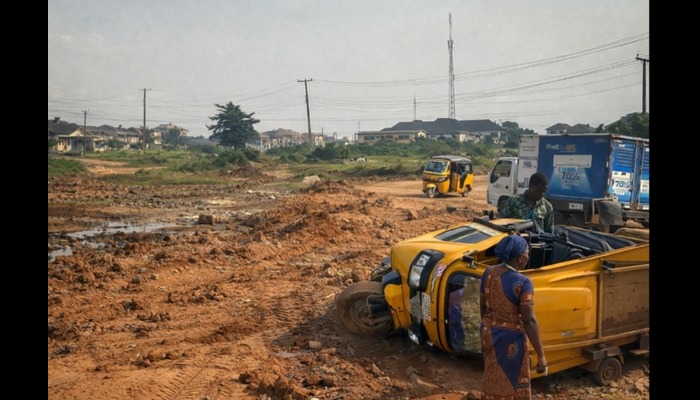
When it rains, the road reveals a different reality. Water fills deep craters formed by years of neglect, while erosion eats away at the edges, leaving hidden pits along the roadway. Tyres skid, motorcycles wobble, and vehicles inch forward, uncertain of what lies beneath the muddy surface.
Late Aina Opeyemi had come home to visit his parents shortly after a rainfall on December 24, 2020, when he lost control of his vehicle while navigating a bad section of the Adiyan road. In the blink of an eye, his car veered off the poor, muddy road and crashed into a pole.

Speaking with BusinessDay Investigations, Aina’s sister, Dayo, says her brother was a victim of a road that had failed the community for years.
“It is not even a road where you can overspeed. It is always in bad condition. That day was worse because of the rain. While trying to pass the slippery part, he lost control and hit a pole. He was rushed to a private hospital around Olokose along that same road, but unfortunately, he didn’t make it,” she narrates.
Dayo stresses that the tragedy changed her relationship with the area permanently.

She adds, “Honestly, I left Adiyan because of this road. If not because our parents are still living here, I would have stopped coming entirely. Every time it rains, you remember that this road has taken lives, and nothing has changed.”
Yemi Sotayo, a community leader in Adiyan, said Aina’s death was not an isolated incident, noting that more than 30 people had lost their lives on the Adiyan–Orudu Gasline Road over the past 15 years.
He added that several others had been injured, while goods worth millions of naira had been destroyed in accidents caused by the deteriorating state of the road.
According to him, most of the crashes were not due to speeding but to the unsafe condition of the route.
“The road serves over 50 communities, yet has continued to deteriorate with only temporary repairs,” he stated.
Bad road causes minor’s death
Just as poor road conditions led to Aina’s death in Adiyan, a similar tragedy occurred in Yewa South Local Government Area of Ogun State. In November 2025, a minor reportedly lost her life after falling from a motorcycle along a damaged section of the Ilaro–Ibese Expressway.
Eyewitnesses and traffic officials said the rider lost control due to the uneven road surface and the heavy load on the motorcycle. The bike veered into the path of an oncoming cement truck, which was unable to stop in time.
The child died at the scene, while three adults travelling with her sustained injuries and were taken to Ilaro General Hospital.
Traffic officials later confirmed that the poor condition of the road contributed to the accident, as the rider struggled to maintain balance on the worn surface.
Residents say the expressway has deteriorated over months of rain and neglect, turning routine journeys into dangerous risks.
Speaking with BusinessDay Investigations, Ibrahim Akorede, a resident, reveals that the road was once vital for farmers, traders, and families moving between villages and markets.
He laments, “Now it feels like a danger zone. People avoid it, especially in the evening, because a single pothole can lead to an accident. That child was just returning home. It should not have ended that way.”
Poor roads stretch across Ogun
Beyond Adiyan and Ibese, the story of bad roads in Ogun State is not confined to one or two places, it is a statewide reality that most motorists, commuters and residents confront every day.
Residents of various communities across the state have repeatedly lamented the poor condition of the roads in their areas, noting that the dilapidated surfaces force motorists to slow to a crawl or avoid the routes entirely, driving up transport costs and clogging alternative streets.
To ascertain the true condition of roads in Ogun State, BusinessDay Investigations visited several locations, including Adiyan-Orudu Gasline Road, Oke-Aro Road, Lambe Road, and Ope-Ilu Road in Ifo Local Government Area.

In these communities, residents recounted years of neglect, describing road surfaces riddled with potholes, erosion-carved gullies, and long stretches of broken asphalt that pose daily dangers to motorists and pedestrians alike.
Our correspondent also visited the Agbado–Abule-Ijoko corridor, where sections near an abandoned bridge have deteriorated severely. The road there is overgrown with weeds and submerged in mud, rendering parts nearly impassable for vehicles.
BusinessDay Investigations further visited other deteriorating routes, including Lisa Road, the Oja-Odan–Ijoun Road, Magboro Road, and Makun Road, among others.

Our correspondent observed that across all the locations visited, there was a prevalence of severely damaged road portions, which have significantly hindered access for residents and motorists.
Residents along Lisa Road expressed frustration over the deterioration of the road, which was originally constructed after the 2005 Bellview Airlines plane crash to provide access to the crash site and surrounding communities.
Despite its strategic importance and access to more than 60 rural communities, they lament that the road has now been largely abandoned and fallen into severe disrepair.
On the Oja-Odan–Ijoun Road, traders and transporters say the poor condition of the road has severely disrupted the movement of goods between the two towns, especially agricultural produce destined for the Oja-Odan market.
Raheedat Sanni, a produce trader, said, “I bring cassava and maize from Ijoun to sell in Oja-Odan, but this road has made everything harder. What used to take less than an hour now takes several hours because vehicles break down or refuse to come.”

She explained that transportation costs have increased sharply, cutting into already slim profits.
The poor condition of roads across the state has prompted appeals even from safety enforcement agencies.
In 2021, the Federal Road Safety Corps (FRSC) Ifo Unit appealed to the state government to repair dangerously bad roads around the Ifo axis, noting that poor surfaces were delaying emergency responses and contributing to loss of life in crashes.
Rising accidents amid deteriorating roads
As road conditions across Ogun State continue to deteriorate, findings by BusinessDay Investigations show a rise in accidents and fatalities, with many crashes directly linked to the poor state of roads in different parts of the state.
Data from the Ogun Traffic Compliance and Enforcement Agency (TRACE) shows that 132 people were killed and 655 others injured in road crashes across the state in 2024 alone. Reported injuries ranged from fractures to permanent disabilities.
In 2023, 351 people were reportedly killed in different Ogun road crashes according to Anthony Uga, the FRSC sector commander in the state.
The victims included men, women and children, while the crashes involved various road users, including buses, motorcycles, trucks and pedestrians.
Although some accidents occurred on major highways, our correspondent gathered that a significant number took place on inner roads, community routes and link roads that are poorly maintained, flooded or badly eroded.
Road safety officials say many of the fatalities are linked to inadequate road infrastructure, including hidden potholes, blocked drainage systems and years of neglect and reckless driving.
This, experts note, highlights the daily danger faced by residents who rely on these roads to access schools, workplaces, markets and healthcare facilities.
Records from previous years also show hundreds of fatalities in traffic crashes across the state, underscoring how poor road conditions and unsafe travel continue to contribute to significant loss of life and injury in Ogun State.
Highlighting the poor state of many roads in the state, a report by StatiSense, a data analytics platform, ranked Ogun as the state with the worst road quality in Nigeria, a finding that caused criticism of the state government’s handling of infrastructure.
Misplaced priorities
While residents navigate crumbling roads and risk their lives every day, findings by BusinessDay Investigations show that Ogun State’s budgetary priorities reveal a different reality.

Officially approved budget records obtained by BusinessDay Investigations reveal a staggering investment in vehicles for government officials over the past three years.
Between 2023 and 2025, official records show that the state spent or approved over N34.3 billion on the purchase of vehicles for lawmakers, commissioners, and other senior officials.
It was gathered that this spending covers dozens of ministries and agencies, covering a range of vehicles from luxury SUVs and sedans to utility vehicles, many of which cost tens of millions of naira each.
In 2023, the state spent approximately N2.63 billion on the purchase of fifteen Toyota 4Runners for key ministries, alongside smaller expenditures on sedans and commercial vehicles for general personnel services and broadcasting agencies.

The following year, 2024, saw an explosion in spending, with over N17.2 billion approved for the acquisition of luxury SUVs, sedans, and utility vehicles, including multiple Fortuners, Toyota Corollas, Innoson cars and Mazda CX50s, intended for lawmakers, commissioners, and directors.
By 2025, an additional N14.5 billion had been budgeted and approved for similar purchases, covering vehicles such as Toyota Land Cruiser Prados, GR Supras, and high-end sedans across executive and legislative organs, education institutions, health services, and housing ministries.
The total outlay across these three years, combining approved budgets and actual expenditures, exceeds N34.3 billion, a figure that rivals the cost of constructing dozens of kilometres of durable, all-weather roads.
An earlier report by BusinessDay, referencing World Bank benchmarks, estimates that N1 billion is sufficient to fund the reconstruction of 5–6 kilometres of a standard two-lane asphalt road in Ogun State, including drainage, grading, and proper surfacing.
By comparison, the N34.3 billion reportedly spent on government vehicles could have been used to rebuild or repair more than 170 kilometres of critical road networks in Ogun State. This includes vital routes such as the Adiyan–Orudu Gasline Road, the Agbado–Ijoko corridor, and several inner-city link roads, all of which remain in poor condition, continuing to endanger lives and disrupt commerce.
Residents, motorists, and transport operators argue that the scale of these purchases reflects a misplaced set of priorities, where public safety and essential infrastructure take a backseat to the comfort of officials.
While families mourn loved ones lost on neglected roads and drivers face daily hazards, findings by BusinessDay Investigations show that state resources are directed toward luxury vehicles for a handful of individuals, leaving the broader population to contend with roads that crumble in rain, erode under pressure, and contribute to accidents and fatalities.
Experts weigh in
Infrastructure and public finance experts say the contrast between Ogun State’s deteriorating road network and its rising expenditure on official vehicles raises serious questions about fiscal prioritisation, safety, and long-term economic planning.
Kunle Oyetayo, a transport infrastructure analyst, notes that while vehicle procurement is a legitimate line item in government budgets, the scale and timing of such spending matter.
“No one argues that government officials should not have vehicles. The issue is proportionality. When a state ranked among the worst in road quality commits over N34 billion to official vehicles within three years, while critical inner roads remain death traps, it suggests a misalignment between public need and budget priorities,” he says.
According to Oyetayo, poor road conditions are not merely an inconvenience but a multiplier of risk, increasing accidents, transport costs, vehicle maintenance expenses, and emergency response delays.
“A bad road quietly taxes everyone every day. You pay through higher transport fares, damaged vehicles, lost work hours, and sometimes, lost lives,” he adds.
Chinyere Eze, a public finance expert at a Lagos-based policy think tank, explains that infrastructure spending should follow a hierarchy that places safety-critical assets ahead of comfort-driven expenditures.
“Roads are productive assets. Official vehicles are consumptive assets. Roads generate economic returns over decades by enabling trade, access to healthcare, and mobility. Vehicles depreciate almost immediately. When budgets tilt heavily toward consumptive assets in a context of infrastructure decay, the opportunity cost is enormous,” she explains.
She notes that even if the governor’s claim of constructing up to 1,500 kilometres of roads is accurate, quality, distribution, and maintenance remain key metrics.
“Kilometres alone do not tell the full story. Where are the roads located? Are they inner-community roads or showcase corridors? Are drainage systems properly done? Without maintenance, roads quickly return to the same deplorable state,” Eze states.
I have done more roads than past administrations – Gov Abiodun
During the recent inauguration of the 1.5-kilometre Alagbole-Akute road and the 4.5-kilometre Akute-Ajuwon road in the Ifo Local Government Area, the Ogun State Governor, Dapo Abiodun, boasted that his administration has constructed more roads than past administrations.
Abiodun criticised previous administrations, which managed the state over the last 16 years, claiming they did not achieve such a record in road construction.
According to him, the state had the longest kilometres of federal, state and local government roads, which were in deplorable conditions when he assumed office.
Also speaking in Abeokuta in November 2025, the governor said his focus is on delivering the dividends of democracy to the people and not responding to baseless criticisms by out-of-favour politicians.
Abiodun claimed his administration consulted widely with stakeholders on the roads with the greatest economic importance to the state to guide prioritisation.
He also noted that roads connecting the state to adjacent states, whether intrastate, interstate, or those connecting farms to markets, have been receiving attention.
He added, “We will continue to remain focused despite the sponsored barking of some naysayers.
“You know I am not one to respond to the frivolous sponsored rhetoric of some frustrated politicians. This is not politics here; this is governance. I am the Governor of Ogun State, and I know what I am doing.
“Some of our governors before, they didn’t know what they were doing, but they now see a governor in action, and rather than applaud, they were sponsoring cheap political rhetoric, but we know how to deal with those kinds of people.
“The most important thing is that all the sponsored rhetoric about bad roads here and there, you know, performance is undeniable. It can’t lie, you know you can sponsor all the Twitter and Facebook in the world, but people can see what we are doing.
“Almost going to 1,500 kilometres of roads, it is unprecedented in the history of this state. The roads I am reconstructing did not degenerate to that level after I became governor; I inherited them, but that is not an excuse.” (BusinessDay)
-

 News15 hours ago
Vehicles Destroyed As CNG Bus Explodes At Kaduna Park
-
News15 hours ago
BREAKING: Tinubu Approves N3.3trn Plan To Tackle Electricity Crisis
-
Politics15 hours ago
ADC Dismisses David Mark’s Resignation Rumour
-
Politics22 hours ago
Factional ADC Chair Now Has Security, Moves Around Like A Governor – Atiku
-
News22 hours ago
Prof Jega Loses Wife
-
News15 hours ago
Troops Deal Major Blow To Bandits, Kill Warlord’s Son, Key Commanders
-
Politics8 hours ago
INEC puts voters revalidation plan on hold
-
News12 hours ago
Suspected herders kill 17 in attack on Benue community