News
Workers’ Day: How Much Work Is Being Done?

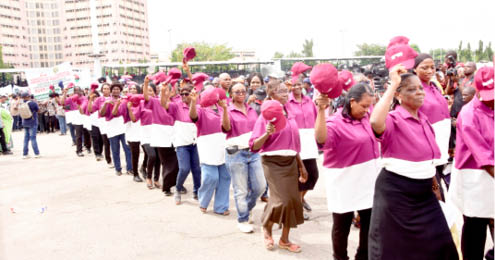
As Nigerian workers commemorate this year’s International Workers’ Day today, concerns are mounting over a noticeable dip in productivity amid the worsening economic hardship in the country, Daily Trust reports.
The cost of living crisis, particularly high transportation cost, driven by fuel price increases, is said to be forcing many workers to reduce their physical presence at workplaces.
This is just as labour and productivity experts warn that declining productivity reflects deeper structural and leadership failures.
A cross section of workers, who spoke to Daily Trust, said survival has taken precedence over efficiency, with many of rationing the number of days they report to work.

A civil servant in Abuja, who simply identified himself as David, said a lot of workers go to their respective workplaces without a job schedule.
Another civil servant, Hajiya Sadiya, said: “I live around Kaduna Road, Niger State. Some of my colleagues in office live at Suleja and we work in the Central Area, Abuja. Transport alone consumes our salaries, so we cannot afford to go every day. So, the issue is about survival, not about productivity.”
Some workers in Benue State also told Daily Trust that the cost of living crisis is making it difficult for them to be productive.
One of them, Dorathy Sabo, said: “For us as federal government workers, we are yet to receive the wage award after the subsidy removal.”
Blessing Atabo, a teacher in a government school, stressed the need for an upgrade of salaries “in order to meet up with current market realities.”
In Lagos State, civil servants said the cost of commuting has become unsustainable, forcing them to reconsider their daily work routines.
“I used to come to work five days a week without thinking twice,” a staff member of Ajeromi-Ifelodun Local Government Area, who preferred anonymity, said. “Now, I have to plan carefully. Three days is what I can afford. I reside in Oko-Afo in the Badagry area of the state, and commuting daily would drain my salary.
“Transport fair from Okoafun to Mike 2, previously was between N700 and N800 in the morning but right now it fluctuates between N1,300 to N1,500,” he said.
A staff member of Apapa Local Government Area, who also spoke on condition of anonymity, said the reduced work schedule, though not ideal, has become necessary.
“The cost of going to work every day is too high. With three days, at least we can manage transport expenses better,” the worker said.
A teacher in one of the public primary schools in Ojo expressed concern about how she would cope when schools resume.
“I don’t think I will be able to go to school to teach every day because of the harsh economic reality. I know I am not the only one thinking along this line, but we don’t have a choice—survival is key,” she added.
In Kano State, the soaring cost of living is also taking a toll on civil servants, with many cannot afford the daily expenses of commuting to work.
This growing challenge is said to be eroding productivity in government offices, as workers struggle to balance survival with duty.
Aisha Ismail, an administrative staff member in one of the ministries in the state, admits she now goes to work only three times a week.
“Transport fare has doubled in the past year. If I spend N1,000 daily just to get to the office, what will be left for food at home?” she asked. Aisha explained that she often stays back to save money for her children’s meals, leaving her desk unattended and her workload piling up,” she said.
Musa Idris, who works in one of the hospitals in one of the local government areas in Kano, said the situation is more dire.
He said he had since dropped his car and has resorted to traveling in commercial bus.
He said even at that, he had arranged with other colleagues that each of them would work overtime for three days instead of normal shifts for five days.
“We decided this because that is the only survival technique that will work. Going to work five times a week is no longer realistic due to economic situation,” Idris said.
According to him, the situation is gradually affecting their productivity as most of them often get exhausted in the three days and cannot function optimally.
Yushau Usman, another civil servant, said: “My salary can no longer sustain me. I run provision store which also help run my home. But it means I miss office days, and my boss is not happy.”
In an interview with one of our correspondents, a retired director at the National Productivity Centre, Dr Gbenga Bamiduro, said the productivity crisis is rooted in systemic inefficiencies, especially leadership shortcomings.
He also cited recruitment practices in the civil service, alleging that meritocracy has been eroded.
He said: “It is a very serious issue. There is a decline in productivity for a lot of matters. One, we have leadership issues. The way our succession plans are in Nigeria is deficient. There is a problem of quality leadership. People are not appointed or elected these days on the basis of merit. People are appointed on the basis of who you know. Whether you have the experience or not, it is none of our businesses.
“Secondly, there are employment problems. The way people are employed these days, particularly in the Nigerian civil service, most new employees are documented after employing them. No advertisement, no interview, no quota system. Some people even buy a job.
“If someone pays to get job, will he or she appreciate it? He has paid for it, he will just misbehave because he got it on a platter of gold.
“Another factor is promotion. Promotion in the civil service is not about merit. People just get promoted anyhow. You know when the leadership is not doing well, he will want to carry everybody along so that whatever he’s doing, people will leave him alone.
“Also, these days, the government is not even concerned about the productivity of workers. Does the government even release money for critical projects, most of the workers are just idle. Economic situations are worsening their idleness. Now, they give people one or two days not to come to work. Who does that in any economy? There are a lot of factors that reduce productivity.”
‘Remote work without infrastructure’
A former Director-General of the National Productivity Centre, Dr Nasir Raji-Mustapha, bemoaned lack of facilities to work from home.
He said: “The truth is that, all over the world, remote work by workers is becoming very popular, but for us in Nigeria, it is a big challenge because we don’t really have infrastructure for remote work. Infrastructure like internet facilities are not available.
“Systems for workers to work with from home, even when they have their systems, do they have data to work with? Who is providing the data? I mean those infrastructure that will make a seamless remote work possible for the workers to still be productive even while not physically at work.
“There is no way this idea of allowing workers to stay at home for some days or days-off for workers will not affect productivity and the economy. Definitely, the absence of workers physically at work in Nigeria would reduce their productivity because there is no infrastructure to support remote works by these workers.
“Workers in Nigeria are very resourceful and ready to work. But when you tell workers to work from home without giving them enabling facilities like computers, internet to work with while at home, it would definitely affect their productivity.”
According to him, the way-out is to provide workers an enabling environment.
“The government should provide computers for a lot of workers in Nigeria and subsidise their data use if you cannot provide data in public places.
“In order to bridge the gap on productivity, we need to provide them (workers) with computers, data (internet facilities) to work with while at home. That’s the only way out.
“In Nigeria, we don’t give our workers a living wage, how do you expect them to use their mega allowances and salaries to provide all these things for themselves? I know some of our workers have laptops and computers at home, but only very few.
“This is the time to popularize and promote the digital economy in Nigeria because we have a digitized economy where workers can work at home and send their reports through emails.
“This will really help in increasing the productivity of workers in Nigeria. These are the ways to go about it. There is no way you can take the government out of it. Government must be part of the provisions of enabling the environment for these workers to be able to work at all from home,” Raji-Musstapha said.
NECA seeks productivity-linked pay model
In an interview with Daily Trust, the Director-General of the Nigeria Employers’ Consultative Association (NECA), Dir Adewale-Smatt Oyerinde, said workers are facing a sustained erosion of their purchasing power; while employers are struggling with crippling energy costs.
“When both sides are under this kind of pressure, the labour-employer relationship will continue to experience fractures. We see it clearly: if a business continues to struggle, it will impact its ability and capacity to meet the expectations of the workforce. And if workers cannot make ends meet, their focus shifts from productivity to survival. That is the reality we are dealing with across all sectors,” he said.
He said any discussion on wages must be accompanied by urgent government’s action to stabilise energy prices, reduce logistics costs and improve the regulatory environment. Without that, we are simply negotiating over shrinking resources.
“Second, the new tax laws are a useful tool. They include provisions like the additional deductions for salary increases for low-income workers. That can encourage employers to improve workers’ welfare without breaking their bottom line. We have endorsed these reforms, but awareness and proper implementation are key.
“Third, we need to move toward productivity-linked pay models. It is not sustainable to demand wage increases without corresponding improvements in outputs and efficiency. That is not anti-worker; it is pro-business and pro-jobs. When productivity rises, wages can rise sustainably.
“Fourth, we must strengthen social dialogue. NECA organised the 4th International Labour Adjudication and Arbitration Forum on February 12, 2026, and the Minister of Labour gave the federal government’s full backing to our drive to strengthen industrial courts and arbitration panels. We believe that preventing disputes before they escalate is one of the most effective ways to protect both workers and businesses,” he said.
The NECA’s DG also stated that workers’ productivity cannot be discussed by ignoring the informal sector.
He said though he had not seen the NECA-specific data on workers skipping work, “energy costs are crippling businesses and workers alike. With diesel at nearly N2,000 per litre, the cost of moving goods and people has skyrocketed.
“But rather than focus on symptoms, we must focus on causes. The real solution is to bring down the cost of the business environment across the board. Stabilise energy prices. Improve logistics. Implement the new tax laws properly. When the cost of doing business falls, employers have room to support workers with transport allowances, flexible arrangements or other creative solutions. Those decisions are best made by individual employers and unions at the enterprise level, not by me sitting here in Lagos.
“What I can promise is that NECA will continue to engage the government on these fundamentals. We have been consistent: fix energy, fix policy consistency, fix security, and the rest will follow. That is the conversation we are having with the Federal Ministry of Labour and other relevant agencies. We are not there yet, but we are pushing every day,” the NECA DG said. (Daily trust)
-

 News16 hours ago
Outcry as fake products flood markets
-
Celebrity Gist16 hours ago
Okoye really sweet, Cardi B says after third sighting
-
News16 hours ago
N33.75bn Cash Transfer Mystery: FG Failed to Prove Millions of Vulnerable Nigerians Received Funds — Auditor-General
-
Business16 hours ago
Airport policies didn’t drive Uber out of Nigeria, says FAAN
-
Metro16 hours ago
Trafficker lures, sells 15 Nasarawa children