Business
Niger ‘nationalised’ its uranium, but it can’t find a buyer

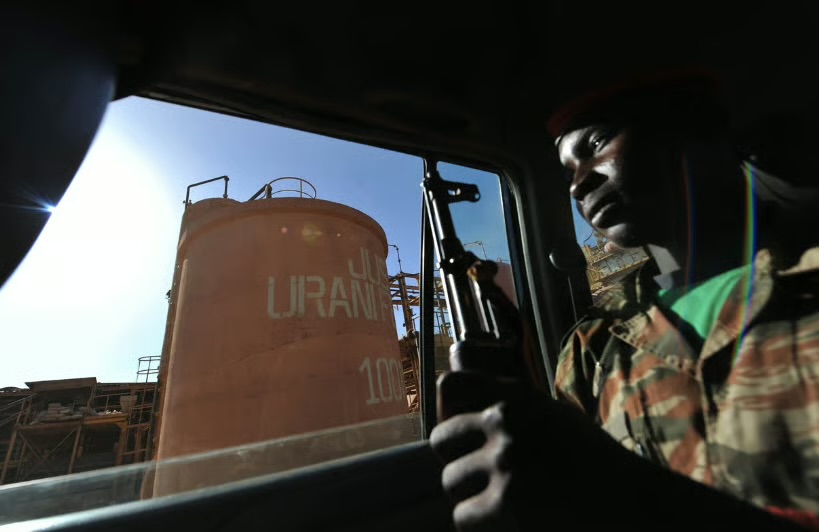
“A dignified Niger is bringing its production to the international market.” On 30 November 2025, Niger’s public television broadcast General Abdourahamane Tiani‘s words with great fanfare. Three days earlier, the French group Orano had denounced the “illegal transport of uranium stored on the SOMAÏR site.” At the time, the Nigerien authorities were holding up the affair as a symbol of the reclaiming of national resources from the former colonial power. Yet as the months passed, the tone has shifted.
In February, Tiani said he was prepared to return to Orano the uranium extracted from the Arlit mine, in the north of the country, before the nationalisation of SOMAÏR (Société des Mines de l’Aïr), which Niamey decided in June 2025.
“France has its 63.4% of 156,231 tonnes,” the Nigerien head of state said at the time. “If they want us to send them that tomorrow, we will pay for the transport ourselves to send it to them, because they were there when it was produced.” That figure corresponds to Orano’s stake in SOMAÏR before nationalisation; the remaining 36.6% belonged to the Nigerien public company Sopamin.
How can Niamey’s about-face be explained? First and foremost, due to the difficulties the Nigerien authorities have encountered in marketing the ore alone on the international market. Finding buyers who have both the necessary financial capacity and the willingness to defy the proceedings brought by the French group before international arbitration bodies has proved insurmountable.

The Iranian option undermined
Before the US-Israeli strikes on Tehran on 28 February, several observers considered the Islamic Republic one of the few possible outlets for Nigerien uranium. That option, at least in the short term, is definitively buried.
“The only realistic buyer could have been Iran, with Russian backing, which might not have been concerned about the French legal proceedings,” says Ulf Laessing, former director of the Sahel regional programme at the Konrad Adenauer Foundation. “But Iran has other problems: the country is fighting for its survival.”
According to several Nigerien sources, including an analyst who requested anonymity, former officials of the Russian civilian nuclear giant Rosatom were approached to act as intermediaries between Niamey and Tehran. The discussions are said to have gone through AXIA Power, a company specialising in the trade of “strategic nuclear materials” based in the United Arab Emirates, where the former Rosatom executives now work.
In early May, without disclosing the identity of the potential buyers, Colonel Ousmane Abarchi, Niger’s mines minister, acknowledged the existence of advanced discussions. “We want to export just over 1,800 tonnes of yellowcake [natural uranium concentrate] worth approximately $380m,” he said. “But we have not yet sold anything.”
Orano’s legal lock
This situation illustrates the paradox facing the junta: claiming reclaimed mining sovereignty while remaining dependent on international networks, on which Orano has launched a legal offensive. The Nigerien authorities speak of around 10 proceedings. For its part, the company, 90% owned by the French state, says it has initiated four arbitration proceedings.
It was under one of these that, on 23 September 2025, the arbitral tribunal constituted under the International Centre for Settlement of Investment Disputes (ICSID) ordered Niger to “not sell, transfer or even facilitate the transfer to third parties of uranium produced by SOMAÏR”.
In Niamey, this decision is seen as an attempt at economic strangulation. Abarchi speaks of “legal harassment”, whose consequences weigh heavily on the negotiations underway with other potentially interested companies, who “frequently raise these questions of proceedings and arbitration”.
The room for manoeuvre of the Nigerien authorities is narrow. “The only option for Niger is to negotiate a compromise with France, but that would prove difficult after all the anti-French rhetoric from Tianiand other officials,” says Laessing. For now, Niamey appears to favour a show of force.
On 18 May, at the close of a Council of Ministers, the government announced the creation of the Teloua Safeguarding Uranium Mining Company (TSUMCO SA), a public body that will take over all of SOMAÏR’s assets. The same day, a draft decree aimed at withdrawing from Orano the Arlit mining concession was also adopted.
“The cancellation of the Arlit mining concession marks a new step in a strategy of expropriation. We note that the authorities have once again deliberately chosen not to comply with the measures issued against them by the competent arbitral tribunals,” Orano told Jeune Afrique. “Orano, having lost operational control of its Nigerien mines since December 2024, has no official information on the uranium stockpile held by Niger.”
A logistical headache
Beyond the legal battles, the question of transport is another major obstacle. The uranium stocks, stored since December 2025 at Niamey’s Military Base 101, where Africa Corps units are present, must urgently find an export route. That urgency was further heightened in the wake of an Islamic State attack on 29 January, which struck a short distance from the storage area.
According to several sources, the Nigerien authorities attempted to use the port of Lomé, in Togo, to ship the ore to international markets before abandoning the plan. “The French authorities probably put pressure on Togo not to proceed with facilitating a uranium export from Niger,” says Laessing.
The equation is also a regional one. “From a practical standpoint, a sale would be difficult to execute as long as the border between Niger and Benin remains closed,” Laessing adds. The prominent presence of a sizeable Nigerien delegation led by Prime Minister Ali Lamine Zeineat the inauguration of Beninese President Romuald Wadagni on 24 May in Cotonou has fuelled speculation about a possible thaw between the two neighbours.
“As with Algeria, there is an economic reality that is imposing itself on the junta. Patrice Talon, who was blamed for everything by Tiani, has gone. It appears more acceptable to the authorities to work with Wadagni,” says a Nigerien analyst who requested anonymity.
Moscow, an ambiguous partner
The securing of uranium transport between Arlit and Niamey by Africa Corps soldiers has further fuelled theories about a possible role for Moscow, enhanced in early December by the sighting off the port of Lomé of the Matros Shevchenko, a bulk carrier sailing under the flag of Russia.
However, several experts play down the strategic importance that Nigerien ore could hold for Moscow. “It is difficult to find a Russian interest in Nigerien uranium, as the country has its own supply chains,” says Ivan Klyszcz, a researcher at the International Centre for Defence and Security.
Rather, the Kremlin seeks to reinforce its economic and security influence in the Sahel. “Moscow wants primarily to improve its economic prospects by supporting commercial projects, with the prospect of giving Niger the means to buy Russian weapons,” Klyszcz says.
Global Atomic, Niamey’s rocky option
To escape the impasse, the Nigerien authorities are counting on Global Atomic to revive the uranium extraction sector. But here too, delays are mounting. Initially announced for 2025, then pushed back to the second half of 2026, the start of production at the Dasa deposit in Agadez has been postponed to the first half of 2028.
The project, 80% owned by the Canadian company and 20% by the Nigerien state, holds estimated reserves of nearly 30,000 tonnes of uranium. Present in Niger since 2007, Global Atomic is struggling to mobilise the necessary financing, notably from the United States International Development Finance Corporation, which is put off by the coup that toppled Mohamed Bazoum in July 2023.
Global Atomic also faces a logistical obstacle. Should the closure of the border between Benin and Niger persist, the Canadian company is considering using the Algerian corridor, its chief executive, Stephen Roman, said after a meeting with Tiani on 18 May.
During the meeting, the junta leader reaffirmed “the state’s commitment to accelerating the project”. While stating that the state “trusts” Global Atomic, Abarchi warned that if work continued to fall behind schedule, the government would apply mining legislation “rigorously” – brandishing the threat of licence withdrawal. (The Africa Report)
-

 Politics17 hours ago
2027: Northern govs pledge total support for Tinubu
-
Business20 hours ago
Petrol: Transporters raise fares, commuters groan
-
Opinion17 hours ago
Nigeria’s jobless growth: The 800m job deficit warning
-
Metro21 hours ago
Man Drowned Trying To Rescue Suspect On Suicide Mission
-
Politics17 hours ago
APC’s internal contradictions scare me more than Atiku, Obi – Shettima
-
Opinion20 hours ago
MKO: The story of an unlikely hero of democracy
-
Metro17 hours ago
Gunmen kill two policemen, set station, operation van ablaze in Abia
-
News17 hours ago
How my mother was kidnapped over $2.4bn subsidy fraud — Okonjo-Iweala