Business
How Tinubu’s reforms drove Nigeria’s stock market to N160trn

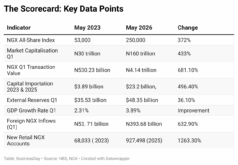
Three years ago, the market capitalization of the Nigerian Exchange (NGX) was N30 trillion. As of May 2026, it has grown to N160 trillion, representing an increase of more than five times.
The NGX is one of Africa’s largest and top-performing equity markets, frequently ranking as the 3rd largest in Africa by market capitalisation and listed companies, behind South Africa’s Johannesburg Stock Exchange (JSE) and the Egyptian Exchange (EGX).
The All-Share Index, meanwhile, has surged from 53,000 points to 250,000 points, a 371 percent gain in nominal terms. For context, an investor who deployed N1 million into a broad basket of NGX equities on inauguration day now sits on close to N4.7 million.
President Bola Ahmed Tinubu, during his speech on his third anniversary in office, attributed the development to growing investor confidence, improved macroeconomic management, and ongoing economic reforms.

The President said companies across various sectors were reporting stronger earnings and declaring improved dividends, reflecting renewed confidence in the economy.
He noted that strengthening public finances and greater fiscal stability had also enhanced state governments’ ability to invest in infrastructure and social services.
The reforms that moved the market
The stock market’s reforms did not occur in a vacuum. It was engineered, partly by design, partly by the force of macroeconomic correction through a sequence of landmark policy interventions spanning the presidency, the Central Bank of Nigeria (CBN), and the Securities and Exchange Commission (SEC).
The Subsidy Removal and Forex Unification (May–June 2023):
The removal of the petrol subsidy on Day One, followed swiftly by the CBN’s unification of the multiple exchange rate windows under Governor Olayemi Cardoso, sent a powerful signal to foreign investors who had long cited Nigeria’s FX framework as the primary barrier to capital deployment.
The elimination of forex arbitrage, which the Presidency estimates cost the country more than N8 trillion over three years, restored a degree of price transparency that institutional investors had demanded for years. Within months, the market had begun repricing Nigerian equities against a cleaner macro backdrop.
The Banking Sector Recapitalisation (March 2024–June 2026):
Perhaps no single policy action generated more direct stock market activity than the CBN’s directive, issued in March 2024, raising minimum capital requirements for commercial banks. The recapitalisation exercise forced Nigeria’s largest financial institutions, GTB, Zenith Bank, Access Holdings, First HoldCo, UBA, and others to return to the capital market to raise fresh equity. The result was a wave of public offers and rights issues that injected an estimated N4.65 trillion into the NGX platform.
According to CBN data, the recapitalisation exercise alone drove the registration of over 2.2 million new retail accounts on the NGX in 2025. By the end of Q1 2026, NGX data showed that more than 500,000 new investors had participated in various bank public offers since 2024, many of them first-time equity participants.
The Investment and Securities Act 2025:
The most structurally significant regulatory intervention was the signing of the Investment and Securities Act (ISA) 2025 by President Tinubu in March 2025, the first comprehensive overhaul of Nigeria’s capital market legislation in 18 years. The old ISA 2007 had been drafted in a pre-digital, pre-fintech era, and its limitations were showing.
The new Act introduced sweeping changes. It classified securities exchanges into Composite and Non-Composite categories, allowing full flexibility in listing equities, debt, derivatives, commodities, and digital assets under a single framework. It expanded the SEC’s regulatory powers to meet IOSCO standards, reinforcing Nigeria’s “Signatory A” status under the Enhanced Multilateral Memorandum of Understanding, a critical benchmark for global institutional investors. It also formally incorporated private equity, venture capital, and digital assets into the regulated framework for the first time, opening new avenues for capital formation.
SEC’s April 2025 Private Debt Rules:
On April 24, 2025, the SEC introduced additional transformative rules that, for the first time, opened a regulated pathway for private companies to issue debt securities, bonds, debentures, and sukuk to the public. This move, enabled by the Business Facilitation Act 2022, significantly broadened access to public capital and introduced a new class of issuers to the market.
T+2 Settlement Transition:
By moving from a T+3 to a T+2 settlement cycle, market operations reduced counterparty risk, improved liquidity, and aligned the Nigerian market with global best practices and international investor expectations.
Extension of trading hours:
In a move designed to deepen market liquidity, enhance price discovery, and broaden investor access, the NGX adjusted the expansion of its trading hours from 9:00 a.m. to 4:00 p.m. (WAT).
The Investor Verdict
Nigeria’s stock market boom has attracted both domestic retail excitement and a measured re-engagement from foreign institutional investors who spent much of 2021 and 2022 liquidating Nigerian positions amid the old managed FX regime.
Total transactions on the NGX rose to N4.14 trillion in the first quarter of 2026, almost double the N2.2 trillion recorded in the same period in 2025. For the full year 2025, total NGX transaction value reached approximately N12 trillion, the highest level of combined domestic and foreign participation ever recorded.
Domestic investors account for roughly 78 percent of market activity, but foreign participation is trending upward: foreign inflows on the NGX surged 78 percent year-on-year to N393.68 billion in Q1 2026, while April 2026 data showed total transactions increased further to N1.803 trillion, a 274 percent year-on-year gain versus April 2025.
According to the National Bureau of Statistics, capital importation, the broadest measure of foreign investor confidence, has validated the directional shift. Nigeria’s total foreign capital inflows for the full year 2025 reached $23.2 billion, the highest since 2019, compared to $12.32 billion in 2024.
The bureau said foreign portfolio investments (FPI) dominated inflows, totalling $19.4 billion or 85.5 percent of the total capital importation value, while other investments contributed $2.5 billion (10.7 percent).
Foreign direct investment (FDI) accounted for $923 million (3.9 percent) of the total capital importation for 2025.
Charles Fakrogha, chief executive of ECL Asset Management, attributes the foreign rebound to a convergence of structural catalysts: “The strong rebound in March is largely a function of increased positioning by domestic institutional investors taking advantage of valuation opportunities. Foreign participation has also surged partly due to Nigeria’s removal from the FATF Grey List and the reclassification by FTSE Russell, as well as improving macroeconomic clarity.”
The FATF grey list exit, one of the least-discussed but highly significant achievements of the reform period, removed a compliance overhang that had made Nigerian securities difficult for certain European and North American institutions to hold. The FTSE Russell reclassification, similarly, expanded the universe of index-tracking funds that can now deploy capital into Nigerian equities.
Kasumu Garba Kurfi, managing director of APT Securities and Funds Limited, during a TV interview, said that many of the reforms introduced under the current administration are likely to continue regardless of future political developments.
“The train has already left the station,” he said. “Whether President Tinubu continues beyond 2027 or not, many of these reforms will remain because people have seen their benefits.”
He added: “Nobody is likely to reverse policies that have improved market confidence, strengthened institutions, and attracted investment. The direction from here is forward.”
The market operator expressed confidence that sustained reforms, deeper capital markets, and stronger financial institutions could help Nigeria achieve its ambition of building a $1 trillion economy.
“If we continue on this path, achieving a $1 trillion economy is possible. It will create jobs, reduce poverty, attract investment, and strengthen economic stability across the country.” (BusinessDay)
-

 News15 hours ago
Outcry as fake products flood markets
-
Celebrity Gist15 hours ago
Okoye really sweet, Cardi B says after third sighting
-
News15 hours ago
N33.75bn Cash Transfer Mystery: FG Failed to Prove Millions of Vulnerable Nigerians Received Funds — Auditor-General
-
Business15 hours ago
Airport policies didn’t drive Uber out of Nigeria, says FAAN
-
Metro15 hours ago
Trafficker lures, sells 15 Nasarawa children