Politics
2027: Obi and Kwankwaso have found a party. Can their followers share it?


Seriake Dickson’s warning sounded less like routine party management than the first stress test of Nigeria’s new opposition pact.
The founder and chairman of the Nigeria Democratic Congress (NDC) said the party would not operate as “a personality cult, political movement, or Special Purpose Vehicle to be used and discarded”. The message was aimed at the two forces now transforming the NDC: Peter Obi’s Obidient movement and Rabiu Kwankwaso’s Kwankwasiyya.
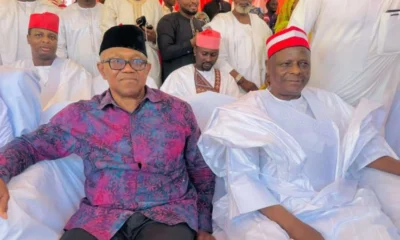
Both camps have pitched their tents with the NDC. Both bring assets that Nigeria’s fragmented opposition badly needs. Obi carries the energy of a young, urban and largely southern reformist base. Kwankwaso brings a disciplined machine rooted in Kano and the North West. Together, they have raised hopes that the 2027 presidential election could become a real contest for President Bola Tinubu.
Kwankwasiyya and Obidients: Two brands, one party?
Yet Dickson’s intervention exposed the question behind the alliance. Can two movements built around two strong political brands submit to a single party structure, a single candidate-selection process, and a single chain of command?

For now, both camps insist they can. “I must acknowledge that the two movements have different modus operandi,” Habibu Sale Mohammed, a Kwankwasiyya spokesman, tells The Africa Report. “But we are flexible enough to accommodate the Obidients as partners in achieving the general goals of the NDC. I foresee no problems.”
Tanko Yunusa, national coordinator of the Obidient Movement, calls the partnership a game-changer. Both movements are “working towards a common goal” and have leaders with “ideological discipline”, he says.
The electoral logic is clear. Obi finished third in the 2023 presidential election with 6.1 million votes. Kwankwaso came fourth with 1.4 million. On paper, their strengths complement each other. Obi’s appeal is strongest in the South, the Federal Capital Territory and among younger urban voters. Kwankwaso’s lies in the North West, especially Kano, where Kwankwasiyya remains a formidable grassroots machine.
But the alliance cannot be judged by simply adding 6.1 million and 1.4 million. The real question is transferability. Would Obidient voters accept Kwankwaso as Obi’s running mate? Would Kwankwasiyya loyalists campaign with the same energy for a ticket headed by Obi? Can Kwankwaso deliver northern votes outside Kano? Can Obi persuade sceptical voters in the North West that his movement is not merely a southern, urban insurgency?
Marriage of convenience
Opposition coalitions often fail not because leaders cannot bargain, but because their followers refuse to move.
For Bayo Fabiyi, a political analyst, the pact is less a merger than a marriage of convenience. “By temperament, they may not mix, but by political exigency, they may pretend to agree,” he tells The Africa Report.
Fabiyi also doubts that Kwankwaso is fully committed to a 2027 victory under Obi’s leadership. He argues that accepting the running-mate slot may be a way to build goodwill with Obi’s youthful supporters and the South East ahead of 2031, when power would be expected to rotate north.
“As far as I am concerned, I still don’t believe that the Obi-Kwankwaso ticket is real,” Fabiyi says. “I believe Kwankwaso wants to use 2027 to register his ‘loyalty’ with the Obidients and the South East, so that he can call upon it in 2031.”
That is why the NDC’s internal balance matters. Dickson wants the Obidient and Kwankwasiyya movements to integrate fully into the party. The demand is logical for any chairman. It is also hard to enforce. Both movements have shown that their primary loyalty is to their leaders. The Obidients followed Obi from the Labour Party to the African Democratic Congress (ADC) and then to the NDC. Kwankwasiyya would probably do the same for Kwankwaso.
That makes both camps valuable and difficult to navigate. They bring numbers, energy and visibility. But they also risk making the politician, rather than the party, the real centre of loyalty.
Party control
The first public flare-up was instructive. Dickson insisted that Obi and Kwankwaso had not done the NDC a favour by joining, and said he was himself qualified to run for president. Aisha Yesufu, a prominent Obidient figure, publicly challenged him, describing his comments as unfortunate and driven by jealousy. Kwankwaso’s camp chose dialogue, meeting Dickson to calm the dispute.
Yunusa says the misunderstanding has been resolved.
The episode showed how quickly party control can become a test of status and authority.
The Obidient movement’s strength is its energy. Decentralised and volunteer-driven, it has built a reformist image and shown little patience for establishment politics. That makes it hard to control and easy to caricature. The movement has clashed with Nobel laureate Wole Soyinka, Tinubu spokesman Bayo Onanuga and Nigerians in Diaspora Commission chair Abike Dabiri-Erewa. “I hope Obi does not contest the 2027 election,” Soyinka once warned, arguing that the movement could become his undoing.
Justin Ijeh, a frontline Obidient leader, rejects the charge. “Not every Obi supporter is part of the Obidient movement,” he says. “As part of that team, I can categorically say it is false to describe us as disrespectful.”
He says the language of disrespect is often used to blunt accountability. “Citizens should not be labelled disrespectful for demanding accountability,” he says. “We must be careful, given our history of political apathy, that the label ‘disrespectful’ is not weaponised against citizens who dare to question power.”
Kwankwasiyya brings a different risk. It is more hierarchical, more disciplined and tied to Kwankwaso’s long political career. Its strength is organisation. Its burden is dependence on one strong personality.
‘Partner, not a spare tyre’
Datti Baba-Ahmed, Obi’s 2023 running mate, has suggested that Kwankwaso’s forceful personality could make it difficult for him to serve under Obi. Both men have tried to answer that doubt directly.
“I don’t see why deputies or vice would fight with the president or governor,” Kwankwaso said in an interview with Arise TV last month.
Obi, for his part, has said he would treat Kwankwaso “as a partner, not a spare tyre” if they win the 2027 election.
Sale, the Kwankwasiyya spokesman, also rejects the idea that Kwankwaso would be unable to adapt. Kwankwaso, he says, “is a strong character and cannot diminish himself”, but understands political boundaries.
The ticket question will decide whether that confidence is justified. Both men have presidential ambitions and command movements that see their leader as the face of change. One idea being used to reassure northern allies is Obi’s stated commitment to serve one term and step down in 2031, giving Kwankwaso a possible path to succession.
That logic cuts both ways. To Fabiyi, Kwankwaso may be using the 2027 ticket to position himself for the next contest. But his presence could also reassure northern power-brokers that Obi would not try to extend his stay beyond one term.
“Kwankwaso is such a strong character,” Fabiyi says. “Obi won’t dare to go back on the promise to leave power after one term.”
For Tinubu’s camp, those tensions are openings: zoning, religion, party ownership, candidate selection and whether either man can truly accept second place.
The opposition has found a boat. It has not yet been proved that everyone inside it will row in the same direction. (The Africa Report)


-

 Opinion13 hours ago
Obafemi Hamzat: Voice of the street, made for Lagos
-
Sports13 hours ago
To make money for ‘generations of my family’— Reijnders explains Saudi move
-
Politics13 hours ago
2027: New strategy in place to checkmate Atiku, Obi – Wike
-
News13 hours ago
Why Nigeria, Ghana-trained teachers were removed from UK qualification list
-
World News13 hours ago
US imposes new visa restrictions on birth tourism operators
-
Business13 hours ago
TotalEnergies, AMNI approve $800m Ima Gas project
-
News13 hours ago
Detention: El-Rufai Speaks On Silence Of Friends He Stood By In The Past
-
Politics13 hours ago
Obi-Kwankwaso Movement defies NDC, insists on independent structures