Business
Stock market selloff wipes $4bn off Nigerian billionaires’ fortune

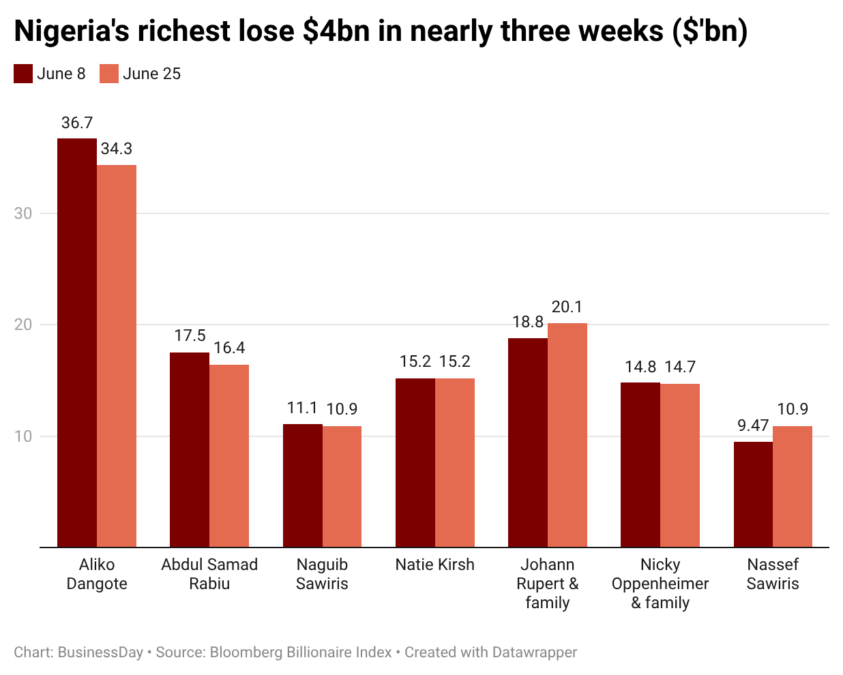
The sharp selloff on the Nigerian Exchange Limited (NGX) is eroding not only the portfolios of retail investors but also the fortunes of the country’s wealthiest businessmen, with Aliko Dangote and Abdul Samad Rabiu losing a combined $3.5 billion in just 17 days as heavyweight stocks came under intense pressure.
Data from the Bloomberg Billionaires Index, which tracks the wealth of the world’s 500 richest individuals, shows that the combined net worth of the two Nigerian billionaires declined to $50.7 billion on June 25 from $54.2 billion on June 8.
The decline mirrors a correction in some of Nigeria’s largest listed companies, particularly Dangote Cement and BUA Cement, whose shares have come under sustained selling pressure.
Africa’s richest man saw his fortune fall to $34.3 billion after briefly almost nearing the $40 billion mark earlier this month. The decline followed a 10 percent plunge in Dangote Cement’s share price on Wednesday, wiping N1.8 trillion off the company’s market capitalisation, which fell to N16.3 trillion from N18.1 trillion on Tuesday.

The drop cost the continent’s biggest cement producer its position as the Nigerian Exchange’s most valuable listed company. MTN Nigeria now leads with a market capitalisation of N17.43 trillion, followed by BUA Foods at N16.9 trillion, Airtel Africa at N16.4 trillion, and Dangote Cement.
Dangote owns 87.45 percent of Dangote Cement, making movements in the company’s share price the biggest driver of changes in his personal wealth.
Rabiu, founder of BUA Group, also saw his fortune decline as investors sold shares in his flagship listed companies. He owns 95.8 percent of BUA Cement and 92.6 percent of BUA Foods, leaving his net worth closely tied to the performance of both companies.
BUA Foods shares slipped to N939 from N967 earlier in the month, while BUA Cement fell to N340.2 on Wednesday from N378 on June 11, reducing the value of Rabiu’s holdings.
The decline pushed Rabiu behind South African luxury goods billionaire Johann Rupert, who reclaimed the position of Africa’s second-richest person after a rally in Richemont shares lifted his fortune to $20 billion.
The erosion in Dangote’s and Rabiu’s fortunes reflects a broader correction in the Nigerian stock market after months of exceptional gains.
Nigerian equities have shed about N8.24 trillion in market value since the start of June as investors locked in profits following a prolonged rally, triggering a long-anticipated market correction. The market’s capitalisation has declined to N152.27 trillion from a record N160.51 trillion at the end of May, with sustained selling in heavyweight stocks accelerating the downturn.
Analysts say the decline is a natural pullback after one of the strongest rallies in the Nigerian Exchange’s history rather than a sign of deteriorating fundamentals.
“The market has appreciated significantly since the beginning of the year, so profit-taking, valuation adjustments and selective portfolio rebalancing were expected,” said David Adonri, vice president of Highcap Securities. “The recent movement is therefore consistent with a consolidation of gains after a strong run, rather than a sign of structural weakness in the market.”
Adonri also dismissed suggestions that the market correction was triggered by the Nigerian Exchange’s transition to a T+1 settlement cycle.
“It is important to distinguish correlation from causation,” he said. “T+1 is a post-trade reform designed to improve settlement speed and efficiency, not a driver of market direction. In both rising and correcting markets, faster settlement allows investors to reposition efficiently. The opportunity now is to build on this improved market infrastructure to deepen liquidity, broaden investor participation and support more efficient capital formation.”
The selloff intensified on Wednesday as the NGX All-Share Index fell 2.35 percent, its biggest single-day decline in June and one of the steepest daily losses this year.
The market capitalisation of the Nigerian Exchange dropped to N150.85 trillion, while the benchmark All-Share Index closed at 235,074.5 points.
The selloff also comes after an extraordinary rally that made Nigerian equities one of the best-performing frontier markets globally. The benchmark index gained 51.19 percent in 2025, its strongest annual performance in nearly two decades.
In response to heightened market volatility, the Exchange has announced a significant change to its pricing methodology, replacing the temporary uniform price movement rule with a three-tier price limit system based on individual share prices, a move aimed at improving market efficiency while maintaining orderly trading. (BusinessDay)
-

 Politics24 hours ago
2027: It’s Our Turn To Repay Tinubu – Shettima Tells Northerners
-
Politics24 hours ago
2027: Forget About Social Media News, Nigerians Love Tinubu – Information Minister
-
Metro24 hours ago
How AI-generated photo cost kidnap victim N4m ransom – Freed Benue graduate
-
Politics24 hours ago
Ebola: Parties reject campaign suspension
-
Politics24 hours ago
2027: Pantami, Adebutu, Gwarzo’s fates uncertain
-
Metro23 hours ago
Self-driving car hits, kills man on US freeway
-
Metro23 hours ago
Expert warns of declining sperm concentration in Nigerian men
-
Sports24 hours ago
After Losing Streak, University Advises Students To Dump Manchester United