News
Senators, reps grapple with faulty e-voting device, mics despite N37bn spent on chamber renovation

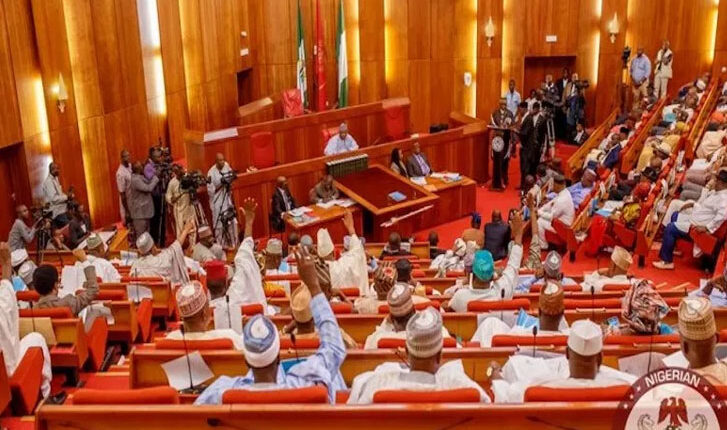
For nearly two years — from April 2022 to April 2024 — Nigeria’s federal lawmakers vacated their chambers and squeezed into committee hearing rooms for plenary while the national assemblycomplex underwent a costly renovation.
It was expected that when senators and members of the house of representatives eventually resumed sittings in their chambers, they would return to a better edifice.
However, after billions of naira were spent on refurbishing the chambers, the outcome has fallen far short of expectations.
Some of the chamber’s microphones are not functioning optimally, while the electronic voting system that once facilitated proceedings has become inoperative.

For journalists, following proceedings on television at the press centre has become a better option than covering from inside the chamber gallery, where lawmakers’ voices are often muffled and barely audible.
THE RENOVATION

In 2019, former President Muhammadu Buhariapproved N37 billion for the renovation of the National Assembly Complex.
The proposed expenditure sparked widespread backlash, with many Nigerians questioning the size of the budget earmarked for the complex upgrade.
In 2020, amid the disruptions caused by the COVID-19 outbreak, the government revised the cost of the rehabilitation exercise to N9 billion and opted to execute the project in stages.
Reports would later indicate that about N37 billion was eventually expended on rehabilitating the complex, with the contract awarded to Visible Construction Limited.
Renovation work on the chambers commenced around April 2022, forcing lawmakers to relocate plenary sessions to makeshift chambers situated within one of the committee rooms.
After nearly two years of temporary arrangements, members of the national assembly resumed plenary in the renovated chambers in April 2024.
The upgraded facilities were expected to enhance legislative efficiency and bring parliament in line with modern standards. But barely two months after lawmakers returned to the renovated chambers, deficiencies began to emerge, raising questions about the quality of work done despite the enormous public resources committed to the project.
EARLY COMPLAINTS FROM THE SENATE
Signs that the refurbishment had fallen short surfaced as early as May 2024 when Ali Ndume, senator representing Borno south, openly criticised the state of the senate chamber.
Speaking during plenary on May 7, 2024, Ndume likenedthe chamber to a conference room, lamenting the alleged absence of electronic voting facilities and the quality of the audio system, which he said made it difficult to identify speakers.
“This is not a chamber; it is like a conference room. You will not even know that it is me, Ndume, that is speaking, so also when the leader is speaking,” he said.
“We need to correct this. We need to change so many things. As with the sitting row, if you want to stand up, you will have to use tactics or a strategy.
“There is no voting device here. If we are to vote electronically, the facilities are not there, but we had that previously.”
In his response, Senate President Godswill Akpabio said the contract for renovation of the national assembly was awarded during the tenure of Ahmad Lawan, former president of the senate.
“This is not our contract; it was a contract that was awarded in the ninth senate,” Akpabio said.
FAULTY ELECTRONIC VOTING DEVICE

In the house of representatives, the electronic voting system initially appeared to be operational.
During plenary on December 17, 2025, Tajudeen Abbas, speaker of the house, directed Amos Daniel, chairman of the committee on house services, to educate members on how to operate the system. Lawmakers were preparing to vote on the constitutional amendment bills at the time.
Legislators had difficulty understanding how to use the voting device during the lecture. Seeking to steer proceedings to the next item on the order paper, Benjamin Kalu, deputy speaker of the house, remarked that members are not expected to master the technology in a single day.
“We can’t use one day to learn this; maybe we need to dedicate one day to it. We may not be voting tomorrow; the leadership has not decided,” Kalu said.
Since then, the electronic voting system has not been deployed during plenary sessions.
Meanwhile, the condition of some of the chamber’s microphones and speakers appears to have deteriorated. It has become commonplace for lawmakers to abandon their designated seats and speak from colleagues’ seats because the microphones attached to their desks no longer work
The challenges are even more pronounced in the public gallery where journalists and visitors observe proceedings. Audio output in the gallery is often muffled and barely audible, making it difficult for reporters to follow debates.
REPS, SENATORS ADOPT MANUAL VOTING ON STATE POLICE DUE TO FAILED E-VOTING DEVICE
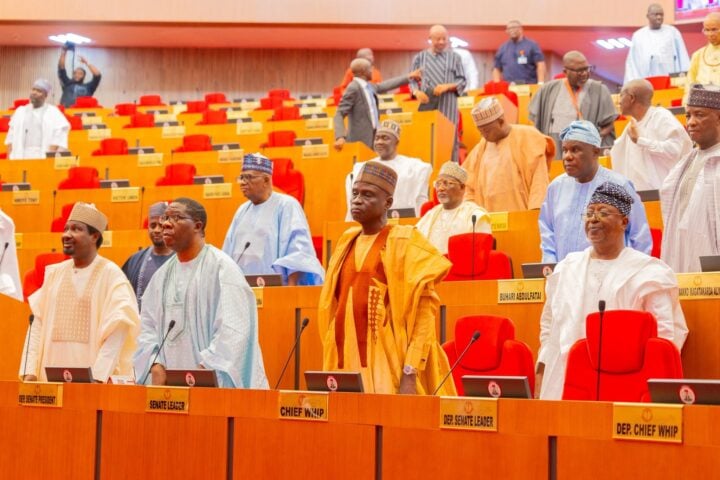
The extent of the technical deficiencies became more apparent on June 11, 2026, during deliberations on constitutional amendments on the state police bill.
As proceedings progressed, presiding officers (Abbas and Kalu) struggled with malfunctioning microphones. Kalu was repeatedly seen striking the microphone’s diaphragm at the committee of the whole in an attempt to revive it.
Before the voting commenced, Abbas informed members that the electronic voting system was not functional and that they would adopt manual voting.
“The electronic voting system is right now not working, so we are going to do a head count, one after the other, to ascertain that we have the number to actually pass this amendment,” he said.
The house subsequently adopted a controversial counting procedure. Rather than conduct electronic voting or invoke a division to determine the exact number of members supporting the amendment, sergeants-at-arms were directed to physically count lawmakers.
The process triggered concerns about transparency and constitutional compliance.
The senate also adopted manual voting on state police bill on June 24 after its electronic voting device developed a technical fault.
‘QUESTIONABLE PROCEDURE’
Chibuzo Okereke, a governance expert and policy strategist, described the process the house used to vote on the state police bill as a missed opportunity for the legislature.
According to the Labour Party (LP) presidential candidate for the 2027 election, constitutional amendments require strict adherence to procedures that guarantee broad consensus.
“If you look at the way the constitution and the standing order have provided for alterations of the constitution, the need for you to have two-thirds and all the processes, you will now realise that there is a purpose for it,” he told TheCable.
“They want to make sure that any policy that will be passed is something that enjoys an adequate and absolute majority. There is what we call division. Any constitutional alteration must be done through division, and division simply means that people will be allowed to vote and their vote will be recorded electronically or manually.”
He argued that the reliance on hand counting without proper division made it difficult to establish with certainty whether the required threshold had been attained.
“The idea that people should raise their hand may be difficult to get that number. In the division, people’s names will be recorded, and a roll call will be taken. If they vote yes, there will be a roll call, and they will be mentioned.
“So, either you divide them, take their votes, and report to the presiding chair, or the presiding chair will decide to do a division by roll call, where he will call people’s names.
“After all, they did it to elect the speaker, so why are they running away from doing it in this one? Call people’s names. When you do, Nigerians will follow and even know whether a quorum was formed, how many people were there, and whether they got the number.”
A PATTERN OF CONTENTIOUS VOTES
The controversy surrounding the June 11 vote is not without precedent.
There have been several instances in which the 10th house of representatives adopted voice votes on matters requiring constitutionally prescribed two-thirds majorities, even though electronic voting could have provided a clearer basis for determining how many lawmakers supported the measure.
On November 26, 2024, the house removed Danladi Umar as chairman of the Code of Conduct Tribunal through a voice vote.
Paragraph 17(3), Part I of the Fifth Schedule to the 1999 Constitution and Section 22(3) of the Code of Conduct Bureau and Tribunal Act provide that the chairman or a member of the tribunal can only be removed following an address supported by a two-thirds majority of each chamber of the national assembly.
Again, on March 20, 2025, the house approvedPresident Bola Tinubu’s request for emergency rule in Rivers state by voice vote.
Section 305(6) of the constitution stipulates that such a proclamation must be approved by a resolution supported by two-thirds of all members of each chamber.
During the debate, Obi Aguocha, the lawmaker representing Ikwuano/Umuahia north/Umuahia south federal constituency of Abia state, raised a point of order and insisted that constitutional procedures, including headcounts, should be strictly followed.
On those occasions, Abbas said the attendance register showed the required number of lawmakers was present.
Legislative experts have argued that signatures on attendance registers do not necessarily indicate the number of lawmakers physically present when votes are taken, since members may sign in and leave before the exercise concludes.
The same controversy played out in the senate during the ratification of the Rivers emergency rule, with some senators later questioning whether the constitutional requirement of a two-thirds majority had actually been met.
Aminu Tambuwal, senator representing Sokoto south and former speaker of the house of representatives, was one of the lawmakers who faulted the national assembly’s ratification of the emergency rule.
He said the parliament did not garner the required two-thirds before approving the emergency rule in Rivers state.
“The parliament is supposed to be guided by the constitution, its rules and its precedents,” Tambuwal said.
Efforts to get a response from the chairman of the house services committee were unsuccessful, as he neither answered calls nor replied to text messages sent to him. (TheCable)
-

 Business23 hours ago
Dangote Petroleum Refinery Set for Landmark IPO Following SEC Approval
-
Business20 hours ago
BREAKING: Nigeria’s external reserves cross $54 billion, highest level in 18 years
-
 News22 hours ago
BREAKING: Explosion As Boko Haram Targets Convoy Of APC Gov’ship Candidate In Borno
-
Metro21 hours ago
Ghanaian government launches app for lovers to verify each other’s marital status
-
News7 hours ago
Outcry as fake products flood markets
-
Celebrity Gist7 hours ago
Okoye really sweet, Cardi B says after third sighting
-
News8 hours ago
N33.75bn Cash Transfer Mystery: FG Failed to Prove Millions of Vulnerable Nigerians Received Funds — Auditor-General
-
Business7 hours ago
Airport policies didn’t drive Uber out of Nigeria, says FAAN