Opinion
Floods: The worst is yet to come

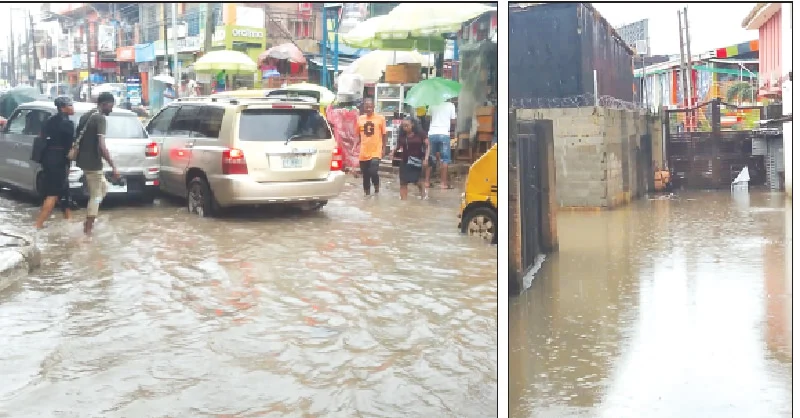
FOR years, relevant agencies have consistently issued warnings and projections about heavy rainfall and devastating floods. Yet governments have largely ignored them. The result is predictable, as recurring floods leave behind deaths, destruction and misery.
On the eve of July and throughout the first week of the month, torrential rains pounded Lagos and Ogun states, leaving heart-rending devastation and disturbing scenes in their wake.
The downpour came in relentless torrents, submerging homes, forcing residents out of their houses, destroying livelihoods, cutting off roads, disrupting electricity supply and shattering food supply chains.
The worst-hit areas included Agege, Ikeja, Oworonsoki, Gbagada, the Lagos-Oshodi Expressway, Abeokuta Expressway by Oshodi Bus Stop, Iwaya in Yaba, the Lekki-Epe Expressway and its environs, Victoria Island, Funsho Williams Avenue and Lagos Mainland.

Ikeja Electric said the floods damaged two power transformers and several 33kV feeders, plunging communities served by the Oworo Injection Substations 1 and 2 into blackout.
The floods also ravaged Ibafo, the Ogun State community contiguous with Lagos, as well as other communities across the state.
Heavy rainfall and flooding were equally reported in several northern states.
Amid the downpour, the Director-General and Chief Executive Officer of the Nigeria Hydrological Services Agency, Umar Mohammed, warned: “As we speak now, with the flooding happening, if nothing is done, this is just the start of the rainy season, sometime around July-September (12 weeks), and it could be worse than what is even happening right now. And we’re expecting it to be worse around August-September, particularly August-September.”
That warning is ominous.
The accuracy of the agency’s prediction in the first week of July is compelling evidence that the worst floods are yet to come.
The National Emergency Management Agency’s After-Action Review showed that Nigeria’s most devastating recent flood year was 2024, when floods claimed over 1,237 lives, affected 5.2 million people and displaced about 1.24 million.
Thanks to coordinated and anticipatory action in 2025, the scale of the tragedy dropped significantly.
Reports indicated that 241 people died, about 460,000 were affected, and 158,588 were displaced that year.
This was lower than the devastation recorded in 2012.
Regrettably, governments appear to have relaxed those anticipatory measures this year.
The intensity of the rainfall recorded so far in July validates the 2026 Annual Flood Outlook released by the Nigeria Hydrological Services Agency. The report warned that 30,707 communities were at risk. Of these, 14,158 face high flood risk, 15,621 moderate risk and 923 low risk across 34 states.
The report further indicated that 4.2 million hectares of farmland would be threatened, while 4,792 health facilities and 10,684 schools are located in flood-prone areas.
It is tragic that despite repeated warnings and scientific predictions, governments and citizens continue to act with indifference, allowing floods to inflict devastating blows on Nigeria year after year.
Flood disasters persist because there is a huge gap between prediction and implementation, and between regulation and compliance.
By contrast, when severe flooding struck Accra, Ghana, President John Mahama immediately ordered the demolition of all structures obstructing waterways and deployed emergency response teams to affected communities. Nigeria should emulate that decisiveness.
Across Nigeria, illegal structures continue to spring up on waterways and drainage channels because planning authorities routinely compromise regulations and standards, apparently for pecuniary gains.
Equally troubling is the obsolete waste management system in many states. In Lagos, for instance, refuse clogs drainage channels in many parts of the city. The demolitions in Oworonsoki have further blocked canals and water channels, while poor refuse collection continues to compound the problem.
Governments must, therefore, make a concerted commitment to climate change adaptation through sound policies and effective legislation.
They should urgently roll out comprehensive flood-control strategies and implement clear, focused and consistent waste management and flood-control policies.
As a low-lying coastal state, the Lagos State Government should invest massively in resilient infrastructure by constructing modern canals, pumping stations, an efficient waste management system and deploying technology to combat flooding while keeping the state clean.
The Lagos State Government should also explore engineering solutions that channel excess water from the Lagoon away from vulnerable parts of Lagos and construct underground pipelines that can discharge excess water into the Atlantic Ocean.
Governments at all levels must deliberately commit resources to flood control while ensuring that drainage systems and related infrastructure are properly maintained during the dry season.
They should also accelerate the construction of dams while redesigning and upgrading drainage channels to ensure the free flow of stormwater.
Officials who compromise planning regulations should be sanctioned, while sweeping reforms should be undertaken to sanitise the relevant agencies for efficient service delivery.
Governments must also mobilise relevant authorities to enforce existing laws against building on drainage channels and curb other environmentally destructive practices.
The Ikosi-Ketu Market Biodigester Plant, which converts spoiled fruits and vegetables into clean energy, demonstrates how waste can be transformed into wealth. Governments should urgently embrace waste-to-wealth initiatives and develop land dedicated to recycling hubs.
Waste Management Inc. and Republic Services, two of North America’s largest commercial waste disposal and recycling companies, in which the Bill and Melinda Foundation is a major shareholder, generate more than $41.7 billion in combined annual revenue. The Nigerian government should embrace this innovative path.
Nigeria cannot afford another catastrophe on the scale of 2012 or 2024. Governments and citizens alike must learn from those painful experiences and urgently revive and strengthen the anticipatory measures that proved effective in 2025. Failure to do so will almost certainly translate into more deaths, greater destruction and avoidable national tragedy.
•Punch Newspaper Editorial
-

 News21 hours ago
UK universities withdraw admission offers to Nigerians over visa crackdown
-
News21 hours ago
Benue: Suspected herdsmen kill nine in fresh Ukum attacks
-
News21 hours ago
Why kidnappers target NYSC members — Security experts
-
Politics21 hours ago
2027: Protest, relief as INEC releases final candidates’ list
-
Politics21 hours ago
2027: Opposition, APC clash over campaign funding
-
World News21 hours ago
US gunman shoots dead 7 relatives, family friend
-
Opinion21 hours ago
Did Obi actually win in 2023?
-
Business21 hours ago
Fitch revises Nigeria’s outlook to positive, affirms ‘B’ rating