Politics
2027: Which running mate brings the most votes – Shettima, Amaechi or Kwankwaso?

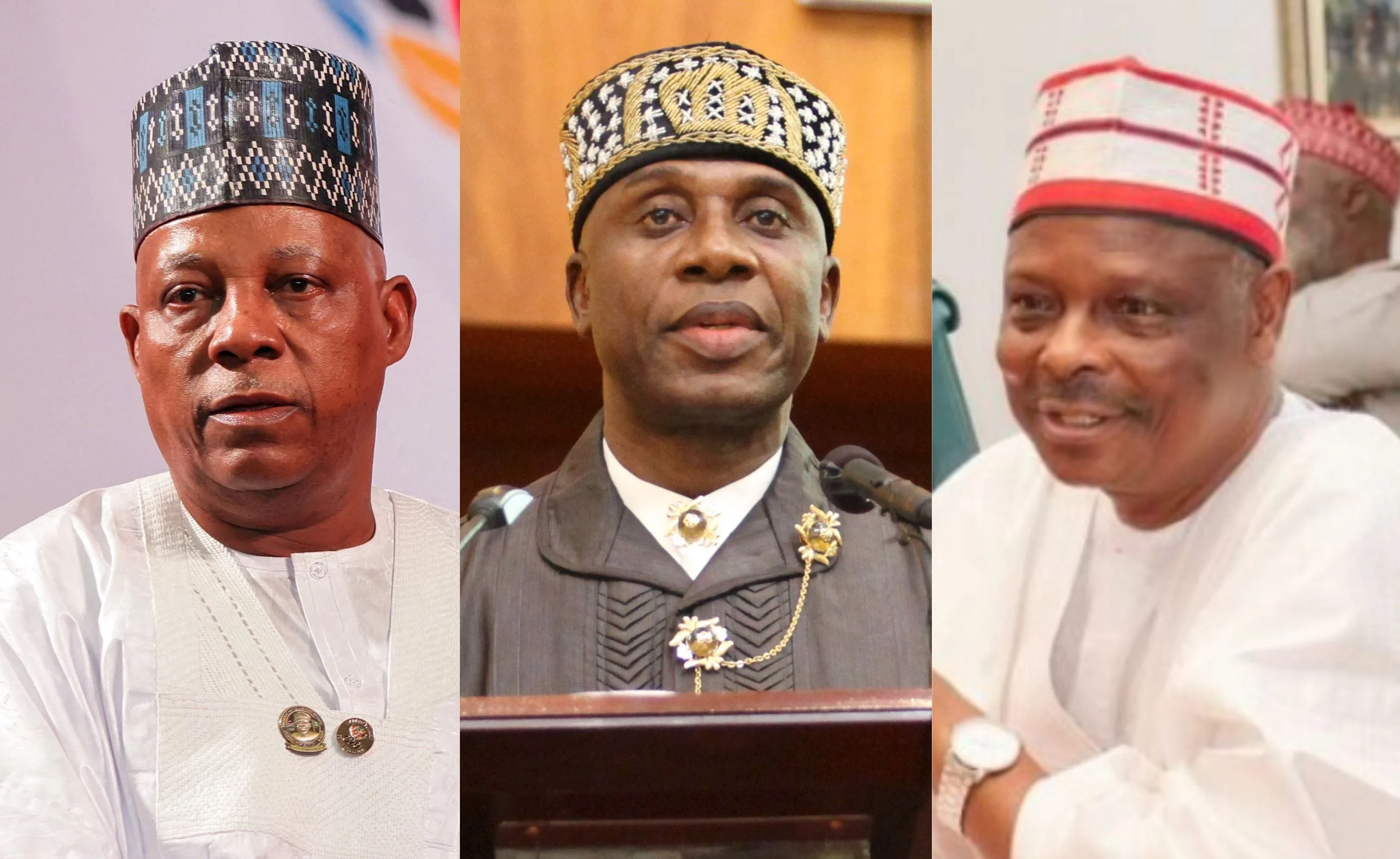
Nigeria’s three leading presidential tickets are now settled. President Bola Tinubu will retain Vice President Kashim Shettima. Atiku Abubakar has chosen former Rivers State governor Rotimi Amaechi. Peter Obi will run with former Kano State governor Rabiu Kwankwaso.
The three pairings, which will compete in the presidential election scheduled for 16 January 2027, meet Nigeria’s familiar demand for regional balance.
Atiku and Obi, one from the North and the other from the South, have also produced Muslim-Christian tickets. Tinubu, by contrast, is again asking voters to accept the Muslim-Muslim combination that helped him win in 2023.
Yet the more important test is not balance but additionality: which running mate can deliver voters who would not otherwise support the presidential candidate?

Tinubu needs Shettima to hold together his northern coalition. Atiku wants Amaechi to help rebuild support in the South-South and run an aggressive national campaign. Obi is betting that Kwankwaso can provide the northern organisation he lacked in 2023.
The stakes are particularly high because Tinubu won the last election with 36.6% of valid votes. Atiku, Obi and Kwankwaso together received more than 60%, although there is no guarantee that those constituencies can be combined. The opposition’s first attempt to unite behind a single candidate collapsed when Obi and Kwankwaso left the Atiku-dominated African Democratic Congress for the Nigeria Democratic Congress.
A valuable running mate must therefore do more than balance religion and geography. He must deliver votes, bring an organisation capable of defending them and avoid creating larger liabilities elsewhere.
Shettima: The cost of changing horses
Tinubu’s decision to retain Shettima is the most cautious of the three choices.
A former senator and two-term Borno governor, Shettima supported Tinubu’s presidential ambitions when much of the northern political establishment appeared wary of him. Replacing him after one term would have risked angering Borno and the wider North East, while raising questions about Tinubu’s loyalty to his allies.
After Shettima’s renomination, Borno governor Babagana Zulum led a delegation of North East leaders to thank Tinubu. Zulum said the decision showed confidence in the region and rewarded loyalty and service. That response illustrates Shettima’s defensive value: even if he cannot deliver the North East, dropping him might have cost the APC votes there.
“I believe Tinubu accommodated Shettima for fear of rocking the boat,” says Gbade Ojo, a professor of political science at the University of Ilorin. “If Shettima is removed, there is a possibility that the North East, where he comes from, may be unhappy and there may be protest votes.”
The electoral evidence is less flattering. In 2023, Atiku won five of the North East’s six states and took 50.6% of valid votes across the region. Tinubu won only Shettima’s Borno State and finished with 34.5%. Rather than neutralising Atiku in his home region, Shettima failed to prevent a clear defeat.
His security credentials are also open to attack. When Tinubu selected him in 2022, the APC said Shettima’s experience governing the state at the centre of the Boko Haram insurgency made him well suited to help tackle insecurity. Yet during his tenure, the insurgents captured towns including Bama and Gwoza, while the 2014 kidnapping of the Chibok schoolgirls put his administration under intense pressure.
“He is a figurehead vice president and hardly adds any value, unlike Osinbajo,” says political analyst Temidayo Akinsuyi. “He promised to handle security while Tinubu focused on the economy. Insecurity has worsened.”
Akinsuyi also believes the Muslim-Muslim ticket remains a liability. “Nigerians have seen that the ticket, rather than unite, has divided the country further. It is a big risk for Tinubu to run with Shettima again.”
Sylvester Akhaine, a professor of political science at Lagos State University, disagrees. He argues that the religious controversy has faded since 2023.
“The Muslim-Muslim ticket will not affect the fortunes of the APC,” he says. “The last three years have shown that Shettima being a Muslim does not affect anything, including appointments by Tinubu.”
Shettima may be the least convincing direct vote-winner of the three running mates. But his value lies in continuity, elite reassurance and the political cost that Tinubu would have incurred by removing him.
Amaechi: A national operator without his old machine
Amaechi offers the strongest campaign résumé.
He governed Rivers for eight years, served as transport minister under Muhammadu Buhari and managed Buhari’s successful presidential campaigns in 2015 and 2019. He also finished second to Tinubu in the APC’s 2022 presidential primary and then second to Atiku in the ADC contest.
The ADC said it selected him after consultations across the party, citing his political experience, national reach and influence in the South-South.
Amaechi cannot win Rivers for Atiku. I don’t see him making any real impact across the rest of the South-South
Atiku needs help there. The South-South was once one of the Peoples Democratic Party’s safest regions, but Obi broke that dominance in 2023. Obi received 42.4% of valid votes across the six states, against 28% for Tinubu and 25.1% for Atiku.
Amaechi’s problem is that his own Rivers base has eroded. His successor and former ally, Nyesom Wike, defeated his political machinery and backed Tinubu in 2023. Now serving as Tinubu’s federal capital territory minister, Wike has pledged to deliver Rivers to the president again in 2027.
The state’s politics are no longer controlled by one man. Wike has also been locked in a long-running battle with Governor Siminalayi Fubara. But Amaechi has been outside elected office since 2015 and no longer commands the state government, the APC structure or the patronage network that once made him formidable.
“I don’t see Amaechi adding much value to Atiku’s ticket,” Ojo says. “In a sense, Amaechi has become a spent force in Rivers politics. Wike seems to have clipped his wings.”
Akhaine agrees. “Amaechi cannot win Rivers for Atiku,” he says. “I don’t see him making any real impact across the rest of the South-South.”
That may judge Amaechi too narrowly. His value is not confined to Rivers. He has relationships across the former Buhari coalition, experience running national campaigns and the confidence to attack Tinubu directly.
“He is a fearless warrior who is never afraid to say negative things about Tinubu,” Akinsuyi says. “That may add a lot of value to Atiku’s camp.”
Amaechi is better understood as a campaign operator and coalition-builder than as the owner of a dependable regional vote bank. He may help Atiku organise a national campaign, but there is little evidence that he can restore the PDP-era dominance of the South-South.
Kwankwaso: The biggest vote bank – but will it transfer?
Of the three running mates, Kwankwaso has the clearest personal following.
His Kwankwasiyya movement gave the New Nigeria Peoples Party control of Kano in 2023 and propelled him to fourth place in the presidential election. He received almost 1m votes in Kano, defeating Tinubu by about 480,000 votes in a state that had 5.9 million registered voters – the country’s second-largest electorate after Lagos.
Tinubu accommodated Shettima for fear of rocking the boat. If Shettima is removed, there is a possibility that the North East, where he comes from, may be unhappy and there may be protest votes
For Obi, the appeal is obvious. The former Anambra governor dominated the South East and performed strongly in parts of the South-South and urban Nigeria in 2023, but took only 5.2% in the North West. Kwankwaso received 19% across the region, almost all of it driven by Kano.
“Kwankwaso has value because he can get votes for Obi in the North West, starting from Kano, where he has a large following,” Akhaine says. “But then, he has Atiku to contend with across the North.”
Akinsuyi also ranks Kwankwaso first. “Among the three, Kwankwaso will add more value to Obi’s ticket because of his Kwankwasiyya movement and large followership in the North,” he says.
But Kwankwaso’s strength has clear boundaries. In 2023, he won only Kano. Tinubu led the North West with 39.6% of valid votes, followed by Atiku on 34.8%. Kwankwaso’s support did not spread strongly into Kaduna, Katsina, Kebbi, Jigawa, Sokoto or Zamfara.
His Kano machine has also split. Governor Abba Yusuf, Kwankwaso’s former protégé, defected from the NNPP to the APC in January 2026, taking parts of the state government and party structure with him. Kwankwaso insists that Yusuf will suffer politically for the move, but the defection gives Tinubu a stronger institutional foothold in the state.
The larger uncertainty is whether Kwankwasiyya supporters will vote for Obi rather than for Kwankwaso himself.
The two men say they have signed a written agreement under which Obi would serve only one four-year term before power returned to the North. That pact is designed to reassure northern politicians who might otherwise resist waiting until 2031 or 2035 for another northern presidency.
But an agreement between candidates does not guarantee support among northern governors, traditional powerbrokers or voters. Kwankwaso must persuade his movement to accept second place on a ticket led by a politician whose 2023 appeal was concentrated overwhelmingly in the South.
Verdict: Kwankwaso offers the largest upside
On direct electoral value, Kwankwaso ranks first. He offers Obi access to a large, organised constituency in territory where the NDC presidential candidate was exceptionally weak in 2023. Neither Shettima nor Amaechi can point to an equivalent personal vote bank.
But Kwankwaso’s value is also the most conditional. His movement has already suffered a damaging split in Kano, his influence remains patchy outside the state, and it is not yet clear how many of his supporters will transfer their loyalty to Obi.
Shettima brings the greatest defensive value. He may not deliver the North East, but removing him could have created a new rebellion within Tinubu’s coalition.
Amaechi brings the greatest operational value. He knows how to run a national campaign and can serve as an aggressive surrogate, but his former power base has weakened, and his wider South-South reach remains unproven.
Kwankwaso is therefore the most valuable running mate – not because he guarantees Obi the North, but because he offers the largest pool of voters that his presidential candidate could not reach without him.
(The Africa Report)
-

 Metro12 hours ago
Child trafficking suspect admits receiving ₦250,000 per child
-
News12 hours ago
Ebola: Uganda seeks Nigerian woman’s travel history from FG
-
Politics12 hours ago
2027: Tinubu campaign council creates new directorate, reshuffles teams
-
News12 hours ago
Abuja bizman arrested over alleged $120m fraud
-
Business12 hours ago
Transport, petrol prices soar in S’East amid fuel discount
-
News21 hours ago
BREAKING: FG confirms Ebola case in FCT, identifies 44 contacts
-
Politics12 hours ago
Ebola case: Atiku urges calm, backs contact tracing
-
Business12 hours ago
Senate Summons Olam Nigeria, MD, Eight Other Executives Over Alleged $15Billion Forex Transactions