Business
How Northern Youths Abandoned Okada Riding For Farming In Ogun

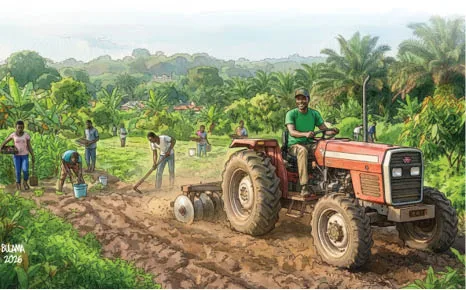
Former commercial motorcyclists, factory workers, teachers and traders are embracing mechanised rice farming. Unlike in the past when northerners returned en masse to the northern part of the country before or during the rainy season to cultivate their farmlands, this time, the tides have changed as most of them have decided to remain in the southern part of the country to cultivate farmlands.
As dawn breaks over Magboro, a bustling community straddling the Lagos-Ogun border, the familiar roar of commercial motorcycles gives way to the hum of tractors. The sound of factory sirens that once dictated the daily routines of many northern youths has been replaced by the rhythmic movement of harvesters and irrigation pumps across vast stretches of rice fields.
Along the Lagos-Ibadan expressway, a quiet agricultural revolution is unfolding.

Every morning, hundreds of young men who left their homes in far away Borno, Kebbi, Katsina, Jigawa and other northern states in search of greener pasture, now make their way to expansive rice plantations instead of navigating the chaotic streets of Lagos as commercial motorcyclists or reporting for shifts at factories.
For years, Lagos represented hope for thousands of young northerners escaping unemployment, poverty and insecurity. Some found work in manufacturing companies while others survived by riding commercial motorcycles, popularly known as okada. Although these jobs provided temporary relief, many said they offered little opportunity to build a stable future.
Today, an increasing number of them are turning to agriculture, describing it as a more rewarding and sustainable source of livelihood.
Weekend Trust visited the rice farms in Magboro and found a community where farming has become more than an occupation. ‘Factory work couldn’t change my life’
Among those whose lives have taken a different direction is Ali Adamu, a seasonal migrant from Borno State. Standing beside his rice field with mud-stained boots after hours of work, Ali recalled arriving in Lagos several years ago with high expectations. Like many young northerners, he believed securing a factory job would provide the financial stability he much-desired to enable him support his family back home.
Reality, however, proved different. He noted: “When I first came to Lagos, I worked in an aluminium factory. The work was difficult. We worked for long hours daily, yet my monthly salary was less than N60,000. I had to wait until the end of the month before receiving my salary; and even then, it was never enough.”
According to him, the income barely covered feeding and transportation. “There was hardly anything left to save. Sometimes I had to call my relatives or friends for financial support before the next salary came,” he said.
However, everything changed after he joined the rice farming project in Magboro.
“Today, I cultivate my own portion of farmland. Apart from working on my farm, I also work as a labourer on other farms and earn money almost daily. We are also fed while working. At harvest, I have enough rice to feed my family and still have surplus to sell. My life has changed completely.”
Adamu admitted that farming required patience, commitment and hard work, but insisted that the rewards far outweighed what he earned when employed in a factory.
“People think farming is only for villagers, but agriculture is business. Here, we have peace of mind. Unlike in some communities in Borno where farmers live in fear of attacks, we can cultivate our crops without constant anxiety. That is one of the reasons many of us now come to the South during the rainy season,” he said.
‘Agriculture is serious business’
Another farmer, Mustapha Bello, noted that many Nigerians still underestimated agriculture. According to him, the notion that farming is meant for poor villagers only discourages many educated youths from exploring its enormous opportunities.
“People still believe that farming is only for those who have nothing else to do. That is not true. Agriculture is one of the most profitable businesses when it is properly organised,” he said.
Mustapha explained that the Magboro project had expanded significantly since it started more than three years ago.
He said, “This season alone, we planted over 1,000 bags of rice seeds, and by the grace of God, we expect one of our biggest harvests within the next three months.”
According to him, the current farming season represents the largest cultivation since the project began.
“We farm during the rainy and dry seasons. Yearly, the number of participants increases because people are seeing the results,” he noted.
According to him, the project’s success became possible after a community leader and Sarkin Noma of Ogun State, Alhaji Muhammed Bello Besse transformed what was once a small initiative into a mechanised farming enterprise.
“The first people who cultivated rice here were northern okada riders living around Magboro. They started on a small scale.
“When our leader, Alhaji Bello Besse saw what they were doing, he encouraged them and later joined the project. He secured more land, introduced mechanised farming and imported modern agricultural equipment that made cultivation much easier.
“That was when professionals and many other people started joining us,” he said.
Mustapha, himself an experienced rice farmer from Kebbi State, said he had cultivated rice for many years before relocating to Ogun.
He described the Magboro project as exceptional, saying, “Kebbi is famous for rice farming, but honestly, farms of this size are difficult to find there. As far as I know, this is one of the biggest rice farming projects anywhere in southern Nigeria.”
He appealed to both the federal government and the Ogun State Government to invest in the project.
“If governments support farmers here with infrastructure, irrigation, improved seedlings and machinery, thousands of jobs would be created and Nigeria’s food security would improve tremendously,” he added.
French teacher finds new calling in farming
Interestingly, among the hundreds of people working on the Magboro rice fields is Adam Abdulwahab, whose story differs from many of the northern migrants.
Unlike others who grew up in farming communities, Abdulwahab had never cultivated a farm before.
A part-time French Language teacher in Lagos, he said the irregular nature of his teaching job compelled him to seek another source of income.
“I don’t teach every day. Most weeks I only have classes two or three times. Instead of sitting at home or looking for another salary-paying job, I decided to invest my free time in farming,” he said.
His parents are Nigerians from the North who migrated to Ghana several decades ago, where he was born and raised.
“I never imagined that I would become a farmer because we had no farming background. When I first came here, I knew absolutely nothing about rice farming,” he also said.
His curiosity, however, soon turned into passion. “I came to observe what they were doing and they welcomed me and taught me everything – from clearing the bush and preparing the land to transplanting rice seedlings, applying fertiliser and using herbicides at the appropriate time,” he recalled.
Today, he proudly calls himself a farmer, saying, “I now have my own farmland. And whenever I am not teaching, I come here
Besides working on my farm, I also work for other farmers and earn income daily.
“I no longer wait until the end of the month before I have money to feed my family. I earn whenever I work. And I am building something that belongs to me,” he said, adding that farming has restored his financial independence.
For Abdulwahab, agriculture is no longer a temporary occupation. “It has become my future,” he noted.
Ali Bukar, on his part, said farming represents more than an economic opportunity; it is a chance to rebuild a life disrupted by insecurity.
The Borno indigene said he grew up in a family where agriculture was the only occupation he knew.
“My parents were farmers and I grew up on the farm. But because of insecurity, many of us could no longer cultivate our land safely,” he said.
He said repeated attacks on farming communities forced many young people to migrate southwards. “I left Maiduguri looking for peace and an opportunity to continue the work I already knew. I didn’t have to learn anything new because farming has always been part of my life. The only difference here is that we have better machines and a safer environment,” he said, explaining how he immediately joined the rice project in Magboro when he heard about it.
According to him, the peaceful atmosphere allows farmers to concentrate on production instead of worrying about survival.
“In many parts of the North, farmers spend more time thinking about security than farming. Here, we wake up every morning with only one goal—to cultivate our crops,” he noted.
‘Why I abandoned okada riding’
For Mustapha Sama’ila, the decision to abandon commercial motorcycle riding was easy. The Katsina State indigene said he migrated to Ogun after repeated bandit attacks made farming and livestock rearing almost impossible in his community.
“When I arrived here, I joined many of my friends who were riding okada. At that time, it seemed like the quickest way to earn a living,” he said.
But the work came with challenges. There was constant harassment by law enforcement officers, frequent seizure of motorcycles and the daily risk of accidents.
When rice farming project started, he decided to give it a try.
“I discovered that farming gives me more peace of mind than okada riding,” he added.
Unlike commercial motorcycle business, he said farming offered something more lasting.
“Every season, you can see the result of your labour. You produce food, support your family and build something for the future. Anyone who sincerely tries this farming will think twice before returning to okada business,” he also said.
From bureau de change to farming
The same conviction inspired Nasiru Abubakar, a Financial Accounting graduate who has spent decades in Lagos working in the bureau de change business.
Before relocating to Lagos, he worked at his local government in Kebbi State. “My monthly salary was N23,000. It was impossible to survive on that income,” he noted.
He later entered the foreign exchange business, but noted: “The challenges affecting bureau de change operators made many of us start looking for alternatives.”
He said rice farming became the obvious choice. “I now see agriculture as one of the safest long-term investments. It creates wealth, provides food and gives people steady income,” he revealed.
As more professionals join the project, rice fields are gradually becoming a symbol of changing attitudes towards agriculture. What was once regarded as a profession for the poor is increasingly attracting educated Nigerians, who now see farming as a modern business capable of generating sustainable wealth.
For Muhammed Isiyaku, moving from factory work to rice farming marked a turning point in his life. The Borno State indigene said he worked in a tomato paste processing company in Wasimi, Ogun State, where he earned N85,000, montly. “But it wasn’t enough to improve my life. I resigned from the factory and joined my friends who introduced me to farming” he said.
According to him, each farmer is allocated a portion of land to cultivate while also working as labourers on other farms to earn additional daily income. “Apart from the wages we receive, farm owners also provide us with meals. That support has encouraged many of us to remain in farming.”
“I rode Okada for 20 Years without anything to Show for It” said Usman Nuhu, who has lived in Lagos for more than two decades. He narrates that he began his journey in Lagos as a cobbler before venturing into being a commercial motorcyclist.
“I started as a shoemaker when I first came to Lagos. Later, I became an okada rider in Port Harcourt, Lagos and eventually Ogun State before I joined rice farming,” he said.
He explained that although commercial motorcycle riding sometimes earned him between n8,000 and n10,000 daily, the income rarely translated into savings. “For nearly 20 years, I had nothing meaningful to show for all my hard work. Most of the money I made went into settling problems with law enforcement agencies or recovering motorcycles seized during operations. Sometimes we also had to deal with harassment from area boys.”
He notes that he left the business after realising that farming offered him greater financial stability. “I wanted a better future, and today, I have peace of mind. I can save, and I have brought my two wives from Kebbi State to live with me in Ogun because I now earn enough to take care of my family.”
Another farmer, Yazid Muhammed from Kebbi State, said he had been riding commercial motorcycles since the administration of former Lagos State Governor Babatunde Fashola. “I started coming to Lagos from Kebbi during the Fashola administration. I initially combined farming with okada riding, but as my farm expanded, I abandoned the motorcycle business completely,” he said. “Today, I concentrate on my farm while also working on other farms to earn additional daily income.
Muhammed Abba, arrived Ogun State early this year, for him, farming is the only occupation he has ever known.
“I was born and raised in a farming community in Borno State. Farming is the only work I know, but insecurity forced us to abandon our farmlands. Because of Boko Haram attacks and banditry, we could no longer cultivate our land safely.” He said he relocated after learning about the rice farming project in Magboro. “We now farm peacefully here. Our major challenge is the weather because the south doesn’t receive as much sunshine as the North, which sometimes delays crop maturity. Apart from that, we have no serious problems.”
Women also thriving in the project
The project hasn’t only attracted menial workers or men, but has also attracted women who also seek better livelihoods.
Hadiza Muhammed, from Kebbi State, said she spent several years in Lagos selling cooked food before venturing into rice farming.
“I invested my little savings, and with the support of Alhaji Bello Besse, established my own rice farm. I no longer sell cooked food. My full attention is now on farming.” She said,
She also narrates that she now employs labourers while supervising activities on her farm, most of which is mechanised.
“It takes about five months from planting to harvest. This is my third year in rice farming, and it has enabled me to support my family financially. My target after this year’s harvest is to buy a house for my elderly mother in Kebbi State.” ‘she said.
Oluwaseun Oyenike,though not a northerner but an indigene of Oyo State, notes that she never imagined she would become a rice farmer.
Formerly a hairdresser, she joined the rice farming project two years ago while still running her salon.
“I started farming alongside my hairdressing business, but I later realised farming was more profitable. I eventually closed the salon to concentrate fully on agriculture.” She said,
According to her, she now employs workers on her farm and supervises them personally to ensure quality production, while noting that she now earns more than she ever earned as a hairdresser.
“I came to Ogun from Oyo State in search of better opportunities, and farming has exceeded my expectations.” She said,
She urged governments at all levels to encourage more youths and women to embrace agriculture.
“There is hope in farming. If more youths and women are properly sensitised and supported, agriculture can provide sustainable livelihoods for thousands of Nigerians.” She said,
‘Why I bought into the northern youths idea’
At the centre of the agricultural revolution in Magboro is Alhaji Muhammed Bello Besse, the Sarkin Noma (head of farmers) of Ogun State and the chairman of the Albarka Farmers’ Group.
Walking through the expansive rice fields, Bello said he never imagined that what began as a small effort by a handful of commercial motorcycle riders would grow into one of southern Nigeria’s largest mechanised rice farming projects.
He recalled that the initiative started when some northern youths living in Magboro decided to cultivate rice on a small piece of land.
“They are like my younger brothers. When they started, they had little capital. I encouraged them by giving them loans, ranging from N1 million to N10 million. Whenever they harvested, they paid me back without any problem,” he told Weekend Trust.
According to him, it was after visiting their farms that he realised the enormous agricultural potential of the area. “When I saw the fertility of the land, I knew this project could become much bigger,” he added.
He said he immediately began discussions with traditional rulers and community leaders, leading to the acquisition of hundreds of hectares of farmland.
“We abandoned the old system of farming and embraced mechanisation. We acquired tractors, planters, harvesters and other modern equipment. That changed everything,” he also said.
Bello said the use of machines significantly reduced labour cost and encouraged more people to venture into rice farming.
“Today, we have people from different professions working together here. Lawyers, teachers, traders, civil servants, bureau de change operators, factory workers, graduates and former okada riders all cultivate rice side by side,” he noted.
According to him, the project has completed three farming seasons and continues to expand.
He said the initiative had also attracted experienced rice farmers from Kebbi, Borno and Niger states, who now provide technical support to younger farmers.
“Rice farming requires experience. We invite experts from states that have been producing rice for decades to teach our farmers modern techniques,” he added.
Government’s involvement
The rapid expansion of the project hasn’t gone unnoticed. Bello disclosed that officials of the Ogun State Government, including the Commissioner for Agriculture and Food Security, Dr Bolu Owotomo, had visited the farms.
“The commissioner came here and expressed satisfaction with what he saw. Officials from Lagos State have also shown interest in collaborating with us,” he said.
He believes that stronger government support could transform the project into a major contributor to Nigeria’s food production.
“If the federal government invests in irrigation, farm roads, storage facilities and processing equipment, this project alone can produce enough rice to supply not only the South-West but many parts of Nigeria,” he also said.
He added that beyond food production, agriculture remains one of the fastest ways of addressing youth unemployment.
“Instead of waiting for government jobs that may never come, our youths can become employers of labour through agriculture,” he said.
Experts advocate peri-urban agriculture
Agricultural experts said projects like the Magboro rice farm demonstrated the growing importance of peri-urban agriculture in Nigeria.
According to them, cultivating crops around major cities reduces transportation cost, improves access to fresh produce and creates employment opportunities for thousands of young people.
The experts noted that agriculture around urban centres also strengthened food security, especially at a time when Nigeria is grappling with rising food prices and increasing rural-urban migration.
They urged the government at all levels to support young farmers with affordable loans, improved seedlings, fertilisers, irrigation facilities and extension services, saying such investments would encourage more young Nigerians to embrace agriculture as a profitable business rather than viewing it as a last resort.
Challenges remain
Despite the impressive progress, the farmers said several obstacles continued to threaten their operations.
Among the major challenges they identified are the high cost of agricultural inputs, limited access to affordable credit, inadequate storage facilities and fluctuating market prices.
Some also expressed concern over rising fuel prices, which have increased the cost of operating tractors, water pumps and other farm machinery.
Others appealed for the government’s intervention in constructing access roads to the farms, saying transporting harvested rice becomes difficult during the rainy season.
They also called for the establishment of rice processing centres closer to the farms to reduce post-harvest losses and increase profitability.
As the sun slowly sets over the sprawling rice fields of Magboro, tractors return from the farms while groups of young men gather under makeshift shelters to discuss the day’s work.
Weekend Trust reports that some of the farmers who once spent long hours weaving through Lagos traffic on motorcycles, exposed to accidents, police raids and uncertain daily earnings and enduring exhausting factory shifts for salaries that barely sustained them, now speak confidently about hectares of farmland, expected harvests and plans to expand production. They no longer see agriculture as an occupation reserved for villagers or the unemployed. Instead, they see it as a business capable of transforming lives.
Their stories also challenge a long-held perception that migration from northern Nigeria to Lagos must end in commercial motorcycle riding, factory work or menial labour.
In Magboro, another narrative is taking shape, one where young Nigerians are building wealth from the soil while contributing to the country’s quest for food security. (Daily trust)
-

 Politics19 hours ago
Tinubu using foreign reserves to create misleading impression of economic growth – Makinde
-
Politics19 hours ago
ADC mocks APC over ‘rented crowds, empty seats’ at Kaduna rally
-
Politics19 hours ago
2027: It’s Our Turn To Repay Tinubu – Shettima Tells Northerners
-
Politics19 hours ago
2027: Forget About Social Media News, Nigerians Love Tinubu – Information Minister
-
Politics19 hours ago
Ebola: Parties reject campaign suspension
-
Metro19 hours ago
How AI-generated photo cost kidnap victim N4m ransom – Freed Benue graduate
-
Politics19 hours ago
2027: Pantami, Adebutu, Gwarzo’s fates uncertain
-
Metro18 hours ago
Self-driving car hits, kills man on US freeway