News
The Agbero Apocalypse – Inside Lekki’s Luxury Car Extortion Crisis

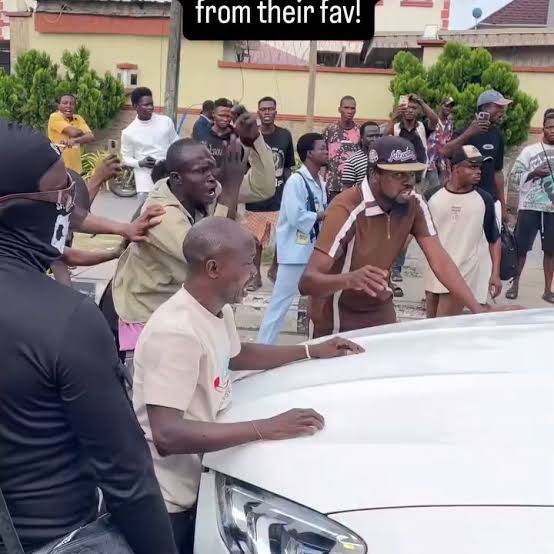
In Lagos, your wealth is a lighthouse and the car spotters are the ones who switch on the beam.
By August 2026, social media fame and street hustling clashed in a wild way after DJ Salt of Life (Hannah Aderibigbe), the younger sister of Afrobeats star Ayra Starr, said suspected local hoodlums (“area boys”) damaged her car after mistaking her for her famous sister.
Even though she wasn’t Ayra Starr, the crowd surrounded her car and chanted the singer’s name anyway, deciding the resemblance was close enough to demand cash.
This is the anatomy of a very modern Lagos crisis.

Along the Lekki-Epe expressway, car spotters film luxury cars to get views on TikTok and Instagram but without meaning to, they are tipping off street hustlers. Every camera flash tells the crowd a rich target is close by.
What started as a fun way for the wealthy to show off has turned into a dangerous scene.
The Lekki Corridor: Background Of The Crisis
The stretch between Marwa, Ikate Roundabout, Admiralty Way, and the Lekki-Ikoyi Link Bridge has become a localized theatre of class friction. Unlike the traditional agbero system, which mainly taxes commercial buses at structured motor parks, a newer, more aggressive strain of street youth now targets private luxury vehicles directly.
By March 2026, Lagos residents and commentators were already sounding alarms. A Punch editorial that month described hoodlums deliberately creating traffic bottlenecks by rolling tyres and obstacles onto the highway to manufacture fresh extortion opportunities, calling it a breakdown of the security system on one of Lagos’s flagship roads.
These extortion tactics are aggressive: people throw themselves in front of moving cars, bang on windows, and threaten to damage the vehicle if you don’t pay immediately. Locals call this illegal fee “Omotaku.” In March 2026, Lagos State used the same term when they arrested 25 “Omotaku” operators for harassing drivers in Lekki.
Case Study — Samuel Banks: In March 2026, content creator Samuel Banks went viral after street boys threw stones at his Mercedes-Benz on the Lekki Expressway and they cracked his windshield simply because he refused to pay them. What made it worse was that this had happened before. This was reportedly the third time his car was damaged at that exact spot as his first two cars were hit there, too.
In a video, Banks was seen grabbing one of the young men, warning him of trouble, and asking if he realized the flying glass could have hurt his passenger.
Case Study — DJ Salt of Life / Saltiana (Ayra Starr’s sister): In early August 2026, area boys allegedly surrounded her vehicle, chanting Ayra Starr’s name. She said the men wouldn’t let her leave unless she paid, warning that refusal often means a stoned car or broken glass. Her post went viral, reigniting nationwide conversation about how “looking wealthy” has become dangerous on Lagos roads.
Case Study — Peller & Jarvis’s Wedding (August 2, 2026): Nothing captured the chaos better than TikTok star Peller’s traditional wedding. Footage showed agberos blocking a Mercedes-Benz GLE headed to the ceremony, demanding “settlement” before letting it pass with the car nearly hitting one of them in the standoff. Days later, Peller revealed that “area boys” outnumbered his guests, surrounded the venue and stole several phones. Security forces eventually cleared the roads using military assistance, sparking angry online threats of revenge from local agberos.
Case Study — Bimbo Ademoye’s Film Set (April 30, 2026): Nollywood actress Bimbo Ademoye refused to be pushed around when men demanded a “shooting fee” mid-production. Her clapback went viral: she told them she was a “street girl” herself who settles people on her own terms, not when ordered to name a price. The standoff escalated when a man threatened to disrupt her camera equipment.
Not every encounter stays at the level of stones and shouting. In April 2026, a viral video showed young men running across lanes and medians on the Lekki axis with machetes and cutlasses in broad daylight, forcing motorists to swerve and pedestrians to flee.
The public outcry was immediate as Lagos State Commissioner for Environment and Water Resources, Tokunbo Wahab, confirmed that the Commissioner of Police, CP Tijani Fatai, launched a rapid sting operation between the Chisco and Osakpa bus stops, leading to the identification and arrest of a number of hoodlums.
The Lagos Police Command publicly assured residents it was “on top of the situation.” This incident is widely cited as the moment Lekki’s extortion crisis crossed from a public nuisance into a genuine security threat.
The Enablers: How Car Spotters Became Unwitting Scouts
Here’s the uncomfortable middle layer of this ecosystem: car spotting.
Around the world, car spotting is just a fun hobby where people take photos of rare and luxury cars but in Lagos, it’s a full-time hustle. Spotters hang out at busy roundabouts with smartphones, chasing supercars to post content for social media audiences obsessed with wealthy lifestyles.
The problem is that a crowd of spotters sprinting toward a car, screaming a driver’s name or the car model, functions exactly like a human siren.
And for nearby area boys, cameras flashing and a crowd forming signals one thing: money is close. What began as a love for cars has turned into extortion. Spotters draw the crowd, area boys trap the vehicle, and the driver is stuck between cameras on one side and threats on the other.
This is not simply a story of rich victims and poor aggressors but also a performance of power, on both sides.
In Lagos high society, just owning a luxury car isn’t enough to prove your status since what matters is how the streets react to you. If you drive through Lekki without anyone noticing, people view your wealth as invisible but if a crowd swarms your car, you are officially a “Big Boy.”
Social commentary across Nigerian entertainment media in 2026 has repeatedly pointed to elite drivers who slow down or roll down their windows in known extortion hotspots not out of fear, but to trigger a reaction they can film and post.
The most visible version of this is “spraying” which entails throwing wads of naira out of a car window and filming the scramble. It reframes a moment of street pressure into a display of benevolence, while turning genuine desperation into background content for someone else’s clout.
Lagos State has taken direct aim at this dynamic with Commissioner Tokunbo Wahab repeatedly and publicly warning residents and celebrities against handing cash to street touts. He said: “Each time you hand them cash, you are not solving their problem; you are encouraging them to stay on the streets, emboldening them to multiply, and reinforcing a cycle of lawlessness.”
He has also argued that what looks like kindness to residents actually makes enforcement harder and deepens both security and environmental risks.
This messaging has been reinforced throughout 2026 as the government intensified street enforcement, including a May 2026 operation that rescued 1,315 vulnerable persons and prosecuted 459 beggars through the state’s Mobile Court, and a July 2026 sweep that detained 396 street beggars in a single enforcement drive along Lagos Island and other axes.
This raises an obvious question: what does detaining beggars actually achieve? State records show most are just sent back to their home states rather than given lasting rehabilitation. However, critics warn this merely relocates the problem instead of solving it, leaving the cycle to repeat as soon as attention shifts elsewhere.
Why This Situation Persists
Despite arrests and public directives, the crisis hasn’t disappeared. Why?
• Poverty and unemployment at scale: Many of the youth involved are unemployed and unskilled, operating in an economy with few formal entry points. Some commentary points to a deeply ingrained street sentiment that if the wealthy are seen as having “taken more than their share,” extracting a “street tax” feels, to some, like informal redistribution, however illegal and dangerous it is.
• Migration and displacement: Government reporting has flagged that many of the children found begging or loitering on Lagos streets migrate in from other states, sometimes brought by adults who profit from their presence. Part of the deeper problem is that Lagos doesn’t actually know who is coming in. There’s no consistent system tracking new arrivals into the state, and the habitual practice of letting people settle in the city with no documentation makes it nearly impossible to separate a genuinely vulnerable migrant from someone being trafficked into street work. Enforcement can only catch people already on the street without an intake or documentation layer upstream, it can’t see them coming, which means local crackdowns alone can’t solve a problem with roots outside Lagos.
• Capacity strain: Even the state’s own rehabilitation infrastructure is stretched as the Majidun rehabilitation centre held over a thousand people undergoing therapy in a volume that ongoing sweeps continue to add pressure to.
Lagos State’s enforcement record through 2026 has been aggressive on paper:
• March 2026: 25 people arrested for harassing motorists on the Lekki axis, alongside 86 street beggars cleared from Agege and Ketu.
• April 2026: Multiple hoodlums arrested after the Chisco/Osakpa machete video went viral.
• May–July 2026: Over 1,700 combined arrests and rehabilitations across Lekki-Ajah, Addo Road, Ikorodu, and Lagos Island.
Critics argue that police arrests are only a temporary fix and without long-term solutions, clearing out these spots just pushes the extortion somewhere else, and the problem soon returns.
As a Punch editorial noted in early 2026, these hoodlums openly do drugs and threaten residents right in front of security guards. Their bold behavior shows they believe they are completely untouchable.
The public reaction to each new incident has followed a pattern: outrage, viral clips, government response, and then debate over who’s really to blame.
Some online commentary has bluntly asked whether Yoruba-populated Lagos communities are being unfairly stereotyped by the extortion narrative, while others place blame squarely on state failure to create jobs and social infrastructure for at-risk youth.
Media personality NaijaShimadun’s viral warning that Lekki risks becoming “the new Oshodi” captured a widening fear that the lawlessness once confined to commercial motor parks has migrated into one of the country’s wealthiest postcodes.
Meanwhile, victims like Samuel Banks and Peller have used their own platforms to publicly demand government accountability, turning personal grievance into pressure campaigns that force official responses within days rather than months.
What Would Actually Fix This?
Based on the patterns across 2026’s documented cases, possible solutions include:
1. Sustainable youth employment, not just periodic mobile court prosecutions. This is because arrests treat the symptom, not unemployment and lack of vocational access.
2. A formal production-and-filming permit system for Nollywood and content creators working in public spaces but only if it’s actually enforced. A paper permit without enforcement changes nothing, leaving filmmakers vulnerable to informal street shakedowns like Bimbo Ademoye’s. Replacing these ad-hoc payoffs with a structured, upfront permit fee would create an honest, accountable system that finally replaces unregulated extortion.
3. Regulating public influencer/celebrity conduct in known extortion hotspots in order to discourage the deliberate triggering of crowds for content, which some argue funds the very street economy the state is trying to dismantle.
4. Interstate coordination on migrant street youth, since Lagos-only enforcement can’t address origins outside the state.
5. Protected corridors with visible, consistent (not reactive) security presence along known flashpoints like Marwa, Ikate, and Chisco/Osapa rather than sting operations that only follow viral videos.
6. Data-recording influx: Lagos needs to track who enters the state and why, rather than relying on reactive arrests after people hit the streets. An overpopulated city cannot keep absorbing invisible arrivals, especially when so many end up homeless.
It’s easy to ignore this story if you don’t drive a luxury car through Lekki but that’s a dangerous mistake. While these extortionists used to target the rich, a recent daylight attack on Lekki Expressway on April 2026 showed men running through traffic with machetes, forcing ordinary drivers and pedestrians to scatter for safety, too.
If extortion isn’t stopped, it spreads to everyone. Rich people can pay for security or leave the country, but everyday Nigerians who use these roads every day will end up paying the biggest price.
Lekki was meant to be Lagos’s safest and most exclusive area, but it’s now seen as more dangerous than parts of the Mainland. Growing extortion in Lekki and Ajah is driving a real security crisis that threatens local businesses and the area’s reputation. That shift should worry everyone, not just the wealthy.
Here is the uncomfortable truth: everyone plays a part in this. Area boys use threats to demand cash and the car spotters help them do it, whether they realize it or not. Also, some rich drivers use the street’s poverty as a backdrop for their social media videos, turning desperation into views.
Lagos State is trying to step in, warning that throwing money to crowds feeds the chaos instead of helping.
But can police action really fix the problem when the bigger issues, like joblessness and lack of support for young people, stay the same?
So we’re asking you directly: Is this street-level extortion a symptom of Lagos’s inequality, or has it become its own predatory industry that deserves zero sympathy?
(Mojidelano Blog)
-

 Metro10 hours ago
Man threatens to release Kano governor’s nude videos, photographs
-
Sports10 hours ago
Harry Kane crowned 2026 Ballon d’Or winner
-
World News10 hours ago
Trump hits back at Obama over Saddam ‘Cheesecake Factory’ jab
-
Politics10 hours ago
‘He was trained in sanitation’ — Shettima says Atiku can’t govern modern economy
-
News10 hours ago
OPHK troops destroy ISWAP enclaves in Lake Chad, kill 16 terrorists
-
Business10 hours ago
Microsoft offers voluntary exit packages to 60,000 staff
-
Politics10 hours ago
2027 Elections: 103m voters, 35m votes and the 68% who may decide the Presidency
-
 News9 hours ago
Economic summit: Tinubu cites growth, capital inflows as reform gains