Politics
As Campaign Begins: Billboard Permit Fees Rattle Candidates

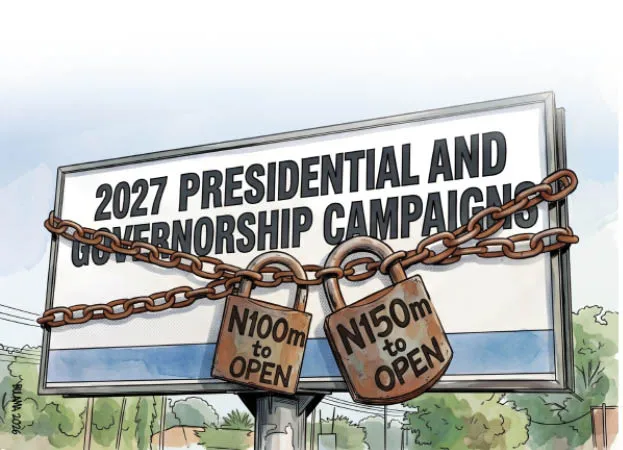
With the commencement of campaigns for presidential and National Assembly elections on Wednesday, it is obvious that all the instruments for attracting public interest in candidates will be deployed to create visibility and sustain the interests of voters ahead of 2027.
The Independent National Electoral Commission (INEC) has cleared 19 presidential candidates so far to contest in the January 2027 general elections.
The publicity instruments to be deployed from previous experiences include roadside shows, rallies and both live and recorded campaigns, which would be facilitated with the use of handbills, flyers, posters, billboards, jingles and advertisements in various media platforms.
Our correspondents report that even before the official commencement of campaigns, especially during the primary elections across the states, various towns and villages had a taste of what lies ahead as streets were littered with posters and billboards of aspirants.

Weekend Trust notes that while there have not been substantial interests in some other forms of campaigns, many state governments have had their policies on billboards reviewed in what many fear might be an attempt to stifle the opposition.
Our correspondents report that even before the lifting of the ban on campaigns, some state governments had fixed what the opposition and analysts described as outrageous fees to secure a permit for placement of billboards.
Some of the politicians said the decision might not be informed by the need to generate revenue alone but to scare opposition candidates, who may not have access to funds.
Several states, including Abia and Anambra, recently introduced significant permit fees for political campaigns, raising concerns that politicians are being forced into a costly bidding war for visibility ahead of future elections.
The controversy comes at a sensitive time for the President Tinubu administration, which faces mounting public criticism over its economic policies.
Prior to the 2015 elections, Weekend Trust recalls that no less than 161 billboards were mounted at strategic places in Abuja for then President Goodluck Jonathan, urging him to seek re-election as president.
N75m for presidential billboards in Rivers
Rivers State is charging N75 million for erecting presidential candidates’ billboards and N50 million for governorship billboards ahead of the next general elections in the state.
A reliable source at the Office of the Special Adviser on Political Affairs to the governor told Weekend Trust that the price is being pegged to curtail the indiscriminate erection of billboards in Port Harcourt, the state capital.
Price difference was also noticed in local government areas. Abua/Odual Local Government fixed N70 million and N50 million for presidential and governorship candidates respectively.
The Abua/Odual Local Government Legislative Assembly recently passed a political campaign (outdoor advertising and signages) regulation by-law, 2026, which has consequently been assented to. It is to provide a comprehensive regulatory framework for outdoor advertising and signages for political campaign purposes within the local government area.
The Chief Press Secretary to the Chairman of Abua/Odual Local Government, Eeguode Sampson Iyabi, noted in a statement that the by-law was principally aimed at curbing indiscriminate posting, pasting, erection, mounting and display of political campaign posters, banners, billboards, signages, hoardings and other outdoor campaign materials, while promoting orderliness, public safety, environmental cleanliness and responsible use and protection of public and private property.
Accordingly, the by-law establishes a mandatory permit regime for political campaign outdoor advertising and signages. In particular, Section 6 requires a valid council permit before any political campaign poster, banner, signage, billboard, hoarding or other outdoor campaign material can be displayed within the local government area.
“The First Schedule to the by-law prescribes permit fees in respect of political campaign outdoor advertising and signages, with presidential campaign at N75 million; governorship, N50 million; senatorial, N30 million; House of Representatives, N20 million; chairmanship; N15 million; House of Assembly, N10 million and councillorship, N1 million,” it stated.
However, unlike other states, the fee is very low in Kano. At N1.1 million, Kano makes no distinction between campaign or commercial billboards. The Kano State Signage and Advertisement Agency, created by Governor Abba Kabir Yusuf in 2025 to regulate outdoor advertising, signage placement and brand promotion, said it did not make a distinction between political campaigns and commercial billboards in its regulations at the moment.
When contacted, the Director of Public Enlightenment of the agency, Munzali Muhammad Hausawa, told our correspondent that the signage agency only deals with APCON-registered companies to grant approval for the erection of billboards in the state, be it commercial or otherwise.
According to him, what obtains in Kano is that politicians would approach an advertising practitioner or firm who would pay the appropriate fees (administrative and annual rate), which amounts to N1,150,000.
There were speculations that the Federal Capital Territory Administration (FCT) put a N750 million fee on billboards. A publisher and politician, Dele Momodu, raised the alarm over the claim, but Lere Olayinka, the Special Assistant on Media to the FCT Minister, Nyesome Wike, dismissed it as “political propaganda common during election seasons.”
Kogi pegs N150m for presidential candidates
The Kogi State Government, on Tuesday, August 11, approved fees to, among other things, regulate political advertising across the state, ensure compliance with existing signage regulations and generate revenue for the development of the state.
According to the Commissioner for Information and Communication in the state, Kingsley Fanwo, the approved fees serve as bills for placement of billboards, posters, branded T-shirts, caps and other campaign materials by political parties and candidates and parties contesting the upcoming elections in the state.
The announced fees include N150 million for presidential candidates, N50 million for senatorial candidates, N30 million for House of Representatives candidates, N5 million for State House of Assembly candidates.
Also, N2 million was approved for chairmanship candidates and N300,000 for councillorship candidates for the October local government election in the state.
The state government stressed further that placement of campaign materials without payment of the prescribed fees and non-compliance with the relevant regulations would constitute an offence.
“Defaulters or anyone found aiding or facilitating such violations would be prosecuted. The regulations apply to all political parties and candidates without exception, including candidates of the ruling All Progressives Congress (APC),” Fanwo noted.
The general manager of the Kogi State Signage and Advertisement Agency (KOSSAA), Mr Richard Osaseyi, said the agency would commence full enforcement of the regulations. He urged political parties, candidates, campaign organisations and billboard operators to register with the agency and obtain the necessary approvals before erecting or displaying campaign materials anywhere in the state.
However, the Peoples Democratic Party (PDP) in the state has rejected the campaign signage and promotional fees, describing it as an attempt to shut down opposition.
The chairman of the party in Kogi State, Mohammed Gambo, argued that the regulatory charges should be fair and proportionate and not a decision that would undermine expenditure limits prescribed by the electoral law.
He added that while the government has the right to regulate commercial signage and the use of public advertising infrastructure, it should exercise caution in regulating the personal political expression of citizens.
“Elections are contests of ideas, service and the will of the people. Government’s regulation must never become a financial barrier capable of determining who can effectively communicate with the electorate
“Sections 39 and 40 of the constitution guarantee freedom of expression and peaceful association, including political association,” the PDP chairman said.
Gambo therefore urged the government to review the fees and convene a meeting with registered political parties and other stakeholders to agree on a more reasonable framework to service the signage fee.
Kaduna: Fees depend on location of billboards
In Kaduna State, a source at the Kaduna State Urban Property Development Agency (KASUPDA) explained that while there’s no fixed payment before the process starts, intending campaigners must show that they intend to erect the billboard before being given a space and the amount to pay.
“So far, we have not disclosed any fixed amount for putting up a billboard. The person has to come and show us the location he wants to erect it. We will then assess it and tell him the applicable fee, whether it is for a political billboard or advertisement of a product,” the agency said.
The Bauchi State Government, through its agencies – Bauchi State Infrastructure Development and Maintenance Agency (BASIDMA), Bauchi State Physical Planning and Development Control Board, Bauchi State Environmental Protection Agency (BASEPA) and Board of Internal Revenue – had last June ordered the removal of all campaign billboards, banners and posters mounted on streetlights, utility poles and major flyovers across the state as part of efforts to restore urban order and improve environmental aesthetics.
The general manager of the BASIDMA, Muhammad Ibrahim, gave political parties and their supporters a one-week ultimatum to remove the materials, warning that enforcement teams would remove any campaign materials that remained after the deadline.
But in a swift reaction, the People’s Redemption Party (PRP) issued a three-day ultimatum to the state government to remove campaign materials of the Allied Peoples Movement (APM) from public infrastructure across the state or face legal action.
In a statement signed by its state chairman, Abdurrahman Yusuf Muazu, the PRP alleged that the ruling party in the state had ignored the directive.
“The PRP is alarmed and dismayed by the selective and one-sided enforcement of the so-called ban on posting of campaign materials on public infrastructure.
“While the Bauchi State Government issued an ultimatum last month for all political parties to remove billboards, banners and posters within a specified timeframe, it has come to our notice that the ruling party, the APM, has flagrantly disregarded this directive.
“They have continued to display their logos, colours and insignia across numerous public infrastructures throughout the state,” Muazu stated.
He alleged that Kofar Gombe Gate, Kofar Nassarawa and Kofar Ran were among public facilities where APM campaign materials had been mounted or pasted.
“This blatant favouritism and inconsistent enforcement undermine the principles of fairness, equity and the rule of law that should govern Bauchi State. Notably, sections 92-95 of the Electoral Act strictly prohibit such conduct, yet the APM’s displays remain untouched,” he added.
When contacted through a telephone interview, the general manager of the Bauchi State Physical Planning and Development Control Board (BSPPDCD), Ibrahim Muhammad, said the agency saddled with the responsibility was yet to announce the approved fees for political campaign billboards in the state
He added that the BSPPDCD was concerned about the locations of campaign billboards across the state, adding that the exercise was carried out by joint agencies. He said the agency handling the fees would soon be made public.
Abia, Anambra, others fix amounts
In Abia, the fee for erecting presidential billboards stands at N200 million; governorship: N150 million; senatorial: N100 million; House of Representatives: N50 million; State Assembly: N20 million.
In Anambra, a permit for presidential billboards would cost N50 million; senatorial: N20 million; House of Representatives: N5m and State Assembly: N1.5million.
In Cross River, presidential billboard fee costs N150 million, while governorship is N100 million. In Enugu, a reported N150 million fee applies before candidates can deploy campaign materials, erect or use billboards, or operate branded campaign vehicles.
ADC, NDC condemn ‘arbitrary’ fees
The African Democratic Congress (ADC) has vowed to challenge the high fees on the placing of billboards in several states across the country.
Bolaji Abdullahi, the national publicity secretary of the party, stated this while reacting to enquiries by Weekend Trust. The party alleged that the move in some of the states was targeted at stifling the opposition.
In a terse message to Daily Trust, Mallam Bolaji Abdullahi wrote, “It is certainly targeted at the opposition. And we are going to challenge it.”
The Nigeria Democratic Congress (NDC) also condemned what it called the arbitrary increase in the amount required to mount political campaign billboards by some state governments ahead of the 2027 polls.
Speaking to one of our correspondents on the phone, the party’s director of publicity, Ossai Director, described such increases as undemocratic and unacceptable.
He said the move by some of the states, which are mostly controlled by the All Progressives Congress, is another act by the ruling party to muzzle the opposition ahead of the polls.
‘’Did you hear this kind of unjust action when the Peoples Democratic Party was in power? This shows that the APC and some of its state governments are already jittery, intimidated and afraid, even before the elections,’’ he said.
Director said the party would not pay such money, which, according to him, will end up in individual pockets, noting that there are other various multi-media channels with which the party reaches the electorate.
He said the party was still studying those arbitrary increases and would not hesitate to go to court if the need arises.
Billboards tax ill-timed, could be used to stifle opposition — Prof Fage
A political scientist, Professor Kamilu Sani Fage of the Bayero University, Kano, has criticised the decision by some state governments to impose fees on politicians for placing campaign billboards, describing the policy as unfair and politically motivated.
He noted that while billboard taxation had long existed in states like Lagos, the timing and manner of its enforcement ahead of elections raised concerns. He argued that the measure could be exploited to stifle opposition parties.
“For state governments to introduce it in the name of generating revenue, I believe there are certain sinister political motives. Opposition parties may not be able to pay such money, while ruling parties are often exempted,” he noted.
The professor warned that the policy could deny opposition candidates the opportunity to showcase their programmes, thereby undermining democratic principles. He stressed that democracy required a level playing field where all parties are treated equally.
“Even if the intention is revenue generation, politicians will abuse it. They will use it to gag opposition parties, who may end up being squeezed or dragged to court for violations,” he added.
Fage further observed that ruling parties, even when compelled to pay, would likely draw from public funds rather than personal resources, creating what he described as a “double dip.”
With elections only months away, he cautioned that the policy risked tilting the political space in favour of incumbents.
“It is wrong to introduce such measures now. Ruling parties will continue to display their candidates while opposition parties are denied the same opportunity,” he noted.
We have no hand in billboard fees – APC
The publicity secretary of the ruling APC, Felix Morka, could not be reached on the phone yesterday, but a chieftain of the party told one of our correspondents that the conditions and amount required to mount political campaign billboards lay solely on state governments, and in some instances, local governments.
He said it had nothing to do with political parties or even the federal government.
“Where there should be an issue is when a political party or candidate is denied a chance to mount such billboards even when they have the money to pay the stipulated fees. But the amount to be paid solely depends on the state or local government as the case may be. That is why you see that the amount is not uniform across the states,” he noted.
‘Timing is curious’
Speaking on the issue, the Global Director of Brain Builders Youth Development Initiative (BBYDI), Olasupo Abideen, said: “The placement of billboard fees across several states could be viewed from the government’s perspective as a revenue generation measure. Nigerians should scrutinise the timing and long term objectives of the initiative,”
He said the key questions should be “why the policy is being introduced at this time, what the government hopes to achieve with it and whether adequate stakeholder engagement preceded its implementation.”
Abideen said that while governments may genuinely seek to generate revenue through their advertising and promotional agencies, “there could also be concerns that the measures may restrict opposition parties from accessing publicity to communicate their manifestos and programmes to the electorate.”
He, therefore, called for greater “scrutiny of the rationale behind the charges, the process through which they were introduced and their likely implications for political competition ahead of the 2027 elections.”
On his part, the Director, Media Advocacy and Technologies Centre (MATEC), Malam Musa Aliyu, said it was unfortunate that the ruling party was allegedly using different means to limit the visibility of opposition parties, particularly during campaigns.
Aliyu identified “exorbitant charges” for billboard placement as one of the measures capable of restricting opposition parties from effectively communicating their messages to the electorate.
He acknowledged that billboard fees could serve as a legitimate source of revenue for governments, but cautioned that the pursuit of revenue should not be allowed to undermine political competition or create an uneven playing field for political parties.
According to him, the situation becomes particularly problematic when the charges run into hundreds of millions of naira, making it difficult for opposition parties to afford prominent advertising spaces where voters can see their candidates, programmes and campaign messages.
He questioned the rationale behind imposing such financial burdens on parties seeking to challenge those in power, arguing that access to political visibility should not become a privilege reserved for parties with greater financial resources.
He warned that measures that make it excessively difficult for opposition parties to reach voters could gradually weaken democratic competition, regardless of whether they were presented as revenue generation or regulation.
“This is one of the ways through which politicians endanger Nigeria’s democracy. It is not good for democracy,” he said.
A public relations expert and mass communication lecturer, Balarabe Sa’ad, said politicians had shown a preference for the use of billboards of its strategic advantage.
He said, “Within the context of what radio represents for its audiences and for those who use it for messaging, it is quite true that listenership is dwindling.”
He said using pictures relating to political campaigns or political communication were not getting the kind of attention or traction jingles are getting because lyrics contain more power over the audience.
“The question to ask now is: If we undermine the power of radio, how many people are watching television too, especially in an era where content has shifted digitally to social media. So, even on social media, how much time can people spend? This is because they think of their data. If you want to watch a graphic video, the ordinary poor person thinks that video would consume more data, so he doesn’t want to give it the kind of attention somebody can give a lighter medium that is more relatable,” he explained.
Another analyst said while the jingles, posters and flyers could fizzle out easily, billboards could stand for a long period of time unless they are removed.
The durability of billboards, come rain or shine, coupled with the fact that they are placed in strategic parts of the town according to publicists, is what makes it the number one choice of campaign instruments deployed by politicians.
In Enugu, N150m fee applies before candidates can deploy campaign materials, erect or use billboards, or operate branded campaign vehicles.
The Anambra State Government, through the State Signage and Advertisement Agency, has unveiled permit fees for political campaigns ahead of the 2027 general elections.
A presidential candidate will pay N50m, while a senatorial candidate is charged N20m for outdoor campaign activities. Under the arrangement, House of Representatives candidates will pay N5m, House of Assembly candidates N1.5m, local government chairmanship candidates N2.5m, while councillorship candidates will pay N100,000 before being allowed to campaign in the state.
Campaign spending limits for 2026
The maximum amount a presidential candidate can spend on election expenses has been doubled from N5 billion in the 2022 Electoral Act, which governed the 2023 general elections, to N10 billion under the Electoral Act 2026.
The new limit is contained in Section 92(2) of the Electoral Act 2026, compared with Section 88(2) of the Electoral Act 2022. Section 92 (1) of the new law states that “Election expenses shall not exceed the sum stipulated in subsections (2)-(7).”
It subsequently provides in Section 92(2): “The maximum election expenses to be incurred by a candidate at a presidential election shall not exceed N10,000,000,000.”
Under the Electoral Act 2022, the corresponding provision in Section 88 (2) states: “The maximum election expenses to be incurred by a candidate at a presidential election shall not exceed N5,000,000,000.”
The increase means that the statutory spending ceiling for presidential candidates has risen by 100 per cent ahead of the 2027 general elections. The Electoral Act 2022 was the legal framework for the 2023 elections.
The increase is also significant at the governorship level, where the spending ceiling has risen from N1 billion under the 2022 Act to N3 billion under the 2026 Act.
Section 92(3) of the new Act provides: “The maximum amount of election expenses to be incurred by a candidate in respect of a governorship election shall not exceed N3,000,000,000.”
The corresponding Section 88(3) of the 2022 Act prescribes a maximum of N1 billion for a governorship candidate.
For the National Assembly, the new law also significantly raises the limits. Section 92(4) provides that: “The maximum amount of election expenses to be incurred by a candidate in respect of senatorial and House of Representatives election shall not exceed N500,000,000 and N250,000,000 respectively.”
Under the 2022 Act, the limits were N100 million for a senatorial candidate and N70 million for a House of Representatives candidate.
This represents a five-fold increase for senatorial candidates and an increase of more than three-and-a-half times for House of Representatives candidates.
The spending ceiling for State House of Assembly candidates has also risen from N30 million under the 2022 Act to N100 million under the new law.
For area council elections, the chairmanship spending limit has increased from N30 million to N100 million, while the councillorship ceiling has doubled from N5 million to N10 million.
The new law, therefore, sets the spending limits at N10 billion for presidential candidates, N3 billion for governorship candidates, N500 million for Senate candidates, N250 million for House of Representatives candidates, N100 million for State House of Assembly candidates, N100 million for area council chairmanship candidates and N10 million for councillorship candidates.
The National Assembly lists the Electoral Act 2026 as the legislation regulating the conduct of federal, state and area council elections.
Campaign regulations not part of Electoral Act – Lawyer
A constitutional lawyer, Kehinde Oloje, told Weekend Trust that the amended Electoral Act does not contain a specific section explicitly mandating or prohibiting the physical placement of billboards in public spaces. He said that instead, the regulation of campaign billboards is governed by the state/local government urban planning laws.
According to him, while the Act is silent on the specific location of billboards, it regulates the nature and timing of political advertisements, which include the prohibition of campaigning near polling units. He added that while the Act does not explicitly use the word “billboard,” it mandates a peaceful environment for voting.
It is generally interpreted by INEC that no campaign material—including posters and banners—is permitted within the immediate vicinity or perimeter of a polling unit on election day.
He added that the Act provides that campaigns in public must commence 150 days before polling day and end 24 hours prior to the election.
“Any billboard advertisement that promotes or opposes a candidate during the prohibited 24-hour window before an election constitutes an offence under the Act,” he added.
He said Section 92 of the Act states that political campaigns and advertisements (including those on billboards) must not use abusive language, religious or tribal slurs that are likely to promote ethnic or religious hatred.
The lawyer explained that because the Electoral Act does not provide zoning laws for outdoor advertising, billboard placement is primarily subject to state and local government regulations.
He said some of the regulatory bodies included state signage agencies.
According to him, agencies such as the Lagos State Signage and Advertisement Agency (LASAA) or the FCT Department of Outdoor Advertisement and Signage (DOAS) dictate where billboards can be placed, the size permitted and the required permits/fees.
He added that local municipal bylaws determine which areas are designated for commercial advertising, and that political parties must obtain permits from these local authorities to use designated billboard spaces.
He said most states had laws prohibiting the pasting of posters on public infrastructure (bridges, trees, traffic lights).
Violating these local environmental or sanitation laws, he added, can lead to the removal of materials and fines, independent of the Electoral Act.(Daily trust)
-

 News15 hours ago
Tinubu Confirms Absence From UNGA, Asks Shettima To Lead Nigeria’s Delegation
-
Metro9 hours ago
My wife miraculously woke up after six months in coma – Akpabio
-
Politics9 hours ago
Presidential Campaign Council: We don’t need your validation – OK Movement replies NDC
-
Politics9 hours ago
2027: Remo group warns sons against breaking Ogun zoning pact
-
Politics9 hours ago
2027: I’ll Never Spend Holidays Abroad If Elected – Obi
-
Politics9 hours ago
Tinubu deserves second term, says Mimiko
-
News9 hours ago
Former Kogi governor Ibrahim Idris dies at 77
-
Business9 hours ago
CPPE raises concern over foreign traders’ growing presence in Nigeria’s retail sector