Opinion
Sanwo-Olu: From a promising start to a troubling finish

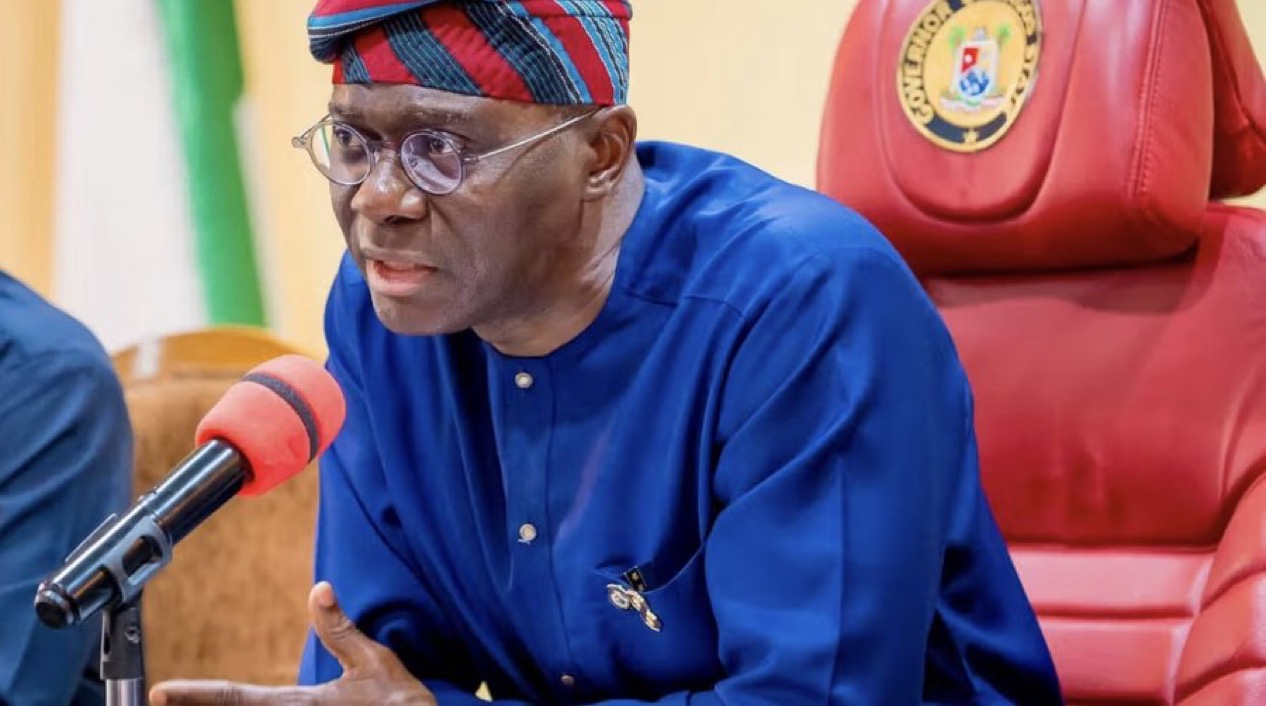
Governor Babajide Sanwo-Olu still has about nine months to vacate office as Lagos State governor but, as social media commentator Balogun Olamilekan puts it, it increasingly appears that the governor has mentally signed out or technically handed over the reins of government. He started well, but unfortunately, he appears to be ending badly. And that will not be good for his name or legacy.
Every day, in a state that prides itself as the “Centre of Excellence”, we are inundated with reports of terrible roads, heaps of refuse littering the streets and, most disturbing of all, residents who are simply trying to survive being attacked in broad daylight by street urchins demanding money. They knock on your car window and ask you to wind down and give them money. If you refuse, they smash your windscreen or side mirrors and, in some cases, inflict injuries on you.
That is not excellence. That is, at best, anarchy.
I first met Sanwo-Olu on September 27, 2018. Five of us political editors were invited to a media briefing by Tayo Ayinde, the current chief of staff to the governor, who was then the Director-General of the Babajide Olushola Sanwo-Olu Campaign Organisation (BOSCO). Gboyega Akosile, the current special adviser on media and publicity to the governor, facilitated the meeting.

During the interview with Ayinde, Sanwo-Olu walked in and had a brief conversation with us. He spoke passionately about the deplorable state of Lagos under Akinwunmi Ambode, particularly the heaps of refuse that had become a major issue across the state, and promised to tackle the problem head-on.
The following day, I wrote a news report titled, “Ambode Has Made Himself Emperor in Lagos – Sanwo-Olu”. The report is still available online.
The events leading to the governorship primary were anything but pleasant. The battle between Sanwo-Olu and Ambode was acrimonious, and the eventual emergence of Sanwo-Olu was followed by Ambode’s concession.
Yet, shortly after assuming office, Sanwo-Olu surprised many people who had expected him to dismantle the projects of his predecessor. Instead, he continued several of them and ensured their completion.
That, for me, was one of the things that distinguished him.
He won my heart, and that of many Lagosians, when he maintained a cordial relationship with Ambode and, more importantly, successfully reconciled his predecessor with President Bola Tinubu. It was an impressive demonstration of political maturity at a time when the easier option would have been to permanently shut the door on Ambode.
Another area where Sanwo-Olu earned my admiration was in the quality of some of the people he appointed into his government. Many were professionals and experts in their respective fields. His administration, particularly in its early years, gave the impression of a government that understood the importance of putting competent people in the right positions.
One of those appointees is Akosile, whom I had earlier mentioned.
When Akosile took over as the governor’s spokesman from Habib Aruna, who had served as Ambode’s Chief Press Secretary, many expected him to dispense with the media assistants who had worked in the office under his predecessor. He did not.
Instead, he made efforts to accommodate them. And where he could not retain some of them, he helped to find opportunities for them elsewhere. That was a commendable gesture and one that demonstrated that political transition did not necessarily have to translate into a personal vendetta.
I have many friends within the Sanwo-Olu administration. But friendship cannot become a reason to abandon professional responsibility or pretend that everything is fine when it is not.
And this is where my assessment of the governor has changed.
Lagos is in a mess under Sanwo-Olu, and, more worrying still, it appears to be getting worse. In some respects, the situation today evokes memories of the problems that characterised the twilight of Ambode’s administration.
Take the refuse crisis, for instance.
Heaps of refuse are not merely an aesthetic nuisance. They constitute a serious public-health risk. Yet the state government appears increasingly helpless in dealing with the problem.
On June 18, 2026, the state government issued a statement titled, “Sanwo-Olu Directs Waste Evacuation Across Lagos”. In the statement, the government acknowledged residents’ concerns over the accumulation of refuse in parts of the state and assured Lagosians that the situation was receiving the “highest level of attention” from the governor and the entire machinery of government.
But from that statement until now, the situation appears to have deteriorated further. Streets and roads in several areas have increasingly become illegal dumpsites.
So, one is forced to ask: Is Sanwo-Olu still in charge?
This is not a question I expected to be asking at this stage of his administration.
In January 2024, when an online news platform published an exclusive report titled, “Sanwo-Olu Abandons Work, Secretly Attends Multi-Billion Naira Party in Grenada”, I was one of those who defended the governor.
My argument then was simple: being governor should not deprive anyone of the opportunity to take some time off, unwind and enjoy life. Governors are human beings too.
I do not think I can make the same argument today.
Not because a governor is forbidden from taking a break, but because it is increasingly difficult to separate the perception that Sanwo-Olu is winding down from the visible deterioration in the quality of governance across the state.
Even more disturbing is the growing menace of street urchins and area boys.
Residents are now being confronted in broad daylight by people demanding money. Motorists are stopped and harassed. Those who refuse to comply risk having their windscreens or side mirrors smashed. Some are physically attacked.
How did Lagos get to this point?
The governor needs to urgently confront this menace. He should perhaps go to his predecessor, Babatunde Fashola, for tutorials on how to deal with street urchins, touts and other forms of urban disorder. Fashola governed Lagos from 2007 to 2015 and confronted several of these challenges with a level of firmness that appears to be missing today.
I must, however, acknowledge that the Sanwo-Olu administration has made efforts to address the menace of Omotaku, Omo Onile and people who deliberately dump refuse on roads and in drainage channels. But the scale of the problem demands far more than occasional enforcement exercises. It requires sustained political will.
The same applies to security.
The Lagos State Commissioner of Police, Tijani Fatai, should also be asked to do his job. The governor and the Inspector-General of Police, Tunji Disu, must demand more from the police leadership in Lagos.
The commissioner was recently sighted at the launch of the pro-Tinubu City Boy Movement in Lagos. There is nothing wrong with the police maintaining relationships with political leaders or attending public events. But at a time when ordinary Lagosians are being harassed by street gangs in broad daylight, the police leadership should be seen spending more energy assuring residents that their lives and property are protected.
If the commissioner knows he cannot protect Lagosians, then he should quit policing and become an aide to politicians.
Lagos is constantly touted as a megacity. But parts of it are increasingly looking like a mega slum.
This is not the Lagos Sanwo-Olu promised when he begged for the job in 2019.
It is also not the Lagos that made many of us support him in the first place.
The governor still has time to change the narrative. He has about nine months left in office, and nine months is a long time in politics. He can still tackle the refuse crisis, fix more roads, restore order to the streets and make residents feel safe again.
What he must not do is allow the final months of his administration to create the impression that he is tired, distracted or simply waiting for his successor to take over.
He begged and campaigned for this job. Lagosians gave him the opportunity to serve for eight years.
He should therefore do the job — and do it well — until the very last day.
President Bola Tinubu lost Lagos State during the 2023 presidential election. I hope Sanwo-Olu’s current performance does not contribute to a repeat of that outcome in 2027.
More importantly, I hope the governor himself understands that his legacy is not yet written.
Sanwo-Olu started well. He earned goodwill. He demonstrated political maturity in dealing with Ambode. He appointed competent people and, in many instances, showed that governance could be about more than settling political scores.
But a good beginning is not enough. Sanwo-Olu should endeavour to finish strong. He is on the final lap of his marathon and cannot afford a bad ending. He should rescue his legacy now. There is too much at stake to do otherwise.
Temidayo Akinsuyi, former group politics editor of the Daily Independent, is a member of the Society of Editors, United Kingdom. He can be reached via shabydayo@gmail.com.
-

 News14 hours ago
FAAC bonanza: Govs face questions as payouts hit N47tn
-
 Sports14 hours ago
‘Osimhen can end Man United’s woes
-
Business14 hours ago
NUPRC gives 31 oil block winners payment deadline
-
News14 hours ago
New ‘Phantom’ Agency Courts SGF, Govs
-
 Metro14 hours ago
How My Husband, 2 Children Died After Eating Amala – Widow
-
Politics13 hours ago
Tinubu Withdraws APC Campaign Team List Amid Controversy Over 2027 Council
-
 Politics14 hours ago
Concerns Over Inclusion Of Betta Edu, Others In Tinubu’s Campaign Council
-
News15 hours ago
Imo: Two killed as DSS rescues kidnap victim, foils N15m ransom demand