Politics
Subsidy: Between Tinubu, Atiku, Obi

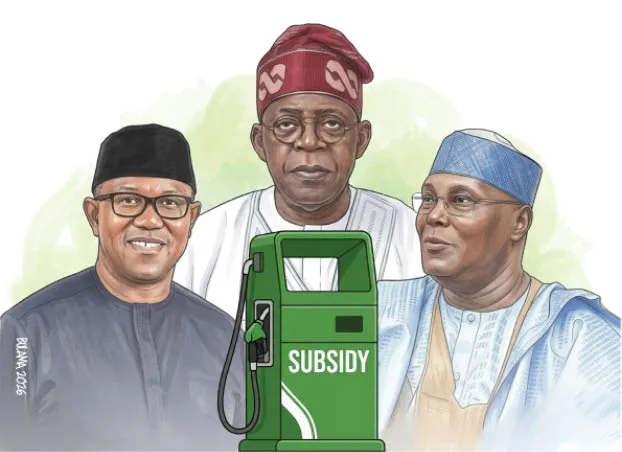
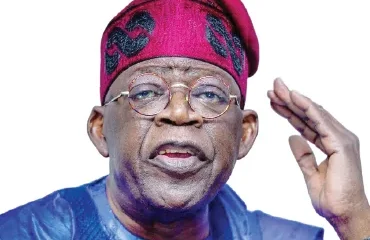
The removal of petrol subsidy by the President Bola Ahmed Tinubu’s administration has become one of the most consequential economic decisions of the federal government in recent years, altering the cost of transportation, food and household consumption across Nigeria.
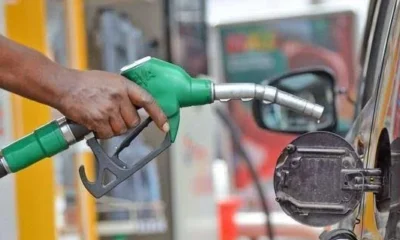
Since the policy was announced in President Tinubu’s inaugural address on May 29, 2023, petrol prices have risen sharply, with the consequences spreading through virtually every segment of the economy.
The government defended the decision as necessary to save Nigeria from fiscal collapse, arguing that the subsidy regime consumed resources that could have been deployed to infrastructure, health, education, agriculture and other productive sectors. But for millions of Nigerians, the immediate experience has been rising living costs.
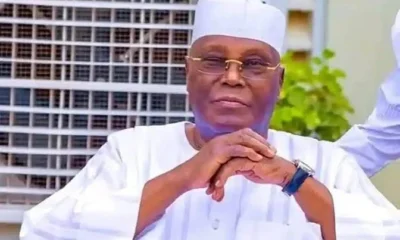
The controversy has now assumed a new political dimension, with former Vice President and presidential candidate of the African Democratic Congress (ADC), Atiku Abubakar, proposing a redesigned subsidy regime if elected president in 2027.

Peter Obi, the presidential flag bearer of the Nigeria Democratic Congress (NDC), agrees with subsidy removal but argues that the proceeds should have been better managed and reinvested for the benefit of Nigerians.
The positions have thrown up a fundamental question ahead of the 2027 general elections: should Nigeria return to subsidising petrol, or retain the subsidy-free regime while ensuring that the gains are properly invested?
What Changed?
Three years after “subsidy is gone,” President Tinubu continues to defend the decision as a necessary economic intervention.On May 29, 2026, when he hosted state governors who visited him to celebrate Sallah and the third anniversary of his administration, the president said subsidy removal saved Nigeria from imminent bankruptcy.
He acknowledged that the decision was difficult and painful but argued that it was necessary to rescue the country from fiscal collapse and restore economic stability.
“It was challenging at the time, but we survived. We face litigation and accusations. We survived them. Instead of bankruptcy, Nigeria has survived. The economy has recovered. It is growing. Agriculture is booming,” he said.
According to the president, Nigeria had spent enormous resources for years on subsidy payments that were unsustainable and benefited only a few, while depriving critical sectors of needed investment.
He also pointed to ongoing reforms in infrastructure, agriculture, social investment, foreign exchange management and fiscal discipline as evidence that the difficult phase of the reforms was beginning to produce results.
“I’m glad governors are no longer borrowing from the federal government and asking for interventions and not knowing how to survive, how to pay salaries, no more,” Tinubu said.
The president said states had been able to improve their finances because of increased revenue following the reforms.
For the administration, the central argument is that Nigerians have endured short-term pain in exchange for a more sustainable fiscal system.
Finance Minister Taiwo Oyedele, in a recent press briefing, said savings from petrol subsidy yielded N15.8 trillion between June 2023 and December 2025.
According to Oyedele, of the N15.8 trillion mobilised from subsidy removal and foreign exchange adjustments, the federal government received N5.4 trillion while N10.4 trillion was shared with state and local governments.
He said the government spent N9.39 trillion on wage adjustments, minimum wage increases and allowances for public servants between June 2023 and December 2025, after the national minimum wage was raised from N30,000 to N70,000.
He added that this incremental wage bill alone exceeded the federal government’s entire share of resources realised from the removal of the petrol subsidy.
Oyedele said the federal government’s total incremental resources during the period — including reform proceeds, additional revenue and new borrowing — amounted to N20.4 trillion, while incremental expenditure reached N30.64 trillion.
He linked the surge in wage spending to post‑reform adjustments, noting that the subsidy removal had pushed up petrol prices and added to household and business costs. Oyedele acknowledged the reforms’ burden on Nigerians but said the administration had taken measures to cushion the impact.
But the opposition has questioned whether the sacrifice has translated into sufficient benefits for citizens.
Following the subsidy removal, President Tinubu promised to roll out mass transportation schemes to ease the burden on Nigerians and provide cheaper alternatives to petrol-powered transportation.
The administration embarked on the Presidential Compressed Natural Gas Initiative (Pi-CNG), amid expectations from many Nigerians that CNG-powered vehicles and other mass transit interventions would translate into cheaper transportation within a short period.
However, almost three years into the administration, transportation costs remain a major burden for households, particularly low-income earners, as the government is still falling short of its CNG infrastructure targets.
The Pi-CNG initiative claimed that more than 120,000 vehicles had been converted to CNG, while more than 200 conversion centres and about 90 refuelling stations had been established.
The mass transit component has also seen the deployment of CNG and electric buses on selected routes, as well as subsidised or free bus services during peak travel periods. Despite these interventions, the impact on the cost of commuting remains limited for many Nigerians.
The cost of removal
The latest figures from the National Bureau of Statistics (NBS) illustrate the continued pressure on commuters. The NBS said the average fare paid by passengers for bus journeys within Nigerian cities rose to N1,431.25 per trip in May 2026, up 2.43 per cent from N1,397.27 recorded in April. Compared with May 2025, the average intra-city bus fare increased by 38.63 per cent from N1,032.46.
The NBS Transport Fare Watch report also recorded increases in fares for intra-city buses.
According to the report, the average intercity bus fare rose to N9,699.55 in May 2026 from N9,607.41 in April, representing a 0.96 per cent monthly increase and a 21.89 per cent increase from N7,957.41 recorded in May 2025.
A September 2025 assessment published by the International Journal of Management, Social Sciences, Peace and Conflict Studies (IJMSSPCS) similarly found that the policy had produced both gains and significant hardships.
The study credited the policy with increasing government revenue, enhancing competition among oil refining businesses and facilitating measures such as scholarships, mass transit options and other palliatives.
However, it said the rise in the prices of goods and services had exceeded the expectations of economically disadvantaged Nigerians, resulting in job losses and other social problems.
The study argued that the government’s failure to implement sufficient mitigating measures before the subsidy removal contributed significantly to the hardship. It also identified corruption and ineffective implementation as factors undermining the policy.
According to the assessment, many impoverished Nigerians, particularly those in rural communities, had not benefited sufficiently from the palliatives introduced by the government.
The study recommended that funds generated from subsidy removal should be reinvested in infrastructure, transportation, housing, agriculture, healthcare, electricity and education.
It also recommended expanding social programmes to cover more Nigerians, especially people living in rural areas.
The researchers called for greater efficiency in state-owned refineries and the promotion of public-private partnerships to establish more refineries, arguing that increased competition could help reduce petrol prices.
Atiku’s proposal
Former Vice President Atiku Abubakar has offered a different approach. Atiku, through his Senior Special Assistant on Public Communication, Phrank Shaibu, said the Atiku Economic Recovery Plan (AERP) 2027 would not restore the old import-sub subsidy regime.
Instead, he proposed moving government intervention from imported petrol to domestically refined petroleum products.
“My proposal is not to resurrect the old subsidy regime. We will move the subsidy from importation to production, from middlemen to Nigerian refineries, and from unverifiable claims to verifiable barrels. The principle is simple: the subsidy will follow the barrel,” Atiku said.
Under his proposed model, qualifying public and private Nigerian refineries would receive domestic crude at a preferential price, subject to production, efficiency, transparency and domestic-supply conditions.
Atiku acknowledged that selling crude below its market-equivalent value would impose a cost on the Federation, but argued that the difference should be openly accounted for, with a clearly defined ceiling and identifiable beneficiaries.
“The cost will be known. The ceiling will be known. The beneficiaries will be known. And, most importantly, the benefit delivered to Nigerians will be measurable. We will determine what Nigeria can afford before we subsidise. We will not subsidise first and discover the bill afterwards,” he said.
The proposal represents a departure from the old system, which Atiku described as opaque and vulnerable to abuse.
Under this model, refinery operators receiving subsidised crude would be required to demonstrate that the benefit reached Nigerian consumers through cheaper petroleum products.
“No refinery would receive subsidised crude without a corresponding, independently verified quantity of petroleum products being supplied to the Nigerian market under a transparent pricing formula reflecting the benefit of the preferential crude price,” he said.
Atiku also proposed reconciling crude allocation, refinery intake, production yields, inventories and domestic deliveries so that every subsidised barrel could be traced.
“No phantom cargoes. No fictitious imports. No unverifiable under-recoveries. No retrospective claims,” he said.
The former vice president also proposed sanctions for operators that diverted subsidised crude or products, manipulated production records or failed to meet domestic supply obligations.
“Any operator that diverts subsidised crude or products, manipulates production records, violates domestic-supply obligations or fails to pass the prescribed benefit to consumers would lose eligibility, refund the subsidy benefit and face applicable regulatory and legal sanctions,” he said.
Atiku’s argument is, therefore, not simply that Nigerians should return to the subsidy system that existed before 2023. Rather, he is proposing a production-linked intervention intended to reduce the cost of petroleum products while simultaneously supporting domestic refining.
However, the proposal has drawn criticism from the Presidency, with President Tinubu describing Atiku’s plan as evidence of “serious ignorance of governance and economy”.
The disagreement has consequently become a contest between two competing approaches: Tinubu’s market-oriented subsidy removal and Atiku’s proposed targeted production subsidy.
Obi’s subsidy plan
Peter Obi, the presidential candidate of the Nigeria Democratic Congress (NDC), holds a somewhat different position. Unlike Atiku, Obi has not called for the restoration of the subsidy.
Speaking at a Nigerian Bar Association conference in Port Harcourt, Rivers State, on Monday, he said he still supported subsidy removal.
“I subscribe and maintain that you need to remove the subsidy. Mismanagement of the proceeds shouldn’t be the reason for removing it,” Obi said.
His objection is principally about what happened after the subsidy was removed.
“What we should have done is that when we removed the subsidy, we would have given the people alternative usage for the subsidy,” he said.
Obi accused the current administration of failing to properly manage the resources generated by the policy.
“What we have today is that the removal and the attendant resources being recovered is also being mismanaged and stolen,” he said.
He cited the federal government’s figure of about N16 trillion in resources generated or saved from subsidy removal.
Obi maintained that the money could have been channelled into areas that would directly improve the lives of Nigerians.
He suggested that five per cent of the N16 trillion figure, amounting to about N800 billion, could have been used to establish primary healthcare centres across the country.
He also argued that part of the money could have been invested in kidney-care infrastructure and machines.
Obi said the resources could alternatively have been saved in Nigeria’s sovereign wealth fund.
“If they had saved the money and decided to do like any other country, we would have had $10 billion added to our sovereign wealth fund,” he said.
His position, therefore, places him between the two major arguments. Like Tinubu, Obi believes the subsidy should be removed and, like Atiku, he is critical of the way the current administration has handled the impacts and proceeds of the policy.
He argued that the removal itself is not necessarily the problem; rather, Nigerians must be able to see tangible benefits from the resources freed by the policy.
“So, don’t say because people use the money they are supposed to utilise very well, and you say no, we should bring back (subsidy). What I’ve said is that people in government have asked Nigerians to fast. They cannot be feasting when Nigerians are fasting,” he said.
What obtains in other oil-producing countries
The debate becomes more complicated when Nigeria is compared with other oil-producing countries.
A 2023 report by the International Monetary Fund (IMF) shows that several major oil-producing countries continue to subsidise petroleum or other forms of energy, although the nature and scale of those interventions vary considerably.
Among the countries listed are Saudi Arabia, Kuwait, the United Arab Emirates, Algeria, Libya, Egypt, Qatar, Bahrain, Brunei Darussalam, Russia, Iran, Oman, Kazakhstan, Trinidad and Tobago and Australia.
The FDI Intelligence data by the IMF lists per capita (per person in a year) oil subsidy figures including $4,817 for Saudi Arabia, $5,058 for Kuwait, $1,813 for the UAE, $1,419 for Russia, $1,994 for Oman, $1,300 for Iran, $1,056 for Kazakhstan and $1,253 for Trinidad and Tobago.The same data also shows that many of these countries subsidise energy sources beyond oil.
Saudi Arabia, for instance, is listed with natural gas subsidies of $1,925 and electricity subsidies of $255, in addition to its $4,817 oil figure.
Kuwait is listed with $708 for natural gas and $1,076 for electricity, alongside $5,058 for oil. The UAE’s figures include $507 for natural gas and $146 for coal, in addition to $1,813 for oil.
Russia is listed with $875 for coal, $206 for electricity and $411 for natural gas, besides $1,419 for oil. Qatar’s figures include $9,979 for natural gas and $308 for electricity, alongside $3,897 for oil.
The comparison nonetheless demonstrates that subsidy is not unique to Nigeria, although the reasons for subsidising energy, the beneficiaries, and the structure of each programme differ.
Nigeria’s pump price against other oil producers
The disparity is also visible in pump prices. The supplied August 2026 comparison, sourced from across Global Petrol Prices, OPEC, EIA, World Bank, NNPCL and country reports, puts Nigeria’s petrol price at approximately N1,270 per litre, or $0.94, while several oil-producing countries with subsidies have significantly lower pump prices.
Algeria’s petrol price is listed at about $0.35 per litre, Egypt at $0.48, Saudi Arabia at $0.58, the UAE at $0.68 and Libya at approximately $0.03.
Angola, which has substantially scaled down its subsidy regime, is listed at approximately $0.66, while Ghana, which has largely removed fuel subsidies, is listed at approximately $0.91.
Based on the figures provided, Nigeria’s pump price is about 3.1 times Algeria’s, 31 times Libya’s, 2.7 times Egypt’s and 1.4 times both Angola’s and Saudi Arabia’s.
The comparison is striking because Nigeria remains a major crude oil producer.
The figures put Nigeria’s daily crude production at approximately 1.47 million barrels, compared with 1.10 million barrels for Angola, 1.14 million for Algeria, 1.23 million for Libya, 3.25 million for the UAE and 9 million for Saudi Arabia.
The federal government’s decision to remove the subsidy was also part of a wider African trend. Between 2022 and 2023, Nigeria, Ghana, Angola and Kenya moved to remove or significantly reduce fuel subsidies as governments faced fiscal pressures, debt burdens and higher global energy costs.
Nigeria removed its petrol subsidy in May 2023, after which the state oil company increased the pump price from N189 to as high as N557 per litre.
Ghana removed its fuel subsidy in March 2023. Angola followed in June 2023, increasing petrol prices from 160 kwanzas to 300 kwanzas per litre.
Kenya had removed its fuel subsidy in September 2022 after President William Ruto took office. Ruto said he preferred subsidising production rather than consumption, although Kenya later temporarily reinstated a smaller subsidy to stabilise retail prices.
The experiences show that subsidy removal is not peculiar to Nigeria and that African governments have been grappling with the same dilemma: whether to protect consumers from rising fuel prices or protect public finances from the cost of maintaining subsidies.
But not all oil-producing countries have followed Nigeria’s path.
The data for this report shows that Algeria, Libya and Egypt continue to maintain significant fuel subsidies, while Angola has retained some support despite major reforms.
The IMF record also identifies countries such as Cameroon, Comoros, Republic of Congo, Equatorial Guinea, Mauritania and Senegal as having partial or transitional subsidy arrangements.
In Cameroon, the IMF assessment puts the remaining fuel subsidy at about 0.3 per cent of GDP in 2025, despite substantial reductions.
The Republic of Congo is gradually phasing out its remaining subsidies, while Togo has been moving towards limiting and phasing out subsidies.
Ethiopia offers another model, having moved towards phasing out broad transitional fuel subsidies while retaining targeted support for public transportation.
What do Nigerians gain?
Countries have adopted different approaches depending on their fiscal capacity, production levels, population, energy policies and political choices.
Nigeria’s experience is particularly significant because it removed the subsidy while petrol prices subsequently became substantially higher than those in several oil-producing countries that continue to subsidise fuel.
Tinubu’s position is that the old subsidy regime was fiscally unsustainable and brought Nigeria close to bankruptcy. His administration believes the removal has strengthened government revenue and the finances of states while laying the foundation for economic recovery.
Atiku accepts that the old arrangement was problematic but proposes a new, targeted production subsidy that would make cheaper domestic crude available to refineries in exchange for verifiable cheaper products for Nigerians.
Obi agrees that the subsidy should be removed but argues that the savings must be visibly and transparently invested in healthcare, infrastructure, education, agriculture and other areas that improve citizens’ welfare.
The disagreement ultimately goes beyond petrol prices. At its heart is a question of what the government owes citizens after taking away a benefit that had kept petrol prices artificially low.
Amnesty International warned at the beginning of the reform that Nigerians should not be made to bear the burden of decades of mismanagement of the subsidy system.
The organisation also called for investigations into smuggling, hoarding and alleged subsidy scams. The IJMSSPCS assessment similarly concluded that the absence of adequate mitigating measures, coupled with corruption and ineffective implementation, had weakened the benefits of the policy.
Its recommendation was straightforward: revenue freed by subsidy removal must be reinvested strategically and transparently in sectors that can reduce the cost of living and improve productivity.
A call for transparency
Former Director, Centre for Petroleum, Energy Economics & Law, University of Ibadan, Professor Adeola Adenikinju, said the controversy over subsidy has highlighted the need for greater transparency in the government’s petroleum-sector spending.
In an interview with Weekend Trust, he said the government should clearly explain whether any form of subsidy remains in the downstream sector and define the huge amounts being allocated by the Nigerian National Petroleum Corporation Limited (NNPCL) under what it calls “energy security.”
“I don’t support that article in the sense of us reversing the subsidy. All my life, my professional life, I have argued for the withdrawal of subsidy because, as an economist, an energy expert, I know that the federal subsidy has destroyed the downstream sector,” he said.
The scholar said the subsidy regime distorted incentives in the petroleum industry, contributing to the collapse of refineries, pipelines and depots, while creating an unsustainable number of tankers on Nigerian roads and fuelling corruption.
He expressed reservations about Atiku’s proposed production subsidy, saying Nigeria’s experience showed that such interventions could be exploited.
“Atiku is trying to say that they would set up a programme and monitor it. But we are dealing with Nigerians, so we’ve had all of these experiences before, so that people will take advantage of it. So, we don’t have to go through that again.
The economist, however, said the government’s handling of the subsidy removal had been weakened by poor communication and inadequate measures to protect vulnerable Nigerians.
“All of this is coming back because the public communication with respect to the subsidy has been extremely poor,” he said.
He argued that savings from subsidy removal should not simply be added to the general budget because Nigerians would then struggle to see a direct connection between the policy and improvements in their livelihoods.
“In many parts of the world, when you remove subsidy, you actually look at how you take care of the poor. Where they have registers of the poor, they send money to them; they send checks to compensate for the economic impact. But what we have done with the removal of subsidy is that we have not taken care of the poor,” he said.
Professor Adenikinju said the government should introduce targeted measures for vulnerable households, mass transit and businesses affected by high energy costs.
“The solution really is not to go back to subsidy, but to administer it in a way that, one, you protect the poor,” he stated.
He said the government could also provide temporary support to domestic refineries through arrangements that would lower the cost of crude supplied to them and ultimately reduce the price of petroleum products.
For manufacturers and small businesses facing high energy costs, he advocated production support through measures such as tax credits.
The energy expert said the subsidy removal had nonetheless produced an important benefit by improving incentives for investment in Nigeria’s petroleum sector.“In my view, the greatest benefit of removal of subsidy is more in terms of alignment of incentives in the sector.”
He said the reforms had attracted investment into both the upstream and downstream sectors, particularly as higher prices provide stronger incentives to build and operate refineries and invest in the petroleum industry.
“Billions of dollars have come in since this removal of subsidy. We can’t afford to lose that,” he said, urging the government to retain the subsidy removal while addressing its social consequences.
“But the implementation of the subsidy has not been the way it should be done, in my view, and the government still has to address that so that the current very difficult exposure that the poor people in Nigeria are going through can be addressed,” he said.
Nigeria has moved beyond subsidy era – Prof Tella
A Professor of Economics, Sherifdeen Tella, said Nigeria had moved beyond the era of fuel subsidy, particularly with the operation of the Dangote Refinery and the prospect of increased domestic refining.
He urged that the focus should not be on restoring the fuel subsidy but on boosting domestic petroleum production and reducing dependence on imported refined products.
“Nigeria has moved beyond subsidy with Dangote Refinery in operation. Subsidy was necessary when we didn’t have an alternative,” he said.
According to him, the beneficiaries of the former subsidy regime should not be allowed to frustrate the development of local refineries that could complement the Dangote Refinery.
“The beneficiaries of the subsidy are the ones presently working against operations of the local refineries that will complement Dangote,” he said.
Professor Tella asked presidential candidates to concentrate on expanding domestic refining capacity and ending reliance on imported petroleum products.
“So, what the candidates should be concerned with is how to boost domestic production and stop importation,” he said.
He urged that subsidies on imported petroleum products should not return, noting that government support should be directed towards domestic production to bring down prices.
“The subsidy on importation should go forever while we talk about how to energise local production to reduce the price,” he said. (Daily trust)
-

 Politics6 hours ago
2027: Atiku demands names of firms printing INEC’s ballot papers
-
Business7 hours ago
Nigeria’s debt interest soars 124% above revenue
-
Business6 hours ago
Refiners back forward crude sales, oppose petrol price cap
-
 News6 hours ago
World Bank report affirms reform gains — Tinubu
-
Politics6 hours ago
Crude shortfall makes Atiku’s subsidy plan not workable – Presidency
-
Business6 hours ago
How 18yrs multiple gas policies sidelined domestic consumers
-
News6 hours ago
NDLEA Arrests 83-Year-Old Woman Again, Intercepts Drugs At Nigerian Airports
-
Politics6 hours ago
2027: Tinubu can break Obi’s Southeast hold – Group