Opinion
Rabiu Ali: The 45-year-old Kano Pillars star who refuses to age

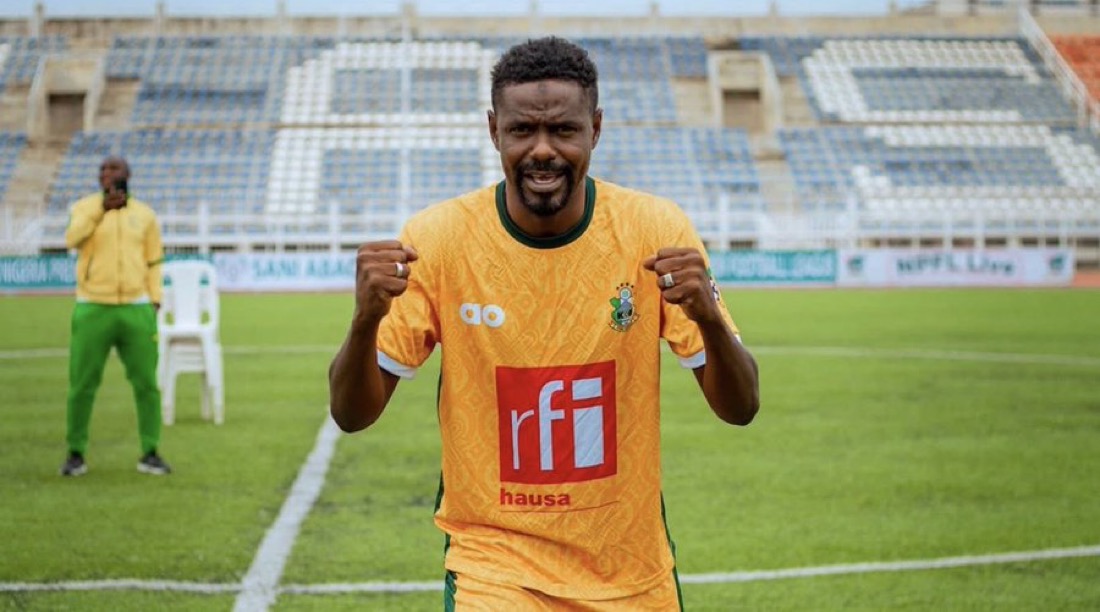
While the world celebrates Cristiano Ronaldo’s extraordinary longevity and players like Gianluigi Buffon and James Milner, among others, Nigeria has quietly produced its own monument to the art of staying power — Rabiu Ali.
On Sunday, August 30, 2026, inside the Kwara State Stadium in Ilorin, something happened that should have made considerably more noise than it did: a 45-year-old footballer walked onto an NPFL match day-one pitch at the Rashidi Yekini main bowl and competed against players young enough to be his sons, and scored a goal.
The Kano Pillars captain opened the scoring for his side against Kwara United in their first game of the 2026/27 EuroMatch Nigeria Premier Football League (NPFL) season, helping the Sai Masu Gida establish a two-goal advantage before the hosts mounted a dramatic comeback to draw 2–2.
It was not a testimonial. It was not a ceremonial appearance designed to give an ageing legend a few minutes in the spotlight. It was competitive professional football — and Ali was still in the middle of it. That is what makes his story remarkable.

THE RONALDO COMPARISON
Football has become accustomed to the phenomenon of Cristiano Ronaldo. At 41, Ronaldo remains one of the world’s most extraordinary examples of sporting longevity, ranked behind only Gianluigi Buffon. The latter is a goalkeeper, not an outfield player, though. Ronaldo’s name has become almost synonymous with discipline, physical conditioning, nutrition, recovery and an obsessive commitment to remaining competitive long after most footballers would have retired. And rightly so.
But somewhere in Kano, another man’s story deserves a chapter in the global conversation about football longevity.
Rabiu Ali does not play in the UEFA Champions League. He has never scored a decisive goal in a European knockout tie. He does not command the astronomical salary, global commercial empire or worldwide celebrity of Ronaldo.
But longevity is not measured only by stadium size. Sometimes, it is measured by how long a man can remain useful in the hardest, most unforgiving environment available to him. And Ali has remained useful for an astonishingly long time. Eighteen years. One club. Still standing.

Ali joined Kano Pillars in 2008 and has spent roughly 18 years associated with the club. The Kano Pillars official player profile lists him as a midfielder who wears the iconic number 10 shirt, while the club’s available records credit him with 31 goals from 108 recorded appearances.
Those figures, however, do not tell the full story. The NPFL has described Ali as its oldest player and noted that, as far back as 2023, he had already spent 16 years playing for Kano Pillars. At 43 then, he still insisted his body had not told him it was time to stop.
That sentence may be the most revealing thing about him. He did not say he was chasing records. He did not say he was trying to prove the doubters wrong. He simply said his body had not told him to stop. That is the mentality of an athlete who understands his profession.
LONGEVITY IS NOT MERELY ABOUT SURVIVING
There is an important distinction between lasting and performing. A footballer can remain registered with a club for years without being an important player (ask Chelsea FC about a certain Winston Borgade). He can become a dressing-room mascot, a ceremonial captain or an occasional substitute.
Rabiu Ali’s case is different. He has continued to start matches, influence games and score goals. His 2025/26 season offered another illustration. Kano Pillars’ official records show him starting numerous matches, including a May 10 victory over Warri Wolves in which he scored.
And now, at 45, he has begun another NPFL campaign by scoring against Kwara United. That is not simply longevity. That is competitive longevity. And competitive longevity is much harder.
What does he know that others don’t? Perhaps the most fascinating question is not why Ali has lasted so long. It is how?
Footballers routinely speak about diet, gym work, recovery, sleep and conditioning. But longevity at this level is rarely the product of one magic ingredient. It is usually the cumulative effect of thousands of small decisions. Knowing when to push. Knowing when not to push. Eating properly. Recovering properly. Avoiding unnecessary physical excess. Understanding one’s body. Maintaining discipline when nobody is watching. And, perhaps most importantly, continuing to love the work.
The professional footballer who survives for two decades at the top level must develop an almost intimate relationship with his own body. Ali appears to have mastered that relationship.

His career reminds us that the greatest athletes are not necessarily those who train hardest every single day; they are often those who understand how to train, recover, and preserve themselves for tomorrow.
The African football context makes it even more extraordinary. There is another dimension to Ali’s achievement that deserves attention. He has done this in African domestic football. That matters. The conditions many African footballers operate under are radically different from those enjoyed by Europe’s biggest stars. Training infrastructure can be inconsistent. Recovery facilities are not always comparable. Long road travel can be exhausting. Pitches vary dramatically. Medical and sports-science support can be uneven.
Yet Ali continues to compete. That makes his longevity more than a personal achievement. It is also a statement about what is possible for the African footballer when talent is combined with discipline, adaptation and professional seriousness. He belongs in the longevity conversation — but not as Ronaldo’s imitation.
Comparing Rabiu Ali with Cristiano Ronaldo must be done carefully. Ronaldo has performed at an extraordinary level in some of the most demanding competitions in world football, while Ali’s career has been predominantly rooted in Nigeria’s domestic game. So, no, it would be intellectually dishonest to argue that their careers are identical. They are not. No. But if the question is, who deserves recognition for sustaining a professional football career deep into an age when most players have long retired, Ali deserves to sit at the table.
In fact, there is something uniquely beautiful about his story. Ronaldo’s longevity has been heavily documented, scientifically managed and commercially amplified. Ali’s has happened comparatively quietly. No global sportswear campaign. No Netflix documentary. No armies of paparazzi. No worldwide social-media machine chronicling every training session. Just a football pitch, a number 10 shirt, a ball at his feet — and another goal. That may be the most Nigerian thing about the entire story.

THE FORGOTTEN GIANT
Rabiu Ali has won Nigerian league titles with Kano Pillars and the Nigerian FA Cup, and he also represented Nigeria at international level, earning caps and scoring goals for the Super Eagles-B.
But perhaps his greatest achievement is one that will never appear properly on a medal table. He has remained relevant.
In professional sport, relevance is brutally difficult to sustain. Young players arrive every season. Bodies slow down. Reflexes decline. Recovery takes longer. The game becomes faster. Coaches become younger. And eventually, almost everybody is replaced.
Ali keeps returning. At 40, 41, 42, 43, 44, and now at 45. Still running. Still competing. Still creating. Still scoring. As a matter of fact, he’s always involved in anything good happening to Kano Pillars in the attack.
There is a lesson here for Nigerian football. Nigeria is often obsessed with discovering the next big thing. The next Jay-Jay Okocha. The next Kanu Nwankwo. The next Victor Osimhen – the next Super Eagles superstar. But perhaps we should pay equal attention to preserving the careers of the professionals we already have.
Rabiu Ali represents an asset that Nigerian football rarely knows how to properly value: institutional memory inside a footballer’s body. He has seen generations of players come and go. He has experienced changing coaches, changing tactics, changing administrators and changing football cultures. He knows the NPFL from the inside. That knowledge has value. A young player can learn technique from a coach. But there are certain lessons that only 18 years of professional football can teach.
THE FINAL WHISTLE HAS NOT COME
At some point, Rabiu Ali will retire. “Father Time” remains unbeaten. Even Ronaldo will eventually discover that. But retirement should not erase the magnitude of what came before it.
When the history of Nigerian football is eventually written, Rabiu Ali should not appear merely as a footnote about an unusually old player. He should be remembered as an extraordinary case study in professional discipline. Because while the world watches Cristiano Ronaldo and marvels at the Portuguese superstar’s refusal to age, Nigeria has been producing its own version of the phenomenon — away from the glare of global mainstream media, without the enormous machinery of global publicity.
Rabiu Ali may never be Cristiano Ronaldo. He does not need to be. He has something else. He has his own story. And at 45, when most professional footballers are long gone from the pitch, Rabiu Ali is still writing it — one match, one tackle, one pass and one goal at a time.
Perhaps the most fitting tribute, then, is not to call him Nigeria’s Cristiano Ronaldo. It is to say something simpler: Rabiu Ali is Rabiu Ali. And that, in itself, has become quite an achievement.
Adebayo Abubakar writes from Ilorin, Kwara State. He can be reached via 0805 138 8285 or marxbayour@gmail.com
-

 Politics20 hours ago
2027: Atiku demands names of firms printing INEC’s ballot papers
-
Business20 hours ago
Refiners back forward crude sales, oppose petrol price cap
-
Business20 hours ago
How 18yrs multiple gas policies sidelined domestic consumers
-
Politics20 hours ago
Crude shortfall makes Atiku’s subsidy plan not workable – Presidency
-
Business20 hours ago
Nigeria’s debt interest soars 124% above revenue
-
 News20 hours ago
World Bank report affirms reform gains — Tinubu
-
News20 hours ago
NDLEA Arrests 83-Year-Old Woman Again, Intercepts Drugs At Nigerian Airports
-
Politics20 hours ago
2027: Tinubu can break Obi’s Southeast hold – Group