Politics
Palliative: ‘Where’s Poor Man’s Money?’ – Atiku Tackles Tinubu

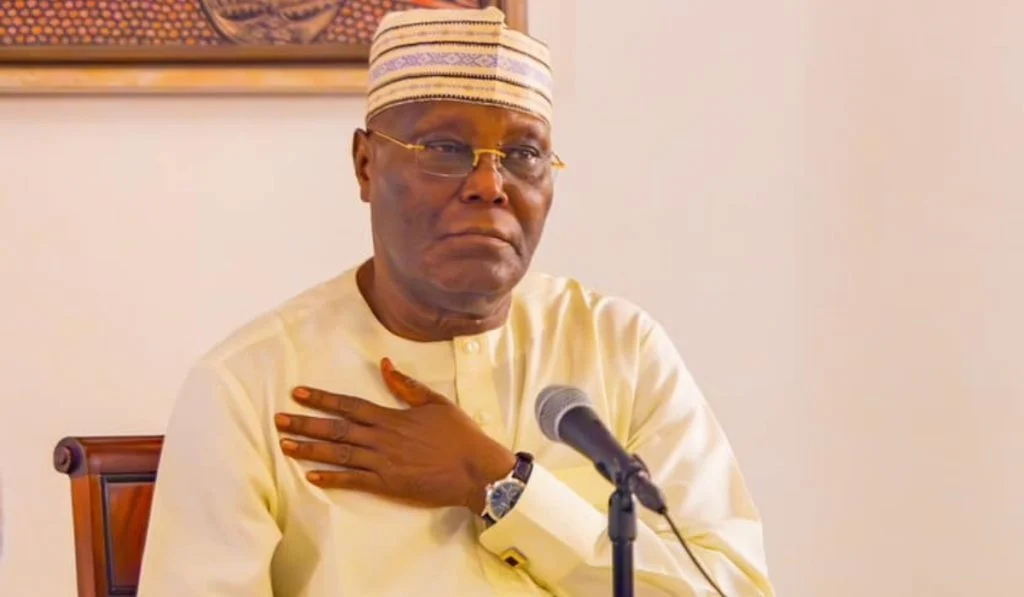
Former Vice President Atiku Abubakar has described the audit findings surrounding ₦33.75 billion reportedly paid to 3.29 million vulnerable Nigerian households as a devastating indictment of a government that took away the poor man’s subsidy, increased his taxes and tariffs, promised support, and is now confronted with serious questions over whether that support ever reached him.
Atiku, in a statement released by his Senior Special Assistant on Public Communication, Phrank Shaibu, said the figures themselves expose the cruelty and inadequacy of the intervention. ₦33.75 billion divided among 3.29 million vulnerable households amounts to barely ₦10,258 per household.
In other words, after removing subsidy, driving up transport fares, electricity costs and food prices, and leaving millions of families struggling to survive, the Tinubu administration’s supposed intervention amounts to roughly ₦10,000 per household — and even that miserable sum has now failed to withstand basic audit scrutiny.
He said there could hardly be a more heartless betrayal than to impose hardship on Nigerians, raise their expectations with promises of support, and then frustrate the audit trail required to establish whether the money actually reached them.

“This is beyond a bookkeeping scandal. The intervention is insultingly small, yet even that small amount cannot be cleanly accounted for. If money meant for hungry Nigerians cannot be satisfactorily traced while access to records required for accountability is frustrated, then what we are witnessing is unapologetic wickedness against the poor. You cannot punish people with hardship and then play hide-and-seek with money appropriated in their name,” Atiku said.
The former Vice President nevertheless commended the Auditor-General of the Federation, Shaakaa Chira, appointed by the Tinubu administration in October 2023, for “putting his constitutional responsibility” above political convenience.
“The Auditor-General deserves commendation. He was appointed by this administration, yet his office has raised questions that are profoundly uncomfortable for the government that appointed him. That is what institutions are supposed to do — protect the public purse, not the political comfort of those in power.”
“What makes the situation even more disturbing is the government’s own claim that more than ₦600 billion had been disbursed to over 10 million households, after Nigerians had earlier been told about 15 million households.
“It now appears that the Tinubu administration cannot give Nigerians a coherent account of how many households actually benefited from its intervention programme, while significant portions of the expenditure have failed to withstand independent audit scrutiny.
“A ministerial announcement is not proof of payment. A name on a social register is not a bank alert. If more than 10 million households received over ₦600 billion, government should be able to show who received the money, how much each household received and when the payments were made.
“The Auditor-General is reportedly questioning ₦33.75 billion supposedly paid to 3.29 million beneficiaries, alongside ₦36.74 billion in payments reportedly made without pre-payment audit and ₦4.62 billion for which payment vouchers were not produced.
“These cannot be dismissed as another set of bogus figures buried in government accounts. These are resources appropriated in the name of poor Nigerians who desperately need protection from a cost-of-living crisis aggravated by this administration’s rash economic policies.
“And because Nigerians cannot reasonably be expected to trust the same government whose expenditure is under question to investigate itself, my team will constitute an independent group of financial, audit, technology and public-accounting experts to interrogate the available records surrounding these cash-transfer payments.
“We will follow the money as far as the available public and institutional records permit. We will examine the beneficiary figures, payment channels, reconciliation records, audit queries and every material inconsistency that has emerged. When that work is completed, we will furnish Nigerians with the findings.
“There must be no black box around the poor man’s money. If Remita processed these transactions, the relevant records should be available for scrutiny. If beneficiaries received the money, there should be evidence. If access to records was obstructed, Nigerians deserve to know by whom and why.
“This is precisely why Nigerians do not need a social intervention model in which government collects enormous sums in their name, passes the money through layers of bureaucracy and contractors, and then leaves citizens wondering whether the benefit was captured by politically connected interests before it reached the intended beneficiaries.
“What Nigerians need is not another palliative announcement. They need purchasing power.
“They need an economic policy that reduces what they spend every day on transportation, food and energy and leaves more money in the pockets of ordinary families.
“That is the fundamental difference between this government’s palliative politics and the production-linked subsidy I have proposed.
“Our intervention will follow production. It will support domestic refining, increase local supply, reduce the cost of energy and ensure that the benefit reaches Nigerians through lower prices. When fuel costs fall, transportation costs ease; when transportation costs ease, pressure on food prices and household budgets reduces.
“That is how you return purchasing power to the people — not by taking money from millions of Nigerians, concentrating it in Abuja, and then asking the same people to trust that somebody somewhere will eventually transfer a fraction of it back to them.
“The Tinubu administration cannot take away the little subsidy that supported struggling families, tax them to the roof, increase electricity and transportation costs, and then obstruct accountability over the intervention supposedly designed to cushion those burdens.
“Nigerians do not need another announcement. They need the records, the recovery of every unaccounted-for naira, and an economic policy that restores their purchasing power.” (Daily trust)
-

 News23 hours ago
NYSC abduction: Mother demands airlift, security escorts for corps members nationwide
-
Metro23 hours ago
Lagos’ War on Beggars: 911 arrested, but streets keep calling
-
Metro23 hours ago
Trading children as commodities in Benue
-
News22 hours ago
Nigerian states’ revenues rise 93%, but education spending drops — World Bank
-
News24 hours ago
Petrol Discount Or Subsidy?
-
Uncategorized22 hours ago
FG moves 2026 unfinished projects into 2027 budget
-
World News23 hours ago
Trump rules out new Iran attack before US midterm elections
-
News12 hours ago
Tinubu’s Case: FG paying US lobbying firm $750,000 monthly — Court papers