Business
Dangote refinery chief defends $49bn valuation as rivals face squeeze

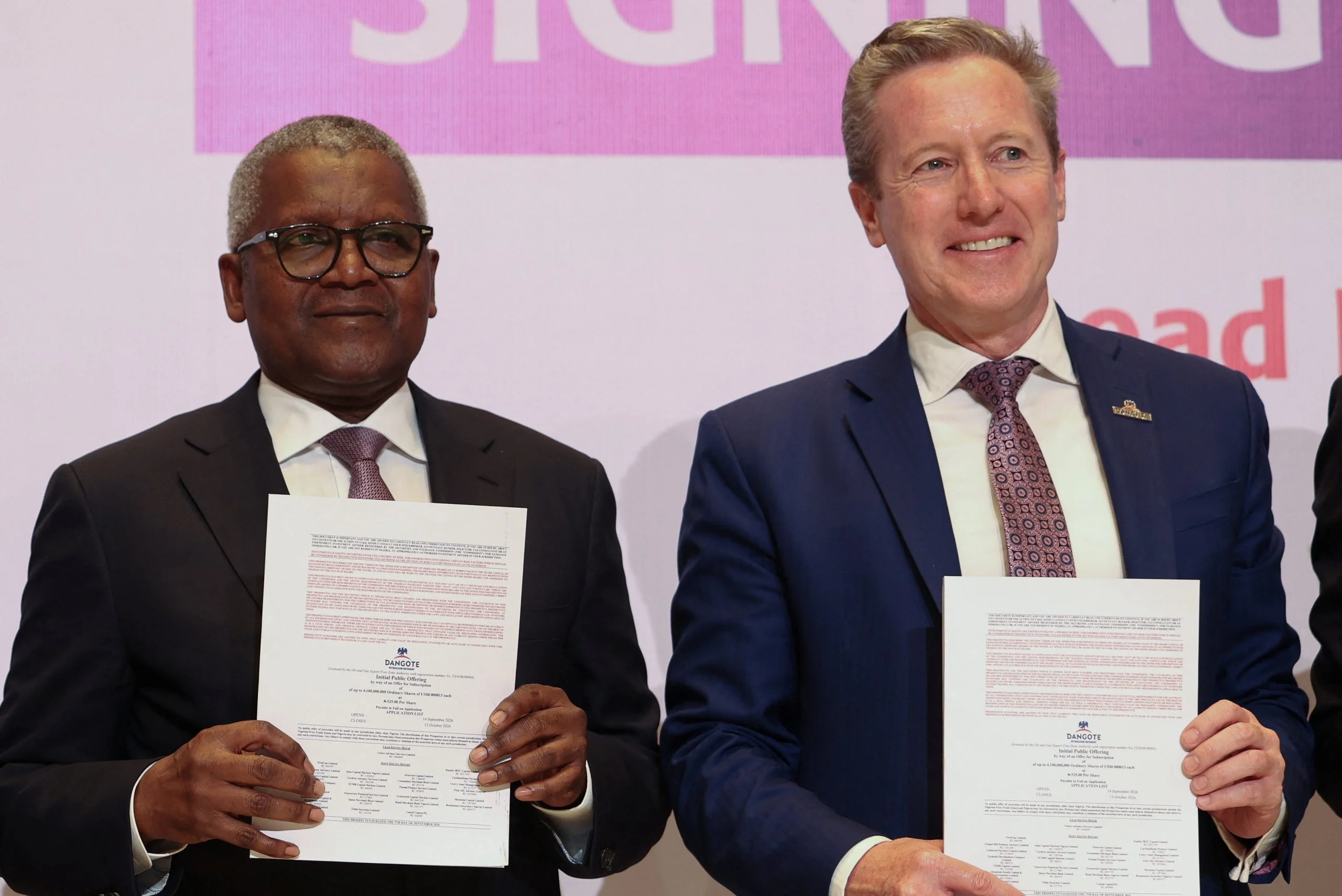
Aliko Dangote’s giant oil refinery outside Lagos is asking investors to accept a valuation of close to $49bn. David Bird, its chief executive, has a simple answer for those who think that is expensive: they are comparing the wrong things.
HF Sinclair, a US refiner with crude-processing capacity of about 678,000 barrels per day (bpd) across several plants, has a market capitalisation of about $19bn. Dangote’s single-site refinery has a nameplate capacity of 650,000 bpd.
Why should it be worth more than twice as much?
“Margins are regional,” Bird told The Africa Report at the Nigeria Exchange (NGX) ahead of the IPO.

A refinery built for the economics of West Africa
His defence of the valuation rests on four advantages: a vast market on the refinery’s doorstep, nearby crude, cheap natural gas, and the economies of scale of a large, modern plant. Where refining capacity is located, he argues, matters as much as how much there is.
Bird also rejects the idea that the valuation depends on the exceptional margins generated by the upheaval in the Middle East. Dangote approved its $14bn Vision 2030 expansion in January, using “through-the-cycle” margins, before the latest surge in refining profits.
The windfall has boosted cash flow and reduced its need to borrow. Bird calls it the “cherry on top”, not the basis of the investment case.
US Gulf Coast refiners, he argues, provide the closest comparison to Dangote’s economics. They have nearby crude, cheap gas and a huge domestic market. But many US plants are older.
Europe looks even less favourable. Its refining base comprises smaller, ageing plants with higher operating costs, while crude often travels farther to reach them.
Asian refiners can be highly efficient, but many must ship crude over long distances and then export much of their product.
Dangote sits in one of the markets those refineries supply.
That is crucial to Bird’s argument. Nigerian fuel prices are shaped by the cost of imported fuel.
The relevant benchmark is therefore not simply the cost of producing a litre of diesel or petrol in north-west Europe, but the cost of getting it to West Africa.
Dangote can avoid much of that freight bill while selling into the same import-parity market.
The $49bn valuation is therefore partly a bet on where Dangote will sit on the global refining cost curve when the cycle turns.
The next downturn
Bird makes no claim that today’s margins will persist. Refining is notoriously cyclical. Another downturn will come.
But Dangote does not need to escape the cycle, he says. It needs to remain profitable after higher-cost competitors have stopped being profitable.
“You don’t have to be the fastest gazelle,” Bird says. “You just mustn’t be the slowest.”
He points to an impending shake-out in the global refining market: older refineries face higher operating costs, large maintenance bills, and tighter fuel standards. Bird expects another prolonged downturn to force further closures, particularly in Europe.
That would not necessarily remove Dangote’s pricing advantage. Even if European refining margins fall sharply, imported fuel still has to cross the Atlantic to reach Nigeria.
The marginal European producer may be under pressure, while Dangote retains the freight advantage embedded in import-parity pricing.
It is a strong defence of Dangote’s margins, but it is not, by itself, proof of the valuation.
Bird says the enlarged business could eventually generate more than $12bn in earnings before interest, tax, depreciation and amortisation.
But when asked how that number holds up under a more conservative refining-margin assumption, he does not provide a detailed explanation.
Instead, he returns to the same proposition: keep costs low enough to survive the trough and keep the refinery reliable enough to cash in when margins rise.
Betting on Vision 2030
Vision 2030 will put that proposition to a much greater test.
Dangote plans to roughly double capacity to 1.4m bpd. However, the $14bn programme goes beyond adding another refining train. It includes additional polypropylene capacity, a linear alkylbenzene plant, a new diesel hydrotreater and regional distribution infrastructure.
Bird says the expansion should also deliver better economics than building another refinery from scratch. Dangote already has the land, utilities, and much of the common infrastructure. In his shorthand, doubling the refinery does not require twice the capital: “one plus one” is closer to 1.4.
Strong cash generation is already changing how it will be financed. When Dangote approved the expansion, it envisaged a mix close to 60% debt and 40% equity.
Bird says that assumption is being revised as cash piles up. The company has also raised unsecured debt, he says, at borrowing costs that came in below those of the Nigerian sovereign.
For investors, the valuation is a bet on more than today’s extraordinary refining margins. It assumes geography will continue to give Dangote an edge over plants elsewhere — and that spending another $14bn will deepen rather than erode that edge.
The real verdict will come not during the current boom, but in the next refining slump. (The Africa Report)
-
Metro20 hours ago
Indian Woman Found Alive 12 Years After She Was Presumed Dead, Husband Had Spent Time in Jail for Her ‘Murder’
-

 News21 hours ago
NLC Demands Palliatives For Nigerians As Petrol Price Rises
-
World News22 hours ago
Only ‘idiots’ think N’Korea will give up nukes, says Kim’s sister
-
Politics3 hours ago
2027: APC governors, Wike’s feud deepens
-
News7 hours ago
Mambilla project: Nigeria wins arbitration case at ICC as Tinubu hails Buhari, Obasanjo
-
Business7 hours ago
Mafab Communications to sell $273.6m 5G Spectrum to MTN Nigeria
-
News22 hours ago
ICRC defends toll pricing on highways
-
Politics3 hours ago
Toyin Abraham rejects inclusion in Lagos APC campaign council