Politics
I Regret Using My Resources On Politics – Professor Daniel Saror

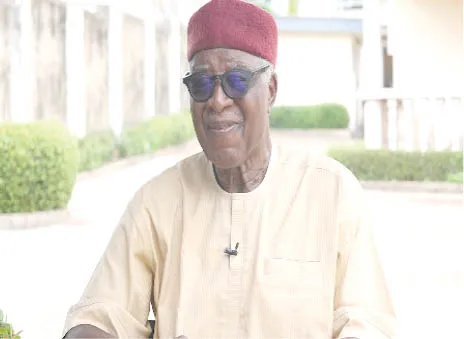
Professor Daniel Iyorkegh Saror spent most of his working life at the Ahmadu Bello University, Zaria, from 1970, when he became a Lecturer, to 1995, when he left as the Vice Chancellor. Along the way, he was Head of Department and Dean of the Faculty of Veterinary Medicine. He has held many other positions outside the academia, including chairman of International Merchant Bank and more recently, Senator from Benue State. Saror, who is now 85, shared his experiences with Weekend Trust at his house in Makurdi.
You were not born in Makurdi, may I start by asking about your background?
I am from Benue State and my local government is Ukum, after Katsina-Ala. I was born there. My father was a chief who had many wives. My mother, who was his second wife, had 9 of us. I was the third of my mother’s children; and I thank God that the firstborn is a woman; she is still alive in Gboko. The second one passed on in 1995. and here I am.
You did very well in school, such that you got the opportunity to go to Gindiri, which was a very rare opportunity for somebody from Benue to across to Plateau. How did that happen?

In those days there were not many secondary schools in northern Nigeria. There were Keffi, Katsina-Ala, Gindiri and Wusasa. We took exams and I was among those who were picked. Six or five of us from Benue State were enrolled.
Gindiri Boys’ Secondary School, we were there in February 1957. I completed secondary education in 1961 with a division one pass. I went on to do the Higher School Certificate, which I completed in 1963.
So you spent a lot of time at Gindiri, how was the experience?
It was quite some experience. It was my first time of being away from home. In those days, it was not easy to go and come back. Sometimes in the year you won’t come home.
We used to travel by road or rail from here to Jos and from Jos to Mangu and from Mangu to Gindiri. Jos was good but the place was very cold for us who came from here.
From Gindiri you wanted to go to the Ahmadu Bello University?
No. I had wanted to study at the University of Ibadan (UI), but I got a job in northern Nigeria as a livestock assistant. I was posted to Jos, where I worked very closely with Alhaji Halliru Kano, the principal livestock officer.
He taught me the rudiments of husbandry and posted me to live with Fulani herdsmen in Maidantoro, a small town outside of Bukuru, near Jos. I spent quite some time there with the herdsmen. We used to get up at 4 o’clock in the morning to milk cows. It was very good.
So you learnt veterinary medicine on the ground ?
Yes. But the interesting thing was that that year, the premier of Northern Nigeria, the Sarduana of Sokoto, somehow got scholarships from the Federal Ministry of Education through the United States Agency for International Development (USAID) for graduates from northern Nigerian high schools that had a science background. He wanted them to go to the United States and study Veterinary Medicine or Agriculture. There were several of us who went, including the late( Prof)Idris Abdulkadir.
So it was a really fair competitive process?
In fact, it was not a question of competitiveness. We didn’t know where the thing came from. We were just told to come to Kaduna if we had the qualification. We reported there and were taken to Lagos. From there, we were taken and put onto the Pan-American Airlines to the US.
And suddenly, you were in America; how was the experience?
We had to undergo orientation at the Washington International Centre for a month. They taught us the manners in the US.
This was in 1963?
- Some went to Tuskegee Institute, Alabama, while some went to Cornell, California. I went to Kansas.
I read somewhere that you were the only( African) student in a class of 81 people?
Yes. It was very challenging.
Was there discrimination?
I can’t say I witnessed overt discrimination in the college, but we had instances where, during the summer, provision was made for us to go to other parts of the United States. I had the privilege of going to Louisiana in Baton Rouge. And there, we had some bad experience because there was real discrimination.
What kind of discrimination? Did they deny you hotel accommodation?
The one that comes to my mind is when we were on a field trip and stopped at a place called Ray Charles and went to an eatery. We went to have some snacks in an open restaurant – quick food items. When we got there, we were received a bit coldly. And the menu they gave us to order from was different from the menu that was on the wall. A hamburger, which was normally 40 or 45 cents, was four or five dollars. We knew that we were in the wrong place.
So you finished from the Kansas State University. Did you do your veterinary medicine in another university?
No; in that school. I was enrolled in the College of Veterinary Medicine, but you had to take a degree before you could graduate. So I took a degree in Biological Sciences, which I was doing concurrently. I finished that one in 1969, and by May 1970, I graduated with the Doctor of Veterinary Medicine.
I understand that you happened to meet Professor Ishaya Audu while he was visiting. Was he then vice chancellor?
He was a vice chancellor and the Ahmadu Bello University (ABU) had a relationship with Kansas State University through the USAID. He was going to establish a Faculty of Veterinary Medicine in 1969 in Zaria.
We met in 1968 and he said, “Young man, I will offer you an appointment. Come straight to Zaria upon your return and I will give you a job as a lecturer.” I hesitated because I went to Kansas on in-service training; I had been employed by the Northern Nigeria Government. But he said I should not worry.
When you finished your PhD your career took off in Ahmadu Bello as Head of department, Dean, Deputy Vice Chancellor, then Vice Chancellor, but you didn’t become a commissioner. Were there no such opportunities?
I was offered the position of a commissioner in Plateau but I rejected it. I just finished my PhD and told them that I wanted to continue in my academic career. I didn’t accept it.
So you continued to be a lecturer and rose through the ranks in ABU?
Yes. When I finished my appointment as Dean of Veterinary Medicine in 1987,(Prof) Nayaya took over( as Vice Chancellor) when Ango Abdullahi left. And you won’t believe that I didn’t ask him to give me any appointment, but I woke up one day and he called me and said, “You are going to be Deputy Vice-Chancellor, Academics. And that’s how it happened.
While I was still there, in 1990/1991, the British Council had a management training programme and I was nominated to go to the United Kingdom (UK) and participate.
There was no GSM at that time, so you couldn’t call somebody home. But to my surprise, when I got back to Nigeria at the airport, I met Colonel( later General) Samuel Victor Malu, who was in charge of Kano. He met me as the plane arrived.
He asked what I was doing and I said I was just coming back from a training course in the UK. He said: “Don’t you know that you are the vice chancellor of ABU?” My heart sank and I asked if Nayaya was dead. He said he just resigned; and I should better go back.
Did the head of state approve your appointment?
General Babangida.
Would you say that unlike the positions of a professor, dean or whatever in the academic setting, vice-chancellorship is political?
Very political.
It was something you didn’t expect, how did you handle it?
It was very difficult; but let me be careful how I say this.
Speak your mind.
My emergence as vice chancellor was unexpected, even by the community. Local academics felt the premier university in northern Nigeria should not be given to a minority from Middle Belt. They didn’t like the idea.
The young Academic Staff Union of Universities (ASUU) chaps were very hostile. They wrote some nasty things about me. I got to hear about it when I came home with my family to receive a chieftaincy title in Gboko on December 31, 1994. On the way back to Zaria, on the radio I was hearing how ASUU had written a petition against me.
I was dumbfounded. Anyway, I went to Kaduna NTA and asked that they also give me a chance to respond to the allegations made against me; which they did. I was very happy about that, but those people didn’t stop.
What was their motivation? According to my knowledge, young ASUU members are radical and nationalistic. They are not really the typical northern nationalists.
When General Babangida introduced the Structural Adjustment Programme (SAP), the universities were affected. In fact, ASUU went on strike and reached agreement with the federal government.
At the end of that agreement, they really wanted to be part of the management of the universities, which was a bit weird. And because I stood firm, they were not happy with me.
You didn’t want to democratise the university system?
That’s what happened.
So things were nasty. I heard stories about snake in your office.
Yeah. They became very desperate because they thought I had good connection with General Babangida and Aliyu Jama’a( Secretary to the Military Government) and I would be reappointed. And they didn’t want me to be reappointed.
Were you entitled to another term?
Yes. At that time, it was possible. So they were very up in arms.
What did they do? Was this snake thing real?
Oh yes. It was very real. They brought a snake – one Haruna from Shika. I know the chap very well. He was a local snake charmer. They recruited him and he brought the snake. They said they wanted me to resign and I told them that I was not going to resign. I said that Abacha, who was the head of state at that time and a visitor to the university, could remove me. So I refused.
There were demonstrations. They locked up the Senate Building. Fortunately for me, I had the support of most of the students. In fact, the students climbed the Senate Building from outside and got to the 8th floor to meet me there and protect me.
Were people killed during the protest?
Some people died.
How did you feel about that? Did that eventually make you think it was not worth the struggle?
My biggest concern was that these young academics or northerners said I was a renegade northerner.
Why did they call you a renegade?
I don’t know.
Did you share their ideology or point of view?
I did my own bit in ABU.
Did you finish your term eventually?
Yes.
Did you seek a second one?
No. I had already written to the Council in June of that year that my tenure would end in November and I was not ready to have a second term.
You chose not to have a second term?
Yes, because the hostility was much. It was so much that I had to protect my family and myself. And sometimes there was a young man who was very passionate about me. He used to sleep by my door in the lodge with a grenade in his pocket.
Just to protect you?
Just to protect me.
Did that commotion change your view as a northerner?
It didn’t change my view because even after that, I maintained a very good relationship with northerners, such as Ango Abdullahi. I had been to Sokoto and Katsina. I had a meeting with Emir Abdulmumuni, the father of the present emir. I had been to Kano because we had a project there.
I produced the second edition of the English-Hausa Dictionary, which had been abandoned since 1935.
Did the university publish it?
Yes. I got the university to publish it. And I gave copies to schools in the North, free of charge.
Probably these radicals didn’t understand you?
No. In my opinion, what they wanted was to get what they didn’t deserve. I think that’s how I put it. And I resisted. But Abacha eventually set up a commission of inquiry for the university to determine the cause of the unrest. It was headed by Major-General Mamman Kontagora.
They had to bring a soldier to take over as a sole administrator?
Yes; after he chaired the commission that investigated me. I was surprised that my tenure was ending on November 31 and he submitted his report to General Abacha on November 15 and still recommended that I should be sacked.
Two weeks to the end of your tenure?
Two weeks to the end of my tenure.
And that’s what happened?
I was not sacked.
So you left quietly?
I left quietly. At the end of my tenure, the presidency asked me to hand over to Mamman Kontagora; which I did. He was then appointed sole administrator.
Did that end your relationship with ABU?
It didn’t. Actually, it was a bit difficult because Kontagora was a bit very hostile to me. In fact, he said I should return the official car I had as a vice chancellor to the university. And I did. He even set up numerous other committees to further investigate me based on rumours that he was hearing.
You still maintained your relationship with ABU?
Oh yes. I had a farm – Shinto Agric – on Shika Road in Zaria. When bird flu became a problem in Nigeria, the farm had to close down. In the end, I sold it to the university when Prof Garba was the VC and they took over the farm.
By 2016, the ABU alumni invited me to Abuja. It was a very good meeting. They gave me a lot of respect and all that. I didn’t have any problem.
It seems your old interest in politics came back when you left the university system. Is that correct?
It didn’t come back immediately. I came here in 1996.
You returned home?
Yes, on sabbatical leave; which was a normal thing.
You needed to retreat home?
I needed to retreat home.
Why didn’t you go on sabbatical in the US or UK?
Family. I had a big family, both here and at home. I needed to be around.
When you say at home, do you mean in the village?
Yes. After my sabbatical here in 1997 I should have gone back to the ABU, but my father’s younger brother, who was the village head at the time, advised me not to go back.
After due consultation with the people, Chief Barnabas Gemade and other leading politicians of the area at that time supported me. So they allowed me to contest for the Senate.
Why did you choose Senate as a first entrant, why not governorship or something else?
I could have tried governorship, but I was not really a politician. And Gemade had wanted Akume to be the candidate because he was related to his wife.
Gemade was the managing director of Benue Cement?
Yes.
And of course very rich then?
After that, he became the chairman of one of the five political parties in Nigeria, if you remember. He was the chairman of the CNC. So I opted for the Senate and it was a very challenging experience. I had experienced politicians who had been in the field. Paul Unongo, a former minister under Shagari, was there, as well as Jacob Tilley Gado. Those were my competitors. But students and most families in Benue supported me.
So you won?
I had a sweeping victory.
I went to the Senate under the CNC. Then Abacha died and Abdulsalami abrogated all the political parties. Then we had to work together to find a party to join. We decided that we would join the Peoples Democratic Party (PDP). That was August 1998. It was when we joined the PDP that I contested again for the same Senate and won.
It must take a lot of money to contest, not once but twice.
Well, I don’t know how much it cost me because I didn’t have money. When I finished from ABU, I didnt have a car. But I had a farm in Zaria and had produced many bags of maize, which I sold and got over N100,000. That was my seed money to use in politics.
The late Patrick Ityohegh, a former director-general of the NTA, told me that he was so impressed with me that he was ready to spend all the money he had to support me. And he did till his dying day. He was one gentleman that really stood behind me.
How was your experience in the Senate? Did you blend well with the politicians?
I think I did. I was respected. I was placed in several important committees. I was a member of the Finance and General Purpose Committee, I mean the Committee on Appropriations and Finance for all the eight years I was in the Senate.
When Abubakar Maikafi from Bauchi was the chairman of the committee, I was his right-hand man. When Senator Bob Effiong was the chairman of the Finance Committee, I was his deputy. I was the chairman of the Communications Committee. It was during my time that GSM was introduced into Nigeria.
I was privileged to go to South Africa two or three times to the MTN office. I helped to produce the Communications Act of 2003 with the assistance of Paul Usoro, a lawyer, now a Senior Advocate of Nigeria (SWAN), with the support of Chief Ernest Ndukwe, who was the chief executive of the National Communications Commission (NCC).
So you had eight good years in the Senate and wanted to be governor. You tried in 2007 and 2011, right?
Yes. After the first four years, I did not get along very well with George Akume, who was the governor. I and Chief JKN Waku disagreed with him.
Waku was also a senator?
Yes. He is from here. So, since we disagreed with him we knew he would not allow us to get nomination to go for a second time, so we went over to the United Nigeria People’s Party (UNPP). But they did not provide a level-playing field, so I left again and joined the All Nigeria Peoples Party (ANPP). I won the election to the Senate for the second time, from 2003 to 2007.
Against the PDP?
Yes. And we won with a landslide. It was after that time that I opted to run for governorship. I hate to talk about that election.
The 2007 governorship election?
Yes. I think any adult in Benue knew that we won the election, but they announced what they wanted to announce. Which is quite common, so I don’t worry about it.
But you tried again in 2011.
That was very interesting. Political thugs came here and shot people in my house.
So it is dangerous to try to become a governor?
Very dangerous. There was a woman; whoever she was, that brought the result of the election from INEC office in a big brown envelope. It was the result that INEC compiled and what the commission was forced to write with pen and announce.
Did you go to court?
I went to court, but the Tiv Area Traditional Council asked me to withdraw it and I obliged. In any case, I didn’t have money to prosecute it.
Given this experience, why did you try again in 2011?
I was the leader of the ANPP in the state. The guy we were preparing to run for governor fell sick at the last minute and there was nobody ready to take over. I didn’t need to contest that year because I knew I wouldn’t win, but the party had to present somebody. So I offered myself, but I knew that we didn’t have a chance.
Are you still involved in politics?
No In February 12, 2016, I wrote formally to state that I was not going to be involved in active partisan politics. And I have never been to any political gathering since that time. I resigned because I was contesting for the stool of Tor Tiv and felt that it would be wrong for me to be partisan.
How did that other contest go?
Which one?
The traditional one; I think another professor made it, right?
I don’t want to talk about it.
You are a very traditional Tiv man, so you live the Tiv way of life, right?
Yeah. I try.
With many wives and children?
I have three wives. The one you saw here is my second wife. My first wife is a retired professor. The third one is in Abuja. She is also a retired civil servant. She was a director at the National Health Insurance Scheme.
I understand a Tiv man can marry a young wife who would take care of him in old age?
No. I have no intention to marry again. At my age now, I just want peace. I cherish my peace. If I have the resources I want to eat good food.
Do you still aspire to be Tor Tiv one day?
No. It is impossible because the way it should rotate means that after this one goes, the next Tor Tiv will come from the Minda axis.
Okay. So you have lost your chance?
I can’t be a Tor Tiv again.
How do you live this peaceful life you aspire to?
You have seen it – no politics, no traditional things. Our people are very funny. At this age, if I were in northern Nigeria proper, I would have people coming to greet me every day, but that is not the case here. They hardly visit. They hardly remember that you are there.
Why? Is it pride?
I think it’s just the system. I personally helped many of them to get into positions, but once they get there they don’t care about you. They never remember me; very few of them do. I hate to say this, but if I need something seriously, if I need support, it’s my friends in the North: Umaru Tsauri, Lawan Shaibu etc.( that help).
People you served in the Senate with?
Yes.
Why did you retire here? Why not in Abuja or Kaduna?
When I finished in 2011, I took a teaching job at the Joseph Tarka University and was there till 2023. I was lecturing and training postgraduate students. I was enjoying it. At that time, the salary was okay.
But when the Academic Staff Union of Universities (ASUU) had a problem with the government on IPPIS, the payment system, the universities said they could not pay contract staff members. The universities were asked to pay from their internally generated resources. So they didn’t have the money to pay us. That was how I stopped teaching.
After a distinguished career in the University and in the Senate, do you really still need a job to sustain yourself?
Maybe I can regret using my resources on politics. Between 2007 and 2011, most of my investments were gone. Everything else was gone, so I had to teach. And I enjoyed it. But at the end of the day, by 2023 they even stopped paying. As I am speaking, the university is owing some of us huge sums of money. I don’t want to mention names of my colleagues that are involved, but that is the situation we are in.
What of pension from where you worked before – ABU?
The pension has been very small. It was N99,000 a few years ago. But it has been increasing gradually. As at today, it is N200,000, but electricity bill is almost N100,000, so it is very difficult. I thank God that my children support me.
You have many of them. Are they abroad?
No; they are all in Nigeria. My first son is a pilot. The second one is married and in Abuja. She has a business. The last girl, who is in Lagos, is also married. She works at Novartis and supports me every month. That’s how I manage. But it is still not easy.
How is your typically day like?
I try to write a textbook on veterinary hematology. I have finished the first draft. I have to find the resources to publish it.
Do you engage in any other activity, day-to-day exercise, including social?
I had a poultry farm here, but there are no birds there now because the cost of feed is prohibitive. And you know that when the economy is bad like this, when people have no money, eggs are the first food item they drop out of their diet. The place is idle. I used to keep birds there. I used to sell eggs. I have a farm in the village.
It also produces food?
Yes.
A while ago you had a health challenge. How are you feeling now?
Yes, April 1 last year, a public holiday. I suffered a severe heart attack. My niece, who is a medical doctor, took me to a cardiologist, Dr Patrick Idoko. He runs the Diamond Heart Hospital here in Makurdi.
At first he thought I should go to Abuja or Lagos to have a heart operation, but I didn’t have the money at the time. It was very difficult to raise money. So I told him to just manage me as best he could. That’s what he has been doing.
He has been very consistent and very good. I am on a cocktail of drugs – morning and evening every day since that day. I have not missed a day.
It looks to me that you are still going strong; you moved around.
Yes, I can move around.
And you have been sitting with me for two hours now talking.
I had a prostate problem but that has gone down. It was not cancer. It was just hyperplasia.
You know enough about medicine to know that you can manage your own problem at 85 years?
I am trying my best.
As a very experienced professional – Academic, Politician, even chairman of a bank, what is your thought concerning this country. Where do you think we are going?
I told you that former President Shehu Shagari appointed me as chairman of the International Merchant Bank (IMB). I served as best I could but didn’t touch any money. In fact, I did not even invest in the bank.
I also became a vice chancellor. And I was happy that I was investigated and nothing was found. I was not found wanting. What I regret is that the government refused to release a white paper on the findings. Alhaji(Gidado) Idris told me to just go. There would be no white paper, because I worried him.
You wanted a conclusion?
Yes. It was never done. But I feel good. I didn’t touch anybody’s money. I came to the Senate after that experience. And I never made a deal that I would approve this so that you would give me something. I didn’t.
I always tell anybody who wants to hear, that in my public life I never asked for or received a bribe from anybody. I haven’t done that because it has not been my nature.
People feel that by now I should be a rich man. But I am happy that I have served my people. I have demonstrated that you can do a job without compromising on principles.
Remember that in the 1980s I was in the US. It was N1 to $1 at that time. Look at what has happened to the naira from that time till now. You are talking about over N1,500 to $1 in the same country. We were not producing.
Do you think our future can be better?
I am very sceptical. The northern Nigeria I belong to has the potential to make this country great, but over the years, if you go from Sokoto to Adamawa by road you will not find companies along the way; yet we have the population.
Should we not blame leaders of the North, including you?
Something happened to northern Nigeria that should never have happened. I have been talking to you here and I know that some of my best friends are Muslim and Fulani till this day, but we have so turned things around that we are more concerned with ethnicity and religion. And you don’t see people based on what they are and what they can contribute; it is what they worship and tribe. That’s why the North is where it is – underdeveloped.
Until we come to our senses and decide that we have to invest in our human beings, population, develop our farms, education, health care, invest, produce, the North will not be away from this problem.
Today, bandits have taken over many parts of the North-West. And these bandits belong to the same religion the local people belong to. Banditry has become a way of life for some people. In some towns in the North-West, if you are in the rural area you are in trouble; you have to be in the town.
This is not how a country can develop. Drive between Lagos and Ogun State and see the industries. I mean that people are engaged. Here in Benue State, where are the places of employment?
We have only government.
Only government, so everybody wants to be a politician – young and old. So, northern Nigeria, including Benue and the Middle Belt, if I want to use that word, has a lot of work to do.
Religion is not about compulsion. We need to respect the rights of other people and see the need to invest in this land. Even rich northerners are not investing in the North. They are making good money, but it is in the South. They are not providing employment here. We need to do something. We need to be our brothers’ keepers. (Daily trust)
-

 News15 hours ago
N267bn in education funds lie idle as 70% of Nigerian children can’t read
-
Sports13 hours ago
Celebrity boxing: Boom for entertainers, bane of professional boxers?
-
News15 hours ago
Child soldier: US threatens to cut military aid to Nigeria
-
News15 hours ago
Obasanjo urges increase in 13% derivation for oil-producing states
-
Metro15 hours ago
Hardship: Jigawa almajiri pupils lament decline in free food
-
Business13 hours ago
Power plants record zero output amid grid instability
-
Politics15 hours ago
Tinubu’s re-election crucial to Nigeria’s prosperity – Hamzat
-
Politics15 hours ago
Pantami Gives INEC 72 Hours To Publish Name On guber List