Business
Dangote IPO: The biggest winner may be Nigeria’s capital markets

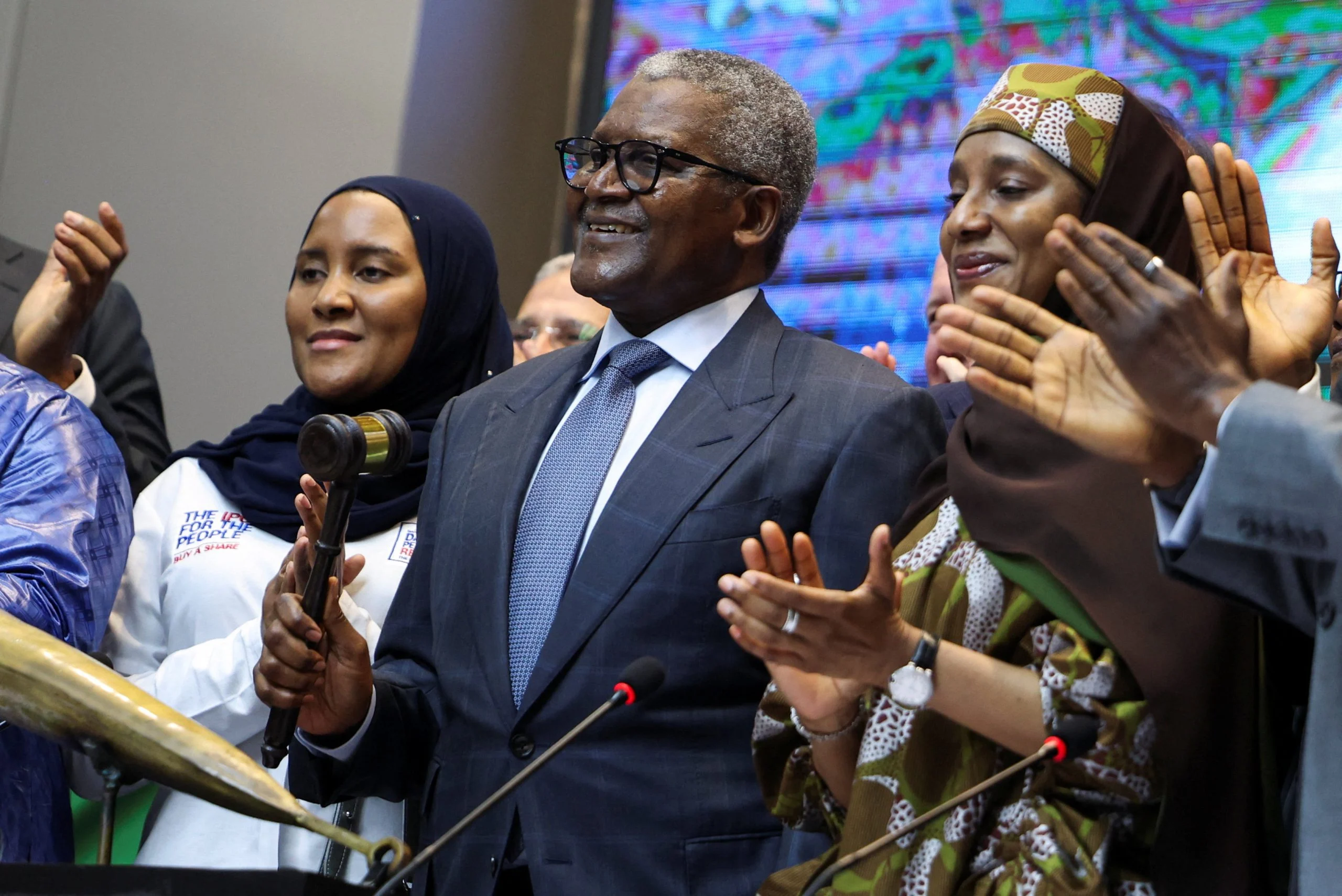
Aliko Dangote does not particularly need Nigeria’s stock market. His refinery had already raised billions of dollars from institutional investors before launching Africa’s largest initial public offering. Demand for the private placement was so strong that money was turned away.
For Nigeria’s capital markets, the bigger prize is proving that the country can distribute a large equity offering at scale — and building the infrastructure for other companies to follow.
“This is really not a capital-raising conversation,” says Temi Popoola, chief executive of Nigerian Exchange Group (NGX). Success, he says, means creating “the rails, the confidence, the market” that allow the next companies to raise money.
The deal is an unusually large stress test. In the Nigerian Exchange control room, large monitors track the Dangote public offering in real time. Four hours after the 8am launch, more than N21bn ($15.78m) had been raised across roughly 38,000 transactions. “We have never seen this quantum of movement before,” says Shehu Yahaya Shantali of Central Securities Clearing System.

Nigeria’s exchange has spent years trading below the weight of Africa’s most populous economy. For comparison, the capitalisation of South Africa’s stock market is around 300% of GDP, while Nigeria’s, even after Dangote’s IPO, does not reach 50%.
Large companies have often relied on bank loans, private investors or overseas capital. Foreign portfolio managers withdrew during successive foreign-exchange crises. Retail participation remained limited.
A real democratisation of wealth?
Dangote wants to change the last part dramatically. The minimum investment is about $4, but more important is what sits underneath the offer.
Nigeria’s bank verification number (BVN) can now serve as the identity layer for a new investor. Someone subscribing through a bank or fintech can be verified against the banking system and, if necessary, automatically issued a securities account.
Shantali says the process can take less than a second. Distribution can run through banks, fintechs, telecoms and POS agents across Nigerian towns and villages. CSCS has built the platform with capacity for up to 150 million investors.
Dangote’s target is 10 million shareholders, though Shantali calls that “conservative”. Even if it reaches half that number, it would be a step change in a market where even the biggest companies have traditionally counted shareholders in the hundreds of thousands.
Nigeria’s wider financial sector shows the way
It would also apply a lesson from Nigeria’s payments revolution to a part of finance that has changed far more slowly.
Digital banking and fintech have made moving money cheap and ubiquitous. Buying shares still often means navigating a specialist world of brokers, forms and unfamiliar intermediaries.
Uzoma Dozie, the former Diamond Bank chief who now runs fintech Sparkle, describes the stock market as too “broker-driven”, complex and expensive. His criticism goes further: Nigeria has built a financial system that serves its largest companies remarkably well while doing far less for millions of smaller firms and households.
Technology should change that, Dozie argues. Cut transaction sizes, reduce distribution costs, and remove unnecessary friction.
Popoola does not want to eliminate brokers. They remain important for regulation and trust. The aim is to bury much of the complexity beneath digital interfaces that banks, fintechs and other distributors can plug into. It’s here, he argues, that the Dangote deal will matter beyond the refinery itself.
Deeper pools of capital
Nigeria has already shown how financial reform can reshape an economy. Bank liberalisation and consolidation produced institutions large enough to finance increasingly ambitious Nigerian companies. Domestic banks helped fund Dangote’s refinery and now operate across the continent.
Aigboje Aig-Imoukhuede, the former Access Bank chief executive, argues that the next step is to replicate that success across pensions, insurance, asset management and capital markets.
If Nigeria can do for those sectors what it did for banking, it can build more of the long-term financial plumbing needed to fund growth.
The Dangote IPO sits at the crossroads of those dynamics. Nigeria has spent the past decade domesticating more of its energy industry. Seplat, Oando, Aradel, Renaissance and others have taken control of assets once owned by international oil majors. Dangote has built the country’s dominant refinery.
Now, ordinary Nigerian savers are being invited to own part of that industrial build-out.
Will foreign investors return?
The harder question is whether foreign investors will follow.
Nigeria’s equity rally has so far been overwhelmingly domestic, with around 90% of investors local. Many foreign funds that once covered the country disappeared during years of currency turmoil and capital controls.
That is beginning to change. FTSE Russell is restoring Nigeria to its Frontier Market index this month, following improvements in foreign-exchange liquidity and capital repatriation. Dangote adds something equally important: scale.
Popoola aims to make Nigeria “too big to ignore”.
One $50bn company will not achieve that alone. Nor will millions of first-time subscribers matter much if they never buy another share. The real test, says Popoola, is what follows: more listings, deeper liquidity, and more household and institutional savings flowing into productive Nigerian companies.
(The Africa Report)
-

 News5 hours ago
Abuja Workers Turn To Pick-Up Trucks Amid Rising Transport Costs
-
 Politics10 hours ago
Security Operatives Guard Tinubu’s Billboards Ahead Campaign Launch
-
 News5 hours ago
Ebola patient in Nigeria is Swiss, had not visited DR Congo – Foreign Ministry
-
Sports24 hours ago
Carrick stays but senior Man Utd figures concerned by performances — Report
-
News23 hours ago
El Niño projected to cause 31,400 deaths in Nigeria
-
Politics5 hours ago
Results With Discrepancies Won’t Be Uploaded On IREV – INEC
-
News24 hours ago
Court grants ICPC’s prayer to play CCTV footage in El-Rufai’s N10bn suit
-
 News5 hours ago
Zamfara Community Fights Back