News
A Trip Through Nigeria’s Uncompleted Roads

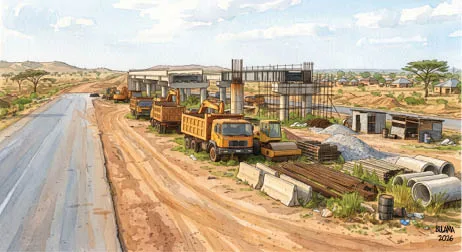
Road networks across Nigeria serve as vital arteries that facilitate movement of goods and people, but such movements have become a nightmare to many as the state of the roads are increasingly deteriorating and wasting man-hours.
Although many of the roads, which were constructed over 30 years ago, have witnessed several contracts for rehabilitation and reconstruction, they have remained in bad state despite years of budgetary allocations.
A report by the Federal Ministry of Works noted that the federal government was working on an estimated 5,400 kilometres of highways and strategic road corridors across the country.
Due to a huge number of roads under construction, the Minister of Works, Senator David Umahi, said recently that he had been directed by President Bola Ahmed to review all the road projects in the country, with a view to deciding the ones that would be given priority.

According to him, there is need for alternative sources of funding outside government’s coffers as funding them through annual budgets alone has become impossible.
While stating that the government was not considering dumping projects it inherited, the minister clarified that projects that would be considered for funding would have reached 80 per cent completion.
Many flag-offs, no completion
From the ambitious Ring Road to the Northern Bypass and the strategic Kano–Maiduguri highway, the story is the same: flag-offs, promises, partial works — and abandonment.
The 46km Ring Road project, designed to connect Naibawa flyover through Dorayi underpass, crossing Gwarzo Road and terminating at Dawanau International Grains Market, was first conceived during the Governor Rabiu Kwankwaso administration (2011–2015). It was meant to divert heavy trucks away from Kano’s congested city centre and link major highways. But after stalling under Ganduje, revival efforts under Governor Abba Kabir Yusuf in 2024–2025 have only delivered partial progress, especially near Dawanau. Today, the road remains incomplete, with earthworks and drainage visible but no continuous loop.
Similarly, the 30km Northern Bypass, initiated over a decade ago, was intended to provide an alternative route for long-haul traffic. Federal takeover in 2025 rekindled hopes, but in 2026, construction is still dragging, leaving commuters to battle gridlock in Kano metropolis.
The 550km Kano–Maiduguri highway, one of Nigeria’s most strategic corridors, tells an even longer tale. Conceived in the mid-2000s and split into sections, it has suffered from funding delays, contractor disputes, and insecurity in Yobe and Borno. While rehabilitation has been attempted under successive administrations, full dualisation remains elusive. For traders, farmers, and humanitarian workers, the incomplete road is more than an inconvenience — it is a lifeline left hanging.
The project, popularly known as North-East Highway, spans Kano State through Jigawa, Bauchi and Yobe states, terminating in Borno State (Maiduguri).
Although the project faced prolonged delays and phased funding across multiple years, major sections were completed and inaugurated during the Muhammadu Buhari administration in 2021.
The expressway is divided into five primary sections: Section I: Kano-Wudil-Shuwarin Road; Section II: Shuwarin-Azare (linking Jigawa and Bauchi); Section III: Azare-Potiskum (linking Bauchi and Yobe); Section IV & V: Potiskum-Damaturu and the Damaturu- Maiduguri road
However, the Maiduguri-Damaturu road stretches 131.9 kilometres, with an additional 13.4-kilometre bypass around Damaturu, bringing the total to 145.1 kilometres.
Our correspondent reports the road was abandoned with unfinished stretches, big potholes and worn-out sections that are barely fit for use.
It was gathered that the section 5 dualisation project was initially budgeted at N39.9 billion, with a completion deadline of December 2009, but the road project remains unfinished.
It has also been reported that there were additional budgetary allocations of N7.9 billion in 2022 and N4 billion in 2023 without any visible progress.
Experts said these projects reflected a larger national malaise: Nigeria’s infrastructure ambitions often collapse under the weight of poor planning, inconsistent funding and political transitions.
“Every administration wants to flag off, but few want to finish,” one civil engineer told Weekend Trust.
Usman Balarabe, a transporter on the Kano–Maiduguri road, said part of the uncompleted road project increased the number of hours they spent on the road.
“I drive trucks, carrying farm produce to the North-East. The uncompleted section is so bad that sometimes we spend hours stuck in traffic or repairing broken axles. The construction delays mean higher costs for us and farmers who depend on this route to sell their goods,” he said.
Similarly, a resident near Ring Road, Shamsu Yakubu, said the abandoned project made the road almost inaccessible.
He said, “The Ring Road is supposed to ease traffic around Kano, but with construction dragging on, diversions and potholes make daily commuting a nightmare.
“The road is supposed to be a shortcut for commuters to avoid entering the city from Naibawa to Dawanau, but now, they have no option but to enter the main city,” he added.
Yakubu explained that if addressed, the road would save a lot of traffic, especially trailers from entering the city to other states.
Motorists, commercial drivers and business owners plying the Maiduguri-Damaturu section of the northwestern highway have raised the alarm over the deplorable state of the uncompleted expressway, describing it as a daily nightmare that threatens lives, security and economic livelihoods.
Speaking to our correspondent, regular users of this vital trade and transit route lamented that years of abandonment had turned the major highway into a deathtrap, characterised by massive potholes, hazardous diversions and half-finished construction work.
Salisu Yunusa, a commercial driver who navigates the route regularly, painted a grim picture of the situation on the 135-kilometer stretch, noting that roughly 50 per cent of the specific section remains unfinished.
“As a commercial driver, I ply the road regularly; and hardly a day will pass without witnessing accidents,” Yunusa said.
According to him, what should ordinarily be a swift one-hour journey now stretches to between two and three hours due to the poor condition of the road. This delay, he added, leads to excessive fuel consumption, making travel on the route highly uneconomical.
Beyond the economic toll, private car owners and commuters are grappling with severe security risks. One of them, Mohammed Abubakar, who is a private vehicle owner, pointed out that the snail’s pace forced upon motorists by the bad road provides an advantage to Boko Haram terrorists, who exploit the traffic situation to launch deadly attacks and kidnappings.
“It is the snail’s movement on the bad section of the road that is giving Boko Haram terrorists the advantage to kill and kidnap drivers and passengers plying the road,” Abubakar said.
Also, the deteriorating road situation is taking a heavy toll on the business community.
Hassan Lawan, a local businessman, recounted the frequent losses traders suffer when cargo trucks, particularly those transporting provisions from Kano, fall victim to the dilapidated terrain.
“We sell provisions, but unfortunately, the trucks that usually bring goods to us are overloaded. The drivers do that to save costs but carry more weight. Each time a vehicle falls, we record a lot of losses,” Lawan lamented.
Frustrated by the prolonged stagnation of the project, Borno citizens have accused the authorities of neglect, leaving them at the mercy of both criminals and accidents.
“We don’t know if it is lack of funding from the government or the contractor’s negligence, but road users are the ones suffering. Let the government act, please,” Abubakar said.
The affected motorists and traders urgently called on the federal authorities to immediately mobilise contractors back to the site to complete the undone parts of the northeastern highway, restore safety to the corridor and revive economic activities in the region.
After decades, East-West road remains uncompleted
The 675km dual-carriageway – East-West road – is the major route to Niger Delta states and was initiated to give access to the areas that produce oil and gas and boost the economy of the region.
The road, seen as one of Nigeria’s most strategic but controversial federal highways, runs through the Niger Delta states – Akwa Ibom, Cross River, Rivers, Delta, Edo and Ondo – and links the oil-producing states to the rest of the country.
The conceptualisation of the road started after the Nigerian civil war when the military governor of the old Rivers State, King Alfred Diete-Spiff and other Niger Delta leaders advocated access road to the area and the federal government started the single-lane East-West road.
Also, the need for a proper coastal highway in the region was first highlighted during the Niger Delta Environmental Survey of 1998 before the then President Olusegun Obasanjo awarded the construction of the dualised East-West road in 2006 to Julius Berger at N200 billion.
The main reason for conceptualising the East-West road was to address militancy and marginalisation in the Niger Delta, appease the youth agitating for resource control and link the region to the South-West for trade and investment.
Since 2006, the road has suffered long abandonment. It is yet to reach Calabar in Cross River State, while construction stops in Oron Local Government Area of Akwa Ibom State.
Most parts of the road initially constructed, such as the Eleme axis in Rivers State, Patani axis in Delta State, Okodia-Zarama axis in Bayelsa State and others, are still deplorable.
During the administration of former President Goodluck Jonathan, he added 23.9km to link Calabar in Cross River State to Oron, Akwa Ibom, bringing the length of the road to an estimated 704km from Calabar to Epe in Lagos.
The plan for the road captured an international dual carriageway, 42 bridges and 768 culverts that will cover states like Cross River, Akwa Ibom, Rivers, Bayelsa, Delta, Edo, Ondo, Ogun, Lagos and cut across major towns of Oron, Eket, Port Harcourt, Ahoada, Kaiama, Warri, Benin, Ore, Sagamu and Lagos.
A motorist plying Yenagoa, Bayelsa State, to Ugheli in Delta State, Emeka Elem, decried the condition of the East-West road, especially in this rainy season, saying most of the incidents along the route are caused by the deplorable condition of the road.
He said that although the road was supposed to be one of the first things the federal government did to indicate that they were ready for peace in the Niger Delta region, they have continued to play politics with it.
According to him, if the road is fully constructed, it will reduce criminality in the region because it will stop most of the illegal oil bunkering and kidnapping along the route, which are being executed because of the failed portion of the road.
Will the Kaduna-Abuja highway be ready by December?
The Abuja-Kaduna highway, a legacy project of the late President Muhammadu Buhari, is currently in its eighth year of construction despite the proposed completion date of 36 months when it was awarded in 2018.
The government has given several deadlines for its completion, but it has not come to fruition. While Minister Umahi has tied this to paucity of funds, he had on several occasions assured of the present administration’s commitment to end the road on time.
He added that funding was no longer an issue for the contractor as the government had approved N17 billion; and other finances would be approved in due course.
While November is the new deadline for completion, Umahi recently stated that the federal government had previously spent more than N200 billion on the portion of the road handled by Julius Berger, from Abuja to Kano, with the contractor completing 240 kilometres on each carriageway, amounting to 480 kilometres.
Umahi also disclosed that 118 kilometers of concrete pavement had been completed on the Abuja-Kaduna highway, with 164 kilometres, 82 kilometres by 2 left to complete the job, adding that the government had paid 80 per cent of the N752 billion the project would cost.
However, motorists and commuters using the road have expressed skepticism and concern over the slow pace of work, saying the project may not be completed by December.
They also lamented the worsening traffic situation along some sections of the highway, attributing the frequent gridlock to the poor condition of the road, breakdown of heavy-duty vehicles and failure by some motorists to obey traffic rules.
A Kaduna resident, Muhammad Babangida Agaie, who recently travelled through the highway, said there was still a lot of work to be done before the project could be completed.
“I don’t think the road project would be completed by December because the work is not progressing well along the Kaduna-Abuja highway,” he said.
According to him, several sections of the highway remain in poor condition, particularly the stretch from Akilibu through Kurmin Kare and Busa to Jere.
“The road is in a very bad condition, especially from Akilibu through Kurmin Kare, Busa and up to Jere. Most parts of the road are still in poor condition,” Agaie said.
He said his recent experience on the road showed that the project still had a long way to go.
“In fact, I just returned from my hometown and passed through the highway. About two weeks ago, I realised that we still have a long way to go before the road can be completed,” he said.
Agaie also expressed concern about the quality of the work, saying there was a need to ensure that the road was properly constructed to prevent it from deteriorating shortly after completion.
“If proper care is not taken, the road may not last long, even after it is completed,” he said.
He recalled how traffic congestion had significantly increased travel time along the highway despite motorists leaving early to avoid the rush.
“I left my hometown in Niger State at 5:30am to beat the traffic around Kurmin Kare, along the Kaduna-Abuja highway, but I could not reach Kaduna until about 2:30pm because of the traffic.
“When we left Kaduna at 9am on our return journey, we did not arrive in Agaie until 5:30pm because of the traffic on the Abuja-Kaduna highway. Honestly, the road is still bad; and it is frustrating,” he added.
Agaie further complained about the condition of the Agaie-Bida road in Niger State, saying motorists were also facing serious difficulties on the route.
Another motorist, Aminu Iliyasu, who regularly travels between Kaduna and Abuja for business, also blamed some motorists for contributing to the traffic crisis. He particularly criticised the failure of some trailer and lorry drivers to obey traffic rules and exercise patience when navigating bad portions of the highway.
“Just the other day, a friend called me and said they were stuck on the road because of heavy traffic. It was also raining, and the road was already in poor condition,” Iliyasu said.
He said his recent experience on the highway convinced him that completing the project before the end of the year would be difficult.
“Honestly, I also returned from Abuja recently, and I can see that it will be difficult to complete the road this year. It may have to be completed next year because there is still a lot of work to be done,” he said.
According to Iliyasu, breakdowns involving heavy-duty vehicles are among the major causes of the persistent traffic jams.
“Another major cause of the traffic jam is the breakdown of heavy-duty vehicles on the road. When this happens, motorists are forced to use one lane, and before long, the road becomes filled with vehicles,” he added.
He also appealed to drivers, particularly those operating trailers, to be more patient and comply with traffic regulations. “Some drivers of heavy vehicles, especially trailers, are also impatient. They try to force their way through the one lane, which makes the traffic worse,” he said.
Iliyasu, however, said motorists could help reduce the problem by obeying traffic rules and cooperating.
“If motorists can be patient and obey traffic rules, the situation can improve despite the poor condition of the road.
“But for now, honestly, travelling from Kaduna to Abuja has become very difficult because of the bad road and heavy traffic,” he added.
The motorists urged the government and contractors handling the project to accelerate work on the highway and ensure that the construction was done to the required standard.
“There is a need for the government to complete the road project so that commuters and other road users can have relief,” Iliyasu said.
Decades after, no relief
In Niger State, the construction of major roads by the federal government under the Nigerian National Petroleum Company Limited’s road projects was expected to bring relief to commuters and communities.
The roads, captured under the special road projects in Niger State, include the dualisation of the Suleja-Minna road, reconstruction of the Bida-Lambata road, Agaie-Katcha-Baro road, emergency repairs of failed sections of the Mokwa-Makera-Tegina-Kaduna road, as well as the Minna-Zungeru-Tegina road.
However, residents of communities along these roads, particularly the Lambata-Bida, Minna-Zungeru-Tegina and Suleja-Minna roads, lament the slow pace of work.
A resident of Agaie, Mohammed Umaru, told Weekend Trust that for years, motorists plying major highways, especially the Lambata-Lapai-Agaie-Bida road, which connects the northern and southern parts of Nigeria, have been subjected to severe hardship.
“Traders transporting perishable food items and animals have incurred economic losses worth millions of naira due to the poor state of the road, especially between Agaie and Bida. The situation is made worse by the rainy season. Heavy-duty vehicles fall on a daily basis because they don’t have an alternative. Lives of human beings and animals are being lost daily between Agaie and Bida,” he noted.
Some heavy-duty vehicle drivers also told Weekend Trust that they spent days in traffic stretching over 50km on the Agaie-Bida road due to the deplorable condition of the road.
Weekend Trust recalls that on September 3, 2021, heavy-duty vehicle drivers blocked the Lambata-Bida road to protest its deplorable condition. During the protest, the federal government reiterated its commitment to reconstructing the road.
Residents told Weekend Trust that similar pledges had been repeatedly made by the President Bola Tinubu-led administration, but the road remains abandoned.
Niger State, with the largest landmass in Nigeria, covering about 76,000 square kilometres, has some of the longest federal roads stretching across the state. These include the Lambata-Bida, Suleja-Minna, Birnin Gwari-Jebba and Minna-Kontagora roads, many of which have remained in deplorable condition for years.
Impact of delayed project execution on contractors
Speaking with Weekend Trust, the president of Federation of Construction Industry (FOCI), Chief Vincent Barrah, said delay in execution of projects were affecting delivery, contracts, liquidity and the long-term sustainability of the sector.
Barrah said a major constraint in executing road projects on time was the gap between the annual budgetary provisions and the actual cash releases, noting that many infrastructure projects were awarded without multi-year funding, resulting in delayed payments, accumulation of certified debts, reduced construction activities, and in some cases, suspension of projects.
He added that contractors often faced arbitrary termination of contracts by the Ministry of Works.
“Although the termination of those contracts can be done by mutual consent, it is mainly due to inadequate funding that delayed execution of those projects. You do not expect a contractor to continue working without the provision of the necessary funds by the employer.
“Road projects are capital intensive, and for contracts to be completed on schedule, it requires constant funding. So, if projects are delayed, suspended or even abandoned, it is not the fault of contractors.
“Another issue is the significant depreciation of the naira and increase in the prices of cement, steel, bitumen, diesel, equipment, spare parts. Other construction inputs have substantially increased project costs.
“Contracts awarded several years ago may consequently become commercially difficult to execute at their original rates. Also, lengthy administrative processes for measurement, certification, approval and payment adversely affect contractors’ cash flow.
“Contractors are often required to finance a substantial portion of global projects while awaiting payments, resulting in increased financing cost and pressure on working capital.
“Also, high interest rates and limited access to affordable local infrastructure make construction financing increasingly expensive. This particularly affects indigenous contractors and limits the industry’s ability to invest in modern equipment, technology and capacity development.
“Borrowing costs across Nigeria’s banking sector remain elevated, with lending rates ranging from about 20 per cent to as high as 46 per cent, reflecting the country’s tight monetary environment and banks’ risk assessment models. It is on record that local contractors heard a peaceful protest at the Office of the Accountant-General of the Federation recently. This shows the level of frustration in the construction industry,” he said.
He also said Nigeria had a significant infrastructure deficit; and therefore, considerable long-term potential for the construction industry, adding that translating increased capital budgets into completed infrastructure requires improvement, not only in budgetary allocation but also in funding certain project prioritisation, payment, discipline, contract administration and implementation policies.
Motorists and residents along the Abuja-Lokoja-Akure highway also expressed frustration over the slow pace of work, calling on contractors to expedite action and take measures to reduce the hardship being experienced by road users and communities along the corridor.
The highway, one of Nigeria’s major transport routes linking the North-Central and South-West regions, has remained under construction for an extended period, with residents complaining about dust, muddy condition and safety concerns arising from the ongoing work.
A commercial motorist, Adeshina Bakare, urged the contractors to regularly wet the road to minimise the dust generated by construction activities.
“We need the contractors to start wetting this road for the comfort of motorists, residents and passersby,” he said.
Bakare also appealed for faster completion of the project, noting that work had been ongoing for more than a year. “We also want them to hasten the construction of the road. They started this road over a year ago, but I can observe a slow pace in the construction because it is a dual carriageway.
“We are suffering in two ways. During the dry season, we battle dust, while in the rainy season the road becomes muddy with too much water on it,” he added.
Residents of communities located along the highway echoed similar concerns.
A resident of Ilu-Abo community, Okeowo David, said residents were enduring difficult conditions while waiting for the completion of the project.
“We have had to endure dust, and the heavy vehicles passing through put fear in us, especially when crossing to the other side,” he said, adding that the health implications of the dust have become evident in the community.
“Two people got sick last week because of too much dust,” David claimed.
Reacting to concerns over the pace of work, the Special Adviser to the Ondo State Governor on Public Engagement, Steve Otaloro, said the state government was engaging with the federal government on issues relating to the project.
According to him, the highway is of strategic importance to the state because of its impact on economic activities and the welfare of residents.
“The state government is engaging with the federal government on matters relating to the project because such projects have significant implications for the welfare and economic activities of Ondo citizens,” Otaloro said.
Efforts to get a reaction from the Ministry of Works on what it is doing to complete the roads was not successful as the Director of Press, Mohammed Ahmed was unreachable and he did not reapond to text messages sent to his phone. (Daily trust)
-

 News16 hours ago
Ebola: Don’t panic – FG tells Nigerians
-
News16 hours ago
Gas leak: Ogun schools shut, over 100 pupils hospitalised
-
News15 hours ago
Italy rejects 2,220 Nigerians seeking asylum
-
 Politics16 hours ago
Imam Removed After Campaigning For Tinubu At Bauchi Mosque
-
Sports16 hours ago
Como Humiliates Manchester United 4-1, Osimhen Scores In Galatasaray UCL Win
-
News15 hours ago
State Police: Ekiti, Kebbi endorse bill, tally hits 15
-
Business15 hours ago
Guinness Nigeria profit jumps 53% to N40.69bn
-
Business15 hours ago
Nigerian billionaire Aliko Dangote eyes Egypt oil refining in $15 billion plan