Metro
Abuja motorists battle cattle on city roads

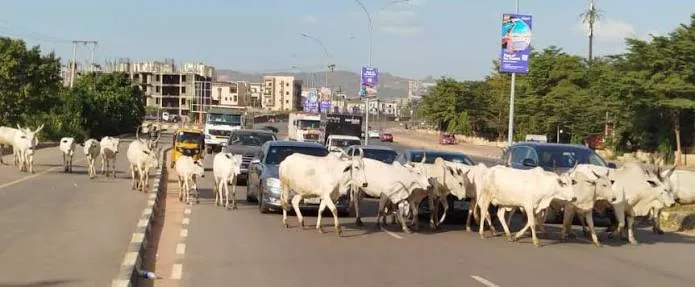
Motorists plying some roads in the Federal Capital Territory (FCT) have raised concerns over the continued movement of cattle along major roads and residential areas in Abuja, describing the practice as a growing road hazard that could lead to avoidable accidents.
Herds of cattle are frequently seen crossing busy streets, walking along road corridors or grazing on open spaces close to residential buildings in parts of the city.
Motorists said the situation was particularly dangerous when the animals suddenly moved onto busy roads, forcing drivers to brake sharply, stop or change lanes to avoid hitting them.
Some also expressed concern about the danger posed by cattle at night, particularly on poorly lit roads where motorists may not see the animals early enough to take evasive action.

Chinedu Okafor, who frequently drives through Gwarinpa, said he sees cattle around the area almost every day.
According to him, the animals are often found grazing close to roads or on road medians, making driving difficult and forcing motorists to exercise caution.
“The cattle had on several occasions caused motorists to apply brakes suddenly when they appeared unexpectedly on the road,” Okafor said.
He said he had witnessed an accident involving a vehicle and cattle, which resulted in severe damage to the car.
Okafor called on the FCT Administration to ensure that cattle were kept away from major roads and residential areas, saying motorists should not have to drive with the fear of colliding with animals.
Another motorist, John Emmanuel, said he regularly encountered cattle around Wuse Market, particularly in the morning when workers and other commuters were heading to their workplaces.
He said the movement of cattle sometimes contributed to traffic congestion as motorists had to slow down or wait for the animals to cross.
Emmanuel said he had not witnessed an accident involving cattle but had heard several complaints from motorists about the danger they posed on major roads.
He urged the authorities to identify appropriate areas for livestock and prevent cattle owners from allowing their animals to move freely on busy roads.
For Daniel Sunday, who drives through Area 11, the problem was not simply the presence of cattle but their unpredictable movement.
He said the animals could suddenly move from the roadside onto the carriageway, making it difficult for motorists to predict their direction.
According to him, a motorist attempting to avoid cattle could also collide with another vehicle, particularly on busy roads.
Similarly, Ahmed Yusuf said the situation was becoming more concerning because of the growing population and increasing number of vehicles in the FCT.
“A lot of motorists have to wait for the cattle to cross, and this sometimes causes traffic congestion on major roads in the FCT. People can be delayed for several minutes because of cattle crossing,” he said.
Yusuf said the situation could become more dangerous when impatient motorists attempted to manoeuvre around the animals.
He called for a permanent solution, saying cattle should not be allowed to use public roads as grazing routes.
Another motorist, Bello Abdullahi, said the situation was particularly worrying at night because cattle could be difficult to see early enough, especially on roads with inadequate lighting.
“The major problem is the possibility of a motorist hitting an animal or swerving suddenly to avoid one,” he said.
Abdullahi urged the FCT Administration to prevent cattle from moving freely on roads, particularly at night, and ensure that livestock owners used appropriate areas for grazing.
Kabiru Musa said he had encountered cattle on several occasions, particularly around Wuse Bridge.
He said their presence sometimes caused traffic obstruction, leaving motorists with little choice but to wait until the animals cleared the road.
Musa urged the government to take the issue seriously and ensure that cattle were moved away from busy urban roads.
Maryam Ahmed, who regularly uses Life Camp Junction, also complained about the continued presence of cattle.
She said she frequently encountered cattle grazing beside the road and sometimes occupying part of the carriageway.
She called on the FCT Administration to take decisive action, saying the continued movement of cattle on major roads posed an unnecessary risk to motorists and other road users.
Efforts to obtain the reaction of the Abuja Environmental Protection Board (AEPB) on measures being taken to address the presence of roaming cattle in Abuja city centre proved abortive.
The agency’s spokesperson, Janet Peni, did not respond to calls put to her.
She had earlier told our reporter that the agency could not respond to media inquiries without written permission from the FCT authorities.
Wike apologises over roaming cattle
Meanwhile, the Minister of the Federal Capital Territory, Nyesom Wike, recently took responsibility for the continued presence of cattle on major roads and streets across Abuja.
Speaking during one of his monthly media briefings in Abuja, Wike expressed regret over the development and assured residents that the administration remained committed to addressing the issue.
“I apologise that up till now there are cows still roaming the streets of Abuja, I take responsibility,” the minister said.
Despite the assurance, residents said the situation had persisted, with cattle still seen roaming some Abuja streets and roads.
The Nigeria Police Force, on its part, said the control of roaming cattle in the FCT was not within its mandate, stressing that its intervention would only be required when the animals were involved in an offence.
The police spokesperson, Ani Iniedu, stated this recently at a joint security spokespersons’ briefing while responding to enquiries about the increasing presence of cattle on roads and other public spaces in Abuja.
Iniedu explained that responsibility for controlling animals, including cattle, rested with the relevant environment authorities, while the police would intervene where the animals caused damage to property, trespassed or became involved in other offences.
“The responsibility for the control of animals is the Ministry or Department of the Environment. Where we come in is if the cow has committed an offence or the cow is involved in the destruction of your property or trespassing your property,” he said. (Daily Trust)
-

 News24 hours ago
FCT Mininister Wike’s son submits American passport in controversial $2.1m land acquisition case
-
 World News22 hours ago
Singapore unveils matchmaking service amid falling birth rate
-
Sports22 hours ago
Everything Guardiola said about Man City’s 115 charges – Report
-
News6 hours ago
30 states’ debt outpaces half their annual revenue
-
Metro22 hours ago
Building collapse kills one in Anambra
-
News6 hours ago
Reforms over, we’ve laid foundation for lasting prosperity — Tinubu
-
Politics6 hours ago
2027: If Tinubu Wins, We Are Retired From Politics – Amaechi Tells ADC Leaders
-
News6 hours ago
Tinubu Signs Bill Extending 2025 Budget Implementation To Dec 2026