Politics
Four visions for Lagos: How Hamzat, Funso Doherty, Rhodes-Vivour, Adedeji Doherty differ on housing, traffic, economy, education

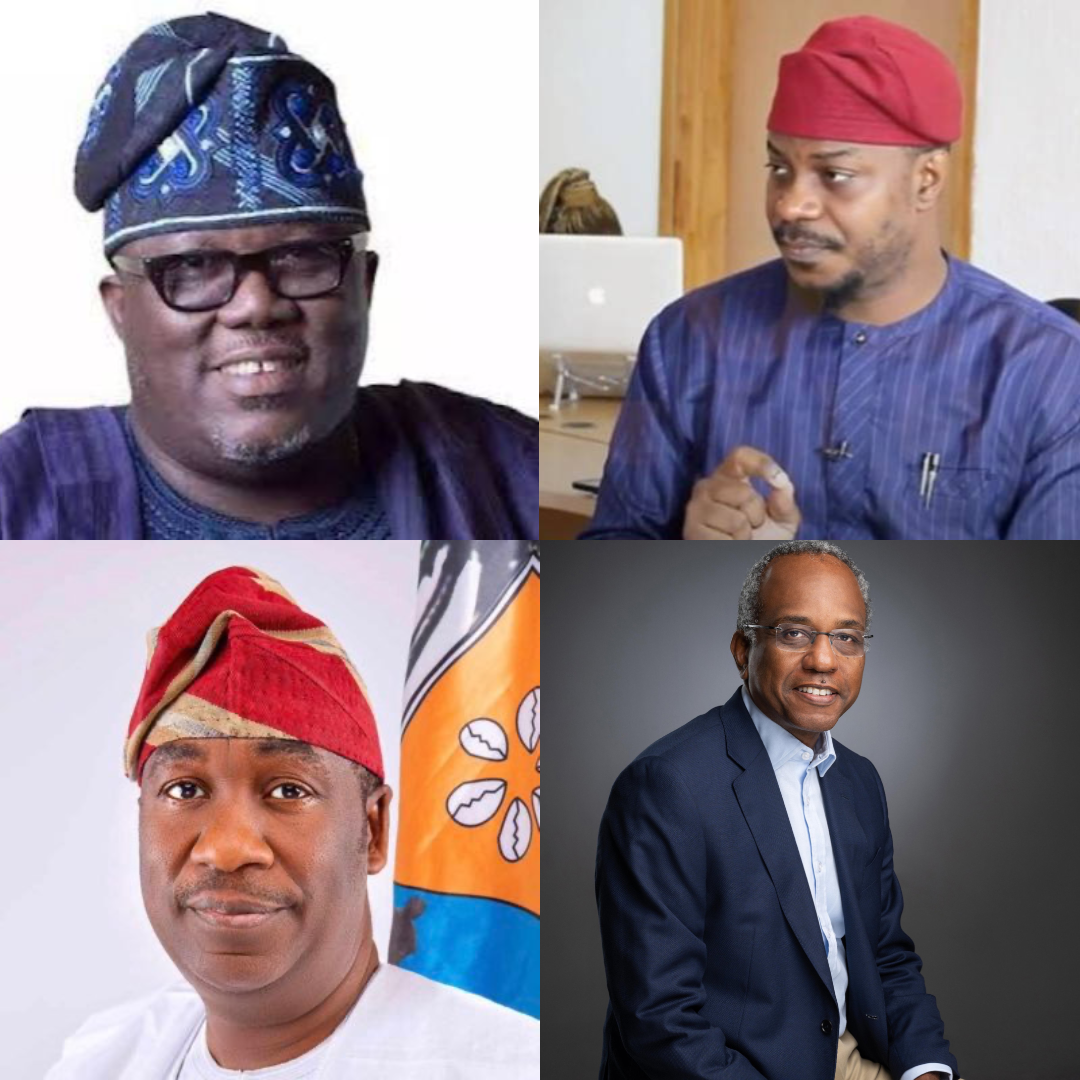
Housing, traffic, waste management, education and the cost of doing business emerged as some of the sharpest points of difference among four Lagos governorship candidates who shared a platform with young voters ahead of the 2027 election.
Obafemi Hamzat of the All Progressives Congress (APC), Funso Doherty of the Nigeria Democratic Congress (NDC), Gbadebo Rhodes-Vivour (GRV) of the African Democratic Congress (ADC) and Adedeji Doherty of the People’s Democratic Party (PDP) presented markedly different approaches to some of Lagos’ most persistent urban and economic problems at The Platform Millennial and Gen Z Town Meeting with Lagos governorship candidates on Thursday.
While Hamzat largely defended the record of successive APC administrations and proposed extending existing interventions, the three opposition candidates framed their proposals around changes in the way the state manages housing, transportation, public services, the environment and the economy.
The differences were particularly evident in how they approached the housing crisis.

Housing: supply, mortgages or new urban settlements?
Rhodes-Vivour proposed building 100,000 housing units within four years, with a financing structure designed to allow residents to make monthly payments and move into homes that can accommodate changes in their income and family circumstances.
His proposal links housing to employment and skills development. He said young people trained in trades such as tiling, bricklaying and POP installation could be deployed on government projects, including the housing programme.
Funso Doherty put a higher numerical target on the table, proposing about 150,000 housing units during his first term. His broader approach places housing within a social-policy framework in which the government is expected to intervene more directly in the provision of basic services.
The NDC candidate argued that housing supply had failed to keep pace with demand and that the government needed to play a greater role in addressing the deficit.
Hamzat took a different route, focusing less on a new headline construction target and more on financing. He proposed deepening the mortgage market so prospective homeowners could pay about 10 percent upfront and spread the balance over as much as 20 years.
He also promised to complete existing housing projects, including developments at Sagotedo, Ibeshe, Egan-Igando and Amuwo-Odofin. At the same time, he acknowledged that not everyone would own a house and said the government had a responsibility to ensure rent did not destroy residents’ dignity.
Adedeji Doherty proposed yet another model: high-rise, low-cost housing in less densely populated areas of the state, combined with better transportation links to employment centres.
He also proposed that the government acquire existing family houses through negotiation with property owners and use land-related revenues to finance housing and infrastructure.
The four approaches therefore revolve around different levers: Rhodes-Vivour emphasises affordable monthly ownership and construction-linked skills; Funso Doherty emphasises large-scale supply; Hamzat emphasises mortgage finance and completion of existing projects; while Adedeji Doherty combines new high-rise development with acquisition of existing properties.
Traffic: rail expansion, roads and the commute
Transportation was another area where the candidates offered different diagnoses and solutions.
Rhodes-Vivour proposed opening the state’s rail procurement system to greater private-sector participation. He argued that Lagos could complete its outstanding rail projects more quickly by allowing private capital and expertise to participate transparently in procurement.
His wider proposal is a multimodal transport system that integrates rail, road and other forms of public transportation while connecting housing and employment centres.
Hamzat approached the problem from the perspective of the commuter, saying his vision was to reduce the amount of time residents spend travelling between home and work or business. His emphasis was therefore not simply on infrastructure but on shortening travel time.
Funso Doherty also focused on the quality and safety of the commuting experience. He said Lagosians should not have to use unsafe or rickety transport or face the risk of robbery while travelling. He also spoke about reforming the activities of transport unions and improving local government roads.
Adedeji Doherty’s approach centres more strongly on road architecture. His 10-point agenda propose efficient road and transport networks, including dedicated roads for commercial vehicles, cyclists and private vehicles on some federal and state roads.
The difference is significant: Rhodes-Vivour’s answer is largely about expanding and financing mass transit; Hamzat’s is about reducing journey times through continued infrastructure and system improvements; Funso Doherty places greater emphasis on safety, affordability and reform of the transport ecosystem; while Adedeji Doherty focuses on road design, connectivity and dedicated infrastructure.
Waste and the environment: collection versus a circular economy
Waste management produced perhaps one of the clearest contrasts between continuity and structural change.
Hamzat defended the direction of the current administration, saying Lagos was expanding its waste collection and processing capacity. He cited plans to bring in about 160 additional waste trucks and establish transfer loading stations capable of handling large volumes of waste.
He also mentioned material recovery facilities and a proposed waste-to-energy plant at Agbara, reflecting an approach that seeks to increase the state’s ability to collect, transfer and process waste rather than rely predominantly on landfills.
Rhodes-Vivour proposed a more decentralised system. Rather than concentrating waste management largely at the state level, he wants local governments to play a greater role and develop waste-to-wealth businesses.
His proposal involves separating waste at source and treating organic waste, plastics and other recyclable materials differently.
“There is no reason why organic waste should be going to the same landfill that plastic waste is going to,” he said.
He also argued for greater private-sector participation in waste collection and linked waste management directly to flood control and urban planning.
Funso Doherty’s environmental position has also focused on the broader question of environmental governance and flooding. In June, following flooding across Lagos, he argued that indiscriminate waste disposal alone could not explain the scale of the problem and called for greater scrutiny of environmental governance and infrastructure projects.
For Hamzat, therefore, the emphasis is on capacity and infrastructure; for Rhodes-Vivour, decentralisation, recycling and wetland protection; while Funso Doherty has framed the issue around environmental governance and accountability.
Adedeji Doherty’s proposals at the event were less detailed on waste management than those of Hamzat and Rhodes-Vivour, but his wider agenda places infrastructure, water and urban development among the areas requiring intervention.
Business and the economy: levies, power and industrialisation
The candidates also differed in their understanding of what is holding Lagos businesses back.
Hamzat’s most direct intervention was on unauthorised levies. He promised to eliminate charges that businesses cannot trace to an authorised government agency and proposed a State Economic Council involving different levels of government to streamline taxes and levies.
“Businesses must know what I am going to pay. And the moment I pay it, you must leave me alone,” he said.
He also linked economic policy to support for small and medium-sized enterprises through training in areas such as bookkeeping and staff management.
Beyond the immediate business environment, Hamzat proposed a State Wealth Fund as a mechanism for Lagos to save and invest beyond individual political cycles.
Adedeji Doherty’s economic proposition is centred on electricity.
“We will create an enabling environment for businesses to thrive. We are going to make sure there is power; we are going to cut down on frivolous charges and levies that pull businesses down,” he said.
His argument is that Lagos cannot industrialise without addressing electricity costs. He also wants to revisit the state’s taxation law and create an environment in which indigenous companies can expand rather than face what he considers excessive charges.
Rhodes-Vivour similarly called for the removal of unauthorised levies and harmonisation of charges across the federal, state and local government levels. But his wider economic model is more decentralised, with local governments expected to play a greater role in employment creation, skills development and economic activity.
Funso Doherty’s economic argument is anchored in the idea of a stronger social contract: citizens contribute through taxes while the government provides public services and creates conditions for businesses and individuals to prosper.
The common thread is that all four recognise the cost of doing business as a major issue, but their proposed solutions differ: Hamzat targets unauthorised charges and institutional coordination; Adedeji Doherty puts power and industrialisation at the centre; Rhodes-Vivour combines tax harmonisation with decentralised economic activity; and Funso Doherty places business within a wider social-service and human-capital framework.
Education: Free access versus system reform
Education produced perhaps the sharpest contrast between the opposition candidates and Hamzat’s defence of the current administration.
Funso Doherty made one of his clearest pledges: public education would be entirely free, including books and examination fees, within his first 100 days.
He also proposed one nutritious meal for every child in public school and free school transportation for children who need it. His argument was that no child should be denied education because of the inability of parents to pay.
Rhodes-Vivour focused more on rebuilding public education and linking it to technology and skills.
He proposed about 40 technical and vocational schools and argued that young people should be trained for occupations demanded by the economy. He also called for better public-school infrastructure, improved teacher salaries and training, and greater use of technology.
He criticised the growing reliance on private schools, arguing that Lagos should build a public education system good enough for families not to have to travel long distances or depend on private schools.
Hamzat defended the administration’s record by pointing to improvements in WASSCE performance while acknowledging that more remained to be done.
He also proposed a Child Welfare Administration Agency within his first 100 days, with the stated objective of ensuring children under 18 are either in school or learning a trade.
Adedeji Doherty also places free, quality and affordable education among the central pillars of his agenda. His proposed model includes a welfare structure for teachers and non-teaching staff, reflecting his argument that education reform must also address the people responsible for delivering it.
Healthcare and social welfare
The candidates also presented different levels of emphasis on healthcare.
Funso Doherty proposed free healthcare, with particular attention to maternal and child healthcare. His social contract model treats healthcare alongside education as a basic service that should not depend on a family’s ability to pay.
Rhodes-Vivour proposed emergency stabilisation centres in every ward, designed to provide immediate intervention before patients are referred to hospitals equipped to handle their conditions. He specifically linked the proposal to reducing maternal mortality.
Adedeji Doherty’s agenda calls for a quality and affordable healthcare network accessible to market traders, artisans and pensioners, while also proposing broader investment in health infrastructure.
Hamzat, meanwhile, cited the expansion of emergency response capacity under successive APC administrations, including the growth of ambulance and fire-service capacity, as part of the record he said should be considered alongside areas where further work is required.
Jobs, skills and young Lagosians
The four candidates also differed on how they would connect young people to the economy.
Rhodes-Vivour’s model is strongly skills-based. He proposed training young people at ward and local government levels and creating opportunities for them to work on government projects.
His proposed technical and vocational schools would train residents in practical skills while his technology programme would expand access to artificial intelligence tools and digital opportunities beyond established technology centres such as Yaba.
Funso Doherty similarly emphasised technical and vocational education, employment and local government development.
Adedeji Doherty’s approach is centred on industrialisation and enterprise, drawing heavily on his experience as a businessman. His agenda specifically includes employment creation and a State Industrialisation Support Programme.
Hamzat’s approach combines SME support with a broader economic strategy, including business training and the proposed State Wealth Fund.
The larger divide
The presentations revealed less of a disagreement over the problems facing Lagos than over the role government should play in solving them.
Hamzat’s approach is predominantly one of continuity and consolidation. He defended existing infrastructure and public-service investments while proposing adjustments such as mortgage financing, better coordination of business levies, expanded waste infrastructure and a long-term wealth fund.
The opposition candidates are proposing more structural changes, but they do not all point in the same direction.
Rhodes-Vivour’s Lagos is built around decentralisation, affordable housing, private-sector participation in rail, skills development, waste-to-wealth, wetland protection and a stronger public education system.
Funso Doherty’s model is more explicitly centred on a social contract, with free public education, healthcare, housing expansion, safer transportation and stronger public intervention in basic services.
Adedeji Doherty’s proposition is heavily economic and infrastructure-driven: cheaper electricity, industrialisation, improved roads, housing outside the metropolitan core, tax reform and stronger support for businesses.
The differences will become more consequential as the 2027 campaign moves from broad promises to questions of financing, timelines, land availability, institutional responsibility and implementation.
For Lagos residents, the town hall therefore offered four different answers to the same basic question: whether the state’s next phase should primarily extend the existing development model or redirect government towards different priorities in housing, mobility, public services, environmental management and economic production.
The candidates have now put their broad positions on the table. The next test will be how specifically those proposals are costed, funded and translated into measurable commitments. (BusinessDay)
-

 Metro22 hours ago
‘DNA tests destroy marriages, should be banned’ — Nigerian woman says
-
Business3 hours ago
Dangote stops petrol sales to fuel importers
-
News22 hours ago
BREAKING: Several Feared Dead As Helicopter Crashes In Ondo
-
Business3 hours ago
Nigeria overtakes four nations in Africa investment ranking
-
Politics21 hours ago
2027: Your mad obsession with Obi is clear — NDC replies Soludo govt
-
Metro20 hours ago
Period Poverty: Some women now use baby diapers in place of sanitary pads
-
Politics20 hours ago
Presidential Poll: Court orders INEC to upload Olawepo-Hashim as candidate
-
News3 hours ago
CAN urges Tinubu to reduce fuel, food prices