Business
Inside the rice price dispute

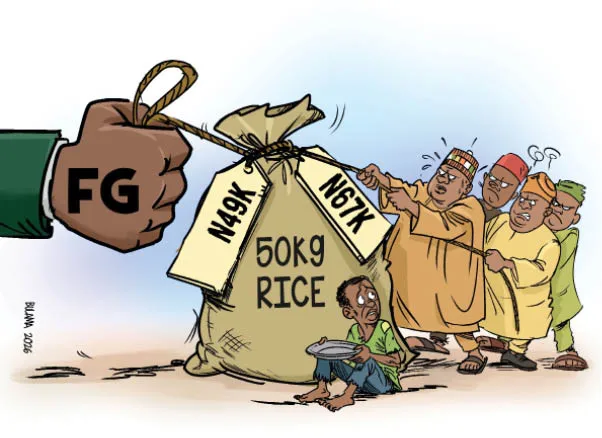
The federal government and rice processors have disagreed on how much milled rice should cost in the country. The government argues that the current rice price, which falls between N60,000 and N67,000 for every 50 kilograms bag, is excessive and should be reduced to what it described as a more reasonable range of N55,000 to N57,000.
On Tuesday, October 6, 2026, the ministers of Agriculture and Food Security, Senator Abubakar Kyari and Dr Aliyu Sabi Abdullahi, along with their permanent secretary, Dr Marcus Olaniyi Ogunbiyi, convened a meeting, which was attended by the president of the Rice Processors Association of Nigeria, Mohammed Abubakar Mai Fata (chairman of Umza Rice Kano), and its Director-General, Dr Andy Ekwelem, representatives of Olam, WACCOT, and the All Farmers Association of Nigeria, including the Managing Director of the Bank of Agriculture, Ayodeji Oludare Sotinrin, to address concerns related to the prevailing market price of milled rice.
Weekend Trust gathered that the atmosphere of the meeting hall was tense as there were accusations and counter accusations over the current price of rice in the market.
Federal government ’s claims

The ministers argued that based on the market survey and analysis they conducted, the average production cost for a bag of rice was N49,389.23; therefore, the current market price, which is above N60,000 per 50 kg was “too high and indiscriminate.”
Senator Abubakar Kyari, the Minister of Agriculture and Food Security, said the current market price is unacceptably high.
“We are not trying to control prices. Mr President is not interested in the crash of business, but let’s look at the factors. It is about the economy, supply and demand, production and cost of production. We have looked at all these areas, and believe that these prices should not be where they are. We are extremely concerned with the indiscriminate increase in prices.
“The government has mechanisms to apply to make sure that the citizenry’s welfare is protected, but at the same time, we are looking at farmers’ and millers’ welfare,” he told the millers and farmers in the meeting room.
The minister of state for agriculture, Dr Aliyu Sabi Abdullahi, also told the RIPAN chairman that he believed there were bad eggs in the association trying to sabotage the country.
“Mr Chairman, we are aware there is bad behaviour among your group, and you must stand your ground and ensure that people who are exhibiting this bad behaviour are asked to stop if they have to continue to be part of it. While we cannot modulate you, we expect that every system that operates in the way you are operating is supposed to auto-correct itself.
“Autocorrecting yourself means that you are capable of disciplining your members who are not sticking to what you have agreed as a group. It is when you are doing that, that the integrity of your group becomes well-sounded, well-recognised and respected,” Dr Abdullahi said.
Speaking further, the minister of state defended government’s position on the current price. He said that when calculating this price, the ministry considered all the cost drivers in the processors’ production system, including waste and losses, as well as the fixed cost of numerous processes that would support their operations.
Therefore, a plus or minus in any market, depending on the average, should not create such a wide gap between the cost of production and the final price of the product in the market.
“I think that’s the point we are making. Getting it that high is what we are worried about,” Dr Abdullahi said.
Also speaking, the permanent secretary of the ministry, Dr Ogunbiyi, insisted that the current price of rice in the market “is too high,” adding that the issues needed to be addressed.
“I am an engineer. I have been in rice processing for a long time. I took this analysis and survey and I looked at it very well. We have addressed every area, every production cost in this area, including diesel etc and we got N49,000. Look at it. We are all Nigerians, please. The current price is too high,” he explained.
RIPAN expresses frustrations
The president of the Rice Processors Association of Nigeria, Mohammed Abubakar Maifata, who spoke on behalf of the processors, did not conceal his dissatisfaction with the government at the meeting, Weekend Trust gathered. He said the importation by some group of individuals was adversely affecting the millers in the country.
“The ministry is even saying that they don’t know that somebody is importing. I have to show them a video of people offloading rice today in Port Harcourt. This is the situation we find ourselves.
“Some years back, we were fighting smuggling; now, the thing has gone beyond smuggling to importing milled rice all the time. Whatever you do with the committee, believe me, I know what is right. It will be counterproductive if importation continues because whatever we do in the next 10 years, even if we invest all we have in agriculture, we cannot match the cost of production of paddy with India and Thailand because they have been doing it consistently.

“So, that means our cost will definitely not be the same as what they have. Then we are left with the option of either abandoning our industries and the food security programme to rely on imports, which is not realistic or make sure we stop it and continue to develop and nurture our industry. This is what is affecting all of us,” the Umza chairman explained.
Speaking further on the factors responsible for the instability in the price of rice, the RIPAN chairman said, “The primary raw material of any processor is paddy. The cost of the paddy drives the cost of the rice (milled).”
He said when the Anchor Borrowers Programme stopped; when the government stopped funding primary production as it was before 2023, issues started to affect the sector.
“Let me recall 2024 when there was an issue that millers were selling rice at N80,000. At that time, it was not mentioned that the millers were buying paddy at N800,000 as well. So the cost of paddy is the issue that affects the industry.
“The issue of the cost of paddy has come back to government. Today, farmers are buying fertiliser at more than N50,000 for the dry season. They are buying diesel at N2,000 per litre.
“Today, at 20 per cent moisture, farmers cannot sell a tonne of paddy at less than N500,000. This is something that is normal – from N450,000 to N500,000,” he said.
But the minister interjected, saying the survey carried out by the ministry showed otherwise, adding that the prices of paddy are changing based on demand and supply, Weekend Trust gathered.
“For instance, in the North-Central, Nasarawa and Niger are the cheapest. A tonne is at N450,000,” he explained.
The minister said he believed that both the government and millers could agree on something to come to a price that is less “because you have a responsibility, and we also have a responsibility. I have the average cost of paddy here (referring to the market survey done by the ministry), which is N460,000 per tonne with 20 per cent moisture. So at the end of the day, dried paddy will be N533, 000 average.”
Although a committee was set up with six members from processors, farmers and two people from the ministry to hash out modalities and reach an agreement, many millers were dissatisfied, Weekend Trust gathered.
Many processors believe that any resolution of the committee would have no influence unless the government addressed the issue of importation.
Millers in states
Rice millers across the country said they were facing mounting challenges that threaten the sustainability of the rice processing industry, including inadequate paddy supply, high energy cost, insecurity and competition from imported rice.
Speaking to our correspondent in Birnin Kebbi on the issue, the General Manager of Labana Rice Mills, Mallam Alhasan Yusuf, explained why selling rice below N58,000 per 50 kg would be a big problem for many millers.
“What we want the federal government and Nigerians to know is that the price of any finished product in any rice mill is directly proportional to the price of paddy. If the price of paddy is high, definitely, the price of the finished rice will be high. If it is low, the price of finished rice will be low as well.
“We have to propose some measures of intervention to the government, such as tax waivers and other incentives that will cushion the effects on the rice mills in the country.
“Let me give you an example of what happened outside Nigeria. There was a situation like this sometimes in Brazil and when their government wanted to bring down the price and didn’t want to shortchange millers, farmers and the people, it asked the processors to sell to people at a reduced price and it subsidised for the processors.
“If that happens here, it will be a win-win for the government, the processors, farmers and the people in the short run. But in the long run, the government needs to do a lot on agricultural extension services.
“At the current price we are buying paddy, the lowest we can sell our finished product, if we must pay salaries, electricity bills and other essential costs, is N58,000. If we sell at anything less than this, we will run at a loss,” he explained.
He alleged that one of the problems they faced as millers in the country was the selective waiver given to an individual to bring brown rice into the country. He argued that this would continue to put both millers and farmers in a position to be shortchanged. Except the government grants waivers to all millers to import brown rice, it is another way to make rice cheaper in the country. And our farmers should be empowered so that they would not be shortchanged in that arrangement.
A rice miller, Malam Ahmad Muhammad, said a number of both large integrated mills and small and medium-scale processors were operating below their installed capacity because of many challenges.
He said high energy cost had also emerged as a major burden as rice milling requires substantial electricity for parboiling, drying, milling and packaging. According to him, unreliable public power supply has forced many operators to depend on diesel-powered generators, increasing production cost.
“With the current situation, having a controlled price of rice is almost impossible without regulating and controlling energy sources and their availability. The rising cost of diesel has increased production expenses and squeezed profit margins,” he noted.
Another miller said fixing the price of rice had become difficult because a tonne of paddy currently costs between N450,000 and N480,000. He said the price was not stable, with indications that it could rise further.
He also said rice processors were facing growing competition from imported and smuggled rice, which he said was creating an unfavourable environment for healthy competition. He explained that cheaper imported rice would always put pressure on locally processed commodities, making it difficult for domestic millers to recover their rising production cost.
The Managing Director of Umza Rice Mills, Kano, Alhaji Abubakar Muhammad, said rice millers alone would not be able to crash the price of rice as requested by the federal government, noting that cost of production must also be addressed.
According to him, millers are spending a lot of money on public supply of electricity and generators to run the rice mills, which adds to the production cost that translates into the rice price. He said Umza Rice Mills spent roughly N100 million to cover electricity bills in a month, which if added to diesel for their generators, would nearly double the amount.
“This is despite the fact that the public supply of electricity is unstable. From the time I entered my office today, there were power interruptions more than 10 times. How can you do something meaningful under such a situation? You still have to use generators that consume diesel, a very expensive commodity. All these add to your production cost,” he explained.
Umza Rice Mill, located along the Kano-Zaria road, was built by Alhaji Abubakar Maifata, with the capability to mill 430,000 metric tonnes of paddy annually.
He argued that rice farmers may abandon their farms next farming season if they could not recoup their investments on account of attempts to crash the price without due regard to the cost of production.
‘Millers alone cannot crash rice price’
“If a farmer who spent a humongous amount to buy fertilisers and other inputs realises that he is selling his rice at a loss, he may not go to the farm next farming season; and rice will ultimately not be available for millers,” the managing director said.
A member of the Rice Processors Association of Nigeria who preferred not to be named, said the government should not tell millers to crash rice prices when last year, in a bid to crash the price, it entered into an agreement with the Indian government through high-level diplomatic negotiation to remove a 30 per cent levy on semi-processed rice and allowed only one or two persons to import semi-processed brown rice into the country.
In similar vein, the RIFAN chairman in Kebbi State, Yusuf Argungu, also maintained that except the government came up with a policy to ensure the availability of paddy for rice millers in the country, its effort to bring down rice prices may not yield any result.
He stressed that for some time now, many of the rice-producing states could not produce paddy for the millers to buy. He argued that the scarcity of paddy for the millers’ finished product had not helped to bring down the price of rice price.
According to him, right now, most of the rice-producing states have insecurity issues. Many of the mills have no paddy to process in their warehouses. And the higher the demand, the higher the price. “If paddy is available, the price of rice will definitely fall. I think what the government should do is to empower farmers across the country. If they are empowered, they will go to the farms to produce more paddy for our local mills; and they will get more paddy to process,” he said.
Warning against the importation of rice into the country, the RIFAN chairman said: “If the government empowers farmers and gives subsidies to rice mills, we will meet the required rice needs of the country. The price being proposed by the federal government is only possible if they could meet the needs of both the farmers and millers”.
He added that the government should come up with a policy for farmers to produce more rice to feed Nigerians and even export the excess to other countries.
“The rice-producing states can meet the rice need of the country if government comes in to support them. The Anchor Borrowers Programme of the administration of the late President Muhammadu Buhari was good but not well implemented. It didn’t work because people were owing and refused to pay back their loans. If it was well utilized, we would have enough rice in the country. Imagine that a well known rice mill like WACOT does not have paddy to process. Their warehouses are empty. Government needs to come in to enhance more rice production in the country,” he also said.
A rice farmer and member of the Rice Farmers Association of Nigeria, Aminu Bashir Warawa said rice farming needed strong and sustainable government support to help stabilise prices. He added that insecurity had compounded the problem by disrupting the movement of farmers, traders and transporters.
Warawa said banditry and other criminal activities in parts of the North had made it more difficult for farmers to access their fields and millers to transport paddy from producing communities to processing centres.
He also said the high cost of fertiliser and other agricultural inputs had made rice farming increasingly expensive, forcing some farmers out of production and contributing to the rising cost of paddy in the open market.
“Addressing the problems requires a coordinated approach involving improved security in farming communities, access to affordable finance, reliable electricity, better rural roads, improved paddy aggregation and storage facilities, as well as stronger links between farmers and millers,” Warawa said.
He added that policies aimed at promoting domestic rice production must take into account the operating cost confronting processors, warning that increased production at the farm level might not translate into competitive and affordable locally milled rice without addressing the challenges facing millers.
‘FG should not impose price’
An economist, Ibraheem Maigari, has advised the federal government against imposing direct controls on the price of rice, saying such a policy could discourage farmers and millers from investing in the sector. Maigari said the government should instead address the major factors driving up the price of rice, including the cost of paddy, fertiliser, energy, transportation and other production inputs.
He said reducing these costs would enable farmers and rice millers to operate profitably while making the commodity more affordable to consumers.
According to him, increasing domestic rice production remains one of the sustainable ways of addressing high prices. He stressed the need for the government to invest in irrigation, rural roads, storage facilities, affordable credit and improved security for farmers.
“The government should address the factors responsible for the high cost of rice rather than simply fixing the selling price. If production and distribution costs are reduced, consumers will ultimately benefit from lower prices,” he said.
Maigari also urged the government to consider targeted support for vulnerable households while pursuing measures to increase rice production, warning that excessive price controls could result in shortages and distort the market.
He said any intervention in the rice sector should strike a balance between protecting consumers from high prices and ensuring that farmers, millers and other players in the value chain remain encouraged to continue production.
‘Government should provide incentives, not compel businesses to support policies’
The government should provide tax holidays, low-interest loans and reliable infrastructure to manufacturers and other businesses instead of expecting them to support its policies without creating a conducive environment for profitable operations, a human rights activist, Debo Adeniran, has said.
Adeniran said businesses would be more willing to cooperate with the government if they could make reasonable profits, meet their obligations to workers and sustain their operations.
“Government has the prerogative of determining what policy they want to introduce and implement, but they don’t have the prerogative of determining which private individuals or companies will cooperate with them in the implementation of that policy,” he said.
He argued that the business environment in Nigeria had not been fully developed to enable manufacturers, rice millers and cottage industrialists to operate profitably.
He said the government should introduce soft loans for small-scale industries and provide manufacturers with access to credit at little or no interest.
According to him, reliable electricity and good roads would reduce production and transportation costs, enabling businesses to operate more efficiently and support government programmes.
He said the government could also establish industrial villages where artisans and small-scale manufacturers, including welders, furniture makers and soap producers, could access equipment and facilities at affordable rates.
Adeniran further said the government could buy produce from farmers at profitable prices and release it to the public at lower prices during periods of scarcity.
(Daily Trust)
-

 News15 hours ago
Tinubu’s Case: FG paying US lobbying firm $750,000 monthly — Court papers
-
Politics15 hours ago
We’ll make campaign difficult for ‘lunatic’ Amaechi in Rivers if he keeps insulting Tinubu’s supporters – Wike
-
Business23 hours ago
Why Elon Musk is taking on India’s richest man over Starlink
-
Business19 hours ago
Hot money props Nigeria’s FX reserves with export earnings aloof
-
Business3 hours ago
Petrol Hits ₦1,900/Litre as Depot Prices Surge Despite NNPC Cut
-
African News19 hours ago
South Africa withdraws asylum directive after xenophobic clashes
-
News19 hours ago
JUST IN: Police confirm abduction of three workers at Oyo Institute
-
News23 hours ago
Igbo youths’ apathy may leave military without Igbo officers — Nwachukwu