
Politics
2027: If Atiku is knocked out, does Tinubu or Obi gain?

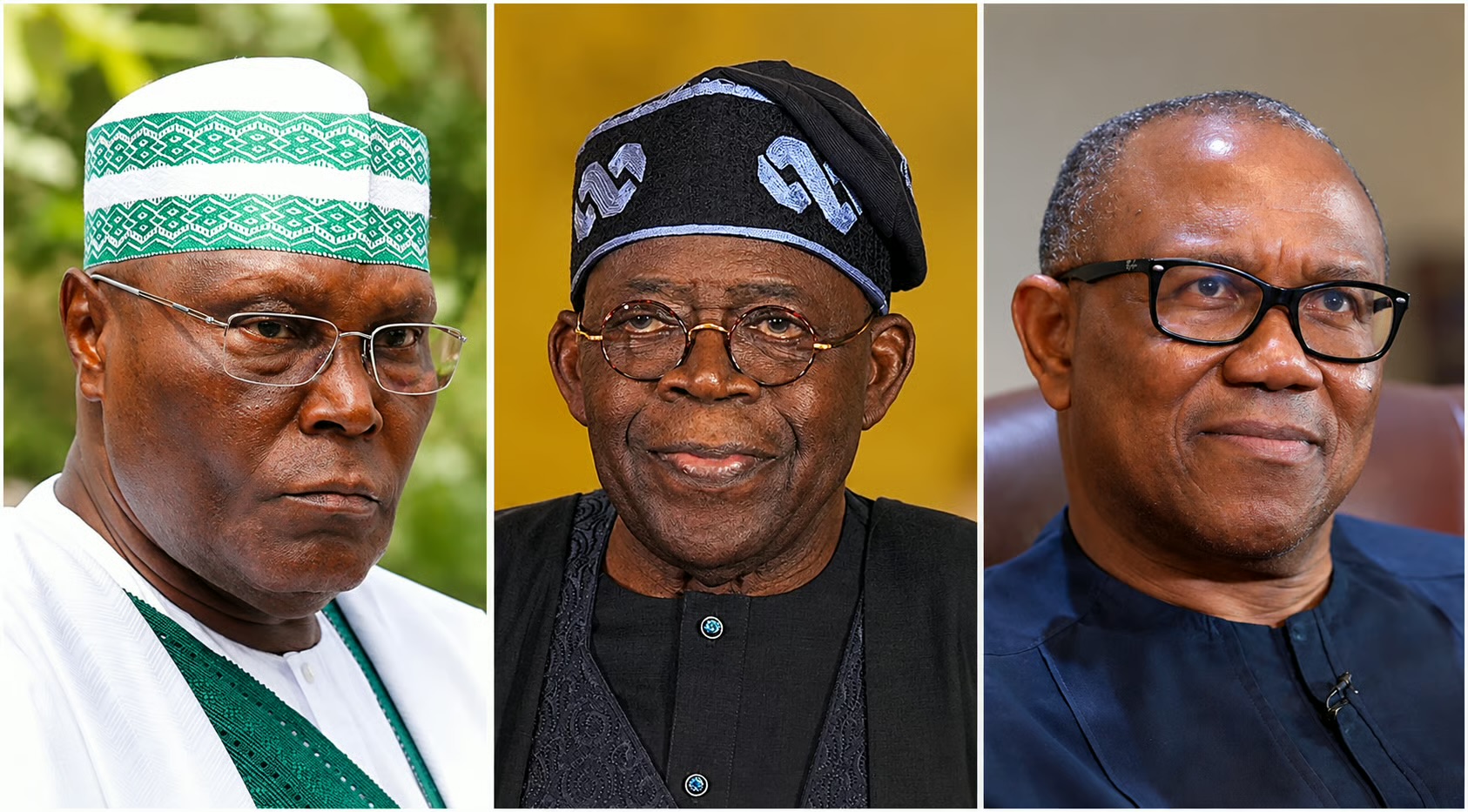
Two months before Nigeria’s presidential election, Atiku Abubakar is fighting to preserve his place on the ballot. A Federal High Court judgment on 5 November invalidated the opposition politician’s nomination, raising the prospect that one of President Bola Tinubu’s strongest challengers could be excluded from the 16 January contest.
That might seem an obvious advantage for the incumbent. But with Peter Obi, the Nigeria Democratic Congress (NDC) candidate, now running alongside Rabiu Kwankwaso, a prominent northern politician, Atiku’s removal could instead help consolidate the anti-Tinubu vote.
The answer may lie less in the courtroom than in northern Nigeria, where Atiku has drawn millions of votes over successive elections.
A court battle with the clock ticking
Justice Peter Lifu ruled that the David Mark-led leadership of the African Democratic Congress (ADC) had been improperly constituted. He annulled its decisions, including the primary that nominated Atiku as presidential candidate, following a challenge by rival party figure Nafiu Bala Gombe.

The judgment also invalidated other nominations made by the Mark-led executive, potentially disrupting ADC candidates in parliamentary races and the local networks on which a presidential campaign relies.
It is the latest turn in a factional struggle that has also involved Dumebi Kachikwu, the ADC’s 2023 presidential candidate. In April, the Supreme Court set aside an earlier order that had led the electoral commission to stop recognising Mark’s leadership, but returned the underlying dispute to the Federal High Court.
The ADC says it lodged an appeal on 6 November and sought a stay of execution. It has asked the Independent National Electoral Commission (INEC) not to act before the courts consider its application. Filing an appeal, however, does not automatically suspend the ruling. With polling day approaching, the timing of any judicial decision matters as much as its substance.
Atiku accuses Tinubu’s government of deploying the judiciary to weaken the opposition, describing the ruling as an attempt “to make genuine competition impossible and push Nigeria towards a one-party state”. The allegation remains unproven.
Presidential spokesman Temitope Ajayi rejects the accusation. “The person who took them to court is not a member of the APC or in Tinubu’s government,” he tells The Africa Report. “It is their internal issues. They should go and deal with it.”
The northern equation
Atiku, a former vice-president, finished second in both the 2019 and 2023 presidential elections. In 2023 he received almost 7 million votes, compared with Obi’s 6.1 million and Tinubu’s 8.8 million.
His strongest regional advantage lay in the north-east, where he won five of six states, and the north-west, where he carried Kaduna, Katsina, Kebbi and Sokoto.
Yet those victories offer only part of the picture. Across the north-west as a whole, Tinubu actually outpolled Atiku by about 455,000 votes, despite winning fewer states. Kwankwaso won Kano.
The numbers make a simple transfer of Atiku’s northern supporters to Tinubu implausible.
… that is an illusion; it’s mediocre thinking
Some could back the president; others might abstain, or look to Obi and Kwankwaso. Their response will depend on local political networks as well as dissatisfaction with Tinubu’s economic record.
Habeeb Sale, spokesman for the Kwankwasiyya Movement, disputes the idea that removing Atiku would deliver northern votes to the APC.
“Their calculation is that those areas believed to be Atiku’s strongholds will automatically go to them if Atiku is not on the ballot,” he says. “But for me, that is an illusion; it’s mediocre thinking.”
Sale argues that voters angered by Atiku’s exclusion could gravitate towards the Obi-Kwankwaso ticket.
That possibility is particularly significant in Kano, where Kwankwaso demonstrated his electoral pulling power in 2023. He secured around 1.5 million votes nationwide, most of them in his home state, making him a potentially valuable bridge to northern voters whom Obi struggled to reach last time.
An opening for Obi?
Obi has a ready-made opportunity to seek support beyond the southern and urban constituencies that propelled his 2023 campaign. His alliance with Kwankwaso offers a northern organisation and an established vote-gatherer. An absent Atiku would remove a rival for voters determined to defeat Tinubu.
But winning over Atiku’s supporters is not guaranteed. The former vice-president’s base spans communities and political structures that are not interchangeable with Kwankwaso’s. Obi must also overcome doubts about his appeal in parts of northern Nigeria where Atiku has longstanding personal and party networks.
Northern political analyst Bashir Dauda believes Obi could gain most from Atiku’s absence, but acknowledges that persuading northern voters remains a serious obstacle.
Tinubu, meanwhile, might benefit without securing many former Atiku supporters. If large numbers of Atiku’s supporters abstain, or the opposition fails to rally behind a single alternative, the incumbent could still win without gaining many new converts. In 2023, he took the presidency with 36.6% of valid votes.
Ajayi insists the president does not need an opponent disqualified.
“Whether or not Atiku is on the ballot, President Tinubu is winning the election; Atiku has no pathway to victory,” he says.
Atiku’s camp remains defiant. “Atiku will be on the ballot; he is unfazed and has continued with his campaign,” spokesman Paul Ibe tells The Africa Report.
For Tinubu, the best outcome may not be Atiku’s disappearance but an opposition divided against itself. For Obi, the opportunity is the reverse: to turn a legal shock into a more united electoral challenge. Neither outcome follows automatically from the court’s decision. (The Africa Report)
-

 African News11 hours ago
Fani-Kayode’s confession to being cured of madness circulates across South Africa
-
World News23 hours ago
US proposed ceding Ukraine territory in exchange for joining NATO
-
Politics23 hours ago
ADC: Atiku hasn’t reached out to me despite coming from the same zone – Nafiu Bala
-
Metro23 hours ago
Zainab, Kwankwaso’s daughter, files for divorce from Gov Yusuf, offers to return dowry
-
Politics7 hours ago
Tinubu, Aregbesola met three times despite rift – APC chieftain, Prof Adeyeye
-
News23 hours ago
Clashes between gangs, vigilantes kill over 50 in Zamfara – Report
-
Opinion10 hours ago
Why Nigerians vote the way they do
-
African News6 hours ago
Nigeria’s mission in S/Africa urges calm in row over Ramaphosa spokesman’s remarks