
Business
Nigeria’s shifting rice policies leave farmers flying blind

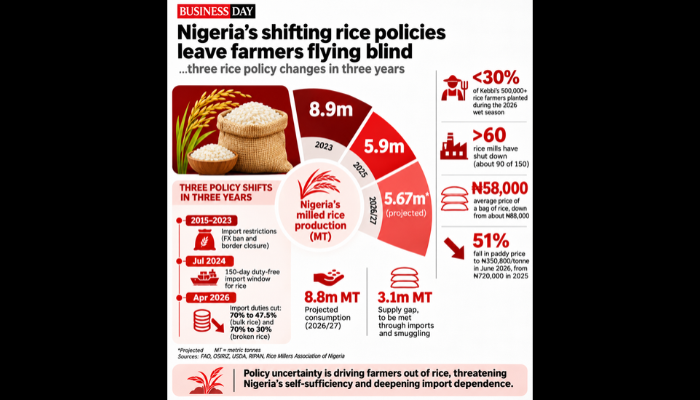
…three rice policy changes in three years
Nigeria’s push for rice self-sufficiency is losing ground as successive policy reversals expose farmers and millers to a market they can no longer plan for.
Three major shifts in import policy in as many years have weakened the protection that once encouraged domestic production, opened the market to cheaper foreign rice and left farmers struggling to sell their harvests.

With mill closures mounting and cultivation shrinking, policy uncertainty threatens to reverse years of investment in the domestic rice industry, deepen import dependence and expose Nigeria to future food supply shocks.
Idris Abdullahi, a 62-year-old farmer in Jigawa State, used to cultivate rice on a scale that supplied two mills. Today, he farms just five hectares. Both mills have shut down since 2024.
His paddy, harvested during the 2026 wet season, remains unsold on his farm, leaving him uncertain about whether to plant again during the dry season.
“I have reduced my cultivation area for rice to five hectares because cultivating paddy is no longer profitable,” Abdullahi said.
Like Abdullahi in Jigawa, farmers in Kebbi State are facing a similar challenge.
In Kebbi State, Nigeria’s leading rice-producing state, farmers are increasingly abandoning the crop as falling prices and weak demand erode returns.
Fewer than 30 percent of more than 500,000 rice farmers in the state planted during the 2026 wet season, according to Muhammed Augie, former chairman of the Rice Farmers Association of Nigeria, Kebbi State chapter. Kebbi accounts for more than 70 percent of national rice output, he said.
“They are pulling back now for the upcoming dry season and switching to cultivating other crops. The reason is not weather; it is policy,” Augie said.
Rice import restrictions (2015-2023)
Under former President Muhammadu Buhari, Nigeria pursued rice self-sufficiency through import restrictions. The government placed rice among 41 items ineligible for foreign exchange at the official market.
In 2019, it also closed the country’s land borders to curb smuggling, particularly through neighbouring Benin, further restricting imports.
The message to farmers was clear: invest in local production, and the government would protect the market. Farmers responded, while investment in domestic milling capacity expanded.
Although reliable data on the full impact of Buhari’s rice revolution remain limited, paddy production increased from six million metric tonnes in 2015, when the programme began, to 8.9 million metric tonnes in 2023, according to the Food and Agriculture Organisation (FAO).
The number of rice mills, including integrated and cottage facilities, also increased from 10 in 2015 to more than 100 in 2023, according to the Rice Processors Association of Nigeria (RIPAN).
Average rice yield rose from 1.9 metric tonnes per hectare to 2.47 metric tonnes per hectare over the period, according to FAO data, reflecting improvements in productivity alongside increased investment in the sector.
The waiver policy
The policy direction changed under President Bola Tinubu. In July 2024, the administration introduced a 150-day duty-free import window for rice and other essential food commodities as part of efforts to curb food inflation.
The move coincided with a surge in rice imports. The Observatory of International Rice Statistics (OSIRIZ) estimates that Nigeria imported 3.4 million tonnes of rice in 2025, up from 2.9 million tonnes in 2024.
As imported rice gained ground, paddy prices came under pressure. Farmers who had borrowed to expand production in anticipation of a protected domestic market suddenly faced competition from cheaper imports.
The duty cut
The expiration of the waiver did little to ease the pressure on local producers.
Under the revised 2026 Fiscal Policy Measures, which took effect in April, the federal government reduced effective import duties on bulk rice from 70 percent to 47.5 percent and on broken rice from 70 percent to 30 percent.
Although the duty differential with Benin, which applies the ECOWAS Common External Tariff of 10 percent, narrowed, it remained wide enough to sustain the incentive for smuggling.
In Lagos markets, imported rice became more prominent, while the average price of a bag of rice, both foreign and locally produced, fell to N58,000 from about N88,000.
For consumers, the lower prices offered relief. For farmers, they deepened an already difficult market.
The price of a tonne of paddy fell 51 percent to N350,800 in June 2026 from a peak of N720,000 in 2025, weighed down by cheaper imports and smuggling.
Farmers are still struggling to sell their wet-season harvests, Augie said, as demand from local millers has weakened amid widespread closures.
Many are now switching to crops with better returns.
“They are diversifying into the production of other crops that are profitable, such as sorghum, soybean and sesame,” he said.
Cost of uncertainty
Peter Dama, national chairman of the Rice Millers Association of Nigeria, said domestic millers cannot compete with cheaper imports because of high operating costs.
“We generate our own power, water, roads and security just to operate, while our counterparts in India, Thailand and Vietnam have their governments providing all these at no cost. Then how can we favourably compete with them?” Dama said.
More than 60 mills have shut down, according to Dama. RIPAN puts the number at 90 out of approximately 150 mills, with surviving operators running at between 30 and 70 percent of installed capacity.
Small-scale millers spend about N700,000 monthly on energy alone, an expense many can no longer sustain.
The consequences are beginning to reflect in production forecasts. The United States Department of Agriculture projects Nigeria’s milled rice production will decline by 4 percent to 5.67 million tonnes in 2026/27, from 5.9 million tonnes a year earlier, while consumption is expected to rise to 8.8 million tonnes.
The projected figures point to a supply gap of about 3.1 million tonnes, which would have to be met through imports and, potentially, smuggling.
A farmer’s calculation
For Abdullahi, the decision is increasingly economic rather than agricultural. He cannot commit resources to a crop whose market conditions change with successive government policies.
He expanded production when import restrictions offered protection to local farmers. Now, with cheaper imports competing for market share and millers shutting down, he is struggling to recover his costs.
At N350,800 per tonne of paddy, rice cultivation no longer offers sufficient returns to cover fertiliser, labour and transportation. Sesame, by comparison, offers a more attractive alternative.
Unless the government provides a predictable policy environment, Abdullahi said he will continue to reduce his rice cultivation.
If thousands of farmers make the same calculation, Nigeria’s next rice crisis may not be about the cost of food but the availability of locally produced rice.
(BusinessDay)
-

 News6 hours ago
Police declare Nestoil chair, Sahara Group’s ED, seven others wanted
-
Politics23 hours ago
BREAKING: Court sacks Omo-Agege as NDC senatorial candidate, orders INEC to delist him
-
Politics21 hours ago
13 governors, 3 ministers, judge risk travel ban over election ‘sins’
-
Entertainment6 hours ago
JUST IN: Veteran Nollywood actor, Pete Edochie dies at 79
-
Business22 hours ago
Dangote Refinery eyes Dec. 1 for historic N65trn NGX listing
-
News19 hours ago
Katsina State Government Suspends Emir of Daura, Sets Up Probe Committee
-
Business23 hours ago
NVIDIA: Elon Musk, Jensen Huang gain $123.3 billion in 24 hours
-
Politics23 hours ago
2027: Why Lagos stopped demolishing Igbo properties, shutting markets – Minister