
Politics
Yiaga Africa flags BVAS glitches, delays, vote-buying in INEC mock election

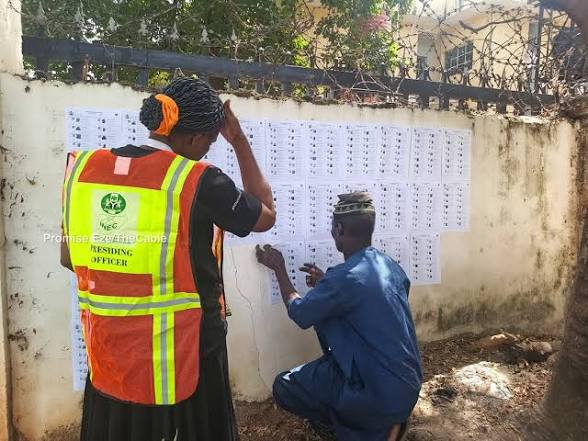
Yiaga Africa, a civil society organisation (CSO), has raised concerns over technical challenges and other operational gaps recorded during the Independent National Electoral Commission (INEC) mock accreditation and results upload exercise.
On Saturday, INEC conducted a mock election in 300 sampled polling units across the country to test its technical readiness ahead of the 2027 polls.
In a statement issued on Saturday and co-signed by Hussaini Abdu, board chairman, and Samson Itodo, executive director of Yiaga Africa, the CSO said its observers monitored the exercise using its process and results verification for transparency (PRVT) methodology.
The organisation said the bimodal voter accreditation system (BVAS) functioned satisfactorily in most of the polling units observed but identified issues that could affect INEC’s preparedness for the 2027 general election.

It said 68 percent of the observed polling units recorded an average voter processing time of one to two minutes, while 27 percent recorded between three and five minutes.
In four percent of the polling units, Yiaga Africa said the average processing time ranged from six to 10 minutes, with some polling units recording BVAS malfunctions and authentication challenges.
“At Gumbi/Wajake Yar Abba in Wamakko LGA, a BVAS malfunction disrupted accreditation for approximately one hour,” the statement reads.
The organisation added that accreditation resumed after the device’s MTN SIM card was replaced with an Airtel SIM card.
At the Oshin Ladega polling unit in Ikorodu LGA, Lagos, Yiaga Africa said INEC officials arrived with two BVAS devices instead of the three expected, while some registered voters could not be authenticated.
It also reported a malfunction at Maternity Ogunsola Filling Station in Ijero LGA, Ekiti, where one of the two BVAS devices failed.
The organisation noted that the affected device had 512 registered voters assigned to it and could not be repaired locally because it was configured in Abuja.
It urged INEC to strengthen real-time technical support and contingency arrangements for malfunctioning devices ahead of the 2027 general election.
DELAYS, BVAS GLITCH, VOTE-BUYING MAR INEC MOCK ELECTIONS
The group also said it observed significant delays in the commencement of the exercise. According to the CSO, only 36 per cent of the polling units monitored had commenced by 9:30am, while the figure rose to 64 percent by 10am.
It said exercise had not commenced in some locations several hours later.
At Fadan Karshi I polling unit in Sanga LGA, Kaduna, INEC officials reportedly arrived at 1:40pm, while officials had yet to arrive at the Wanikde Playground polling unit in Yala LGA, Cross River, as of 1:30pm.
Yiaga Africa said the late deployment of personnel and materials limited the exercise’s ability to properly test the accreditation and voting process.
It also raised concerns over low voter participation, attributing the development partly to inadequate public sensitisation and the short period between the publication of the designated polling units and the exercise.
According to the organisation, the limited turnout reduced the exercise’s capacity to simulate actual election conditions.
Yiaga Africa also questioned the selection of polling units, saying many of those chosen had relatively few registered voters and a history of low turnout.
It recommended that future mock exercises include densely populated and historically high-turnout polling units to properly stress-test the BVAS, particularly following the reported procurement of 57,000 new devices.
The organisation also identified discrepancies in INEC’s polling-unit data.
It said the IReV portal lists 176,846 polling units, while INEC’s recently released official figure is 177,299, representing a difference of 453 polling units.
“INEC should urgently clarify and reconcile these figures in the interest of transparency, data integrity and public confidence,” it said.
Yiaga Africa also said the mock exercise was designed to cover 8,838 registration areas, but the IReV backend had been configured with 8,791 — a shortfall of 47 registration areas.
It said the affected areas comprised 18 existing registration areas across 11 states and 29 additional registration areas in Delta state.
The group said inconsistencies were also found in LGA and registration-area codes, including the interchange of Oju and Ohimini LGA codes in Benue state.
Yiaga Africa said the discrepancies could affect the receipt and publication of results from some polling units. It called for a comprehensive reconciliation of INEC’s geographical datasets.
The organisation also reported an alleged breach of results-upload procedures at Majema II polling unit in Tsanyawa LGA, Kano state.
It said the presiding officer reportedly declined to scan and upload the result to IReV at the polling unit, instead directing observers to the INEC office, where they were told the result would be uploaded.
“This deviation from prescribed procedures undermines the transparency and independent verifiability of the results management process,” Yiaga Africa said.
The group also expressed concern over the use of personal mobile-phone hotspots by some presiding officers to connect BVAS devices and transmit accreditation data and results.
It said the practice raised cybersecurity concerns and highlighted the need for INEC to provide secure and reliable connectivity for election officials.
Yiaga Africa further said new safeguards introduced to improve the integrity of scanned result sheets caused upload challenges in some polling units.
According to the organisation, some BVAS devices rejected result sheets after detecting inconsistencies between information on the sheets and codes configured on the devices.
It said the safeguards were important but should be adequately tested to ensure they did not obstruct the timely upload of legitimate results.
The organisation also reported incidents of alleged vote-buying and interference during the exercise.
It said observers reported the distribution of N3,000 to participants in Ibeno LGA, Akwa Ibom, and Akwanga, Nasarawa state.
In Ibeno, an alleged attempt to influence a presiding officer to inflate figures was reportedly rejected by the official.
At a polling unit in Iwajowa LGA, Oyo, Yiaga Africa said an individual disrupted the exercise by tearing a ballot paper and was subsequently arrested by the police.
It said the absence of replacement ballot papers prevented affected voters from continuing with the exercise.
Yiaga Africa recommended improved voter mobilisation, stronger technical support for BVAS devices, better connectivity and clearer procedures for resolving results-upload errors.
It also called for better training and supervision of election officials and urged INEC to introduce system-level controls on IReV to prevent results from being uploaded before the stipulated 2:30pm threshold.
The organisation said it would release a comprehensive report after the exercise. (TheCable)
-

 News24 hours ago
N78.8b cash transfer queries spark legal battle at ECOWAS Court
-
Politics23 hours ago
You Can’t Win Sympathy Through Blackmail – Kano Govt Replies Kwankwaso
-
Business23 hours ago
Dry Season: Farmers Face Rising Cost Of Cultivation, Insecurity
-
News24 hours ago
UK rejects 84% Nigerian student visa interviewees
-
Politics23 hours ago
2027 alliance: Atiku or Obi?
-
News24 hours ago
Schoolchildren battle killer heat
-
Politics24 hours ago
Furore over ‘rig and die’ slogan
-
Politics24 hours ago
Election Riggers Should Not Be Killed – Fashola