Business
MATTERS ARISING: Does Tinubu have the power to write off NNPC’s debt?

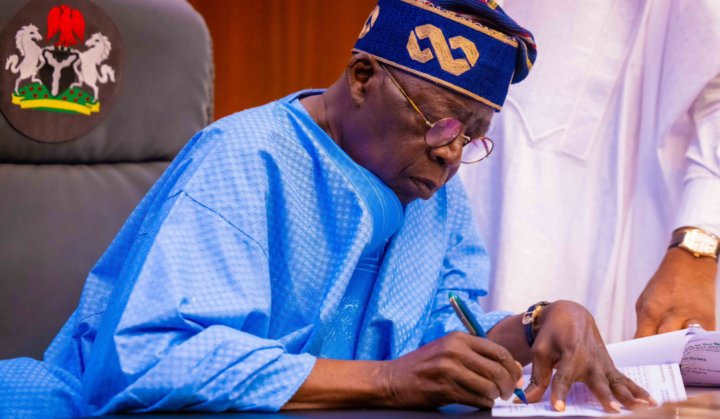
On December 29, 2025, President Bola Tinubu authorised the cancellation of about $1.42 billion and N5.57 trillion of outstanding obligations owed by the Nigerian National Petroleum Company (NNPC) Limited to the federation account allocation committee (FAAC).
According to a FAAC report filed by the Nigerian Upstream Petroleum Regulatory Commission (NUPRC), the president approved the “debt reconciliation” following a review of records by both parties.
The report showed that the NNPC owed “$1,480,610,652.58 and N6,332,884,316,237.13″ for production sharing contract (PSC), direct sale, direct purchase arrangement (DSDP), royalty arrears (RA), marginal fields current account (MCA) liftings and joint venture (JV), and PSC royalty receivables.
But out of the total owed amount, the president approved the cancellation of “$1,421,727,723.00, N5,573,895,769,388.45”.

The cancelled amounts were said to have accounted for about 96 percent and 88 percent, respectively, of NNPC’s debts.
Since the decision made headlines, many have questioned the legality of the president’s action.
Some have argued that, since the NNPC operates under the Petroleum Industry Act (PIA) and the president also serves as the minister of petroleum, the decision to write off the debts was an institutional process.
However, concerns remain about the extent of powers the PIA vests in the president regarding oil and gas sector operations.
WHAT THE PIA SAYS ABOUT THE PRESIDENT’S POWERS IN RELATION TO OIL, GAS SECTOR
The PIA provides guidance for the operation of the oil and gas industry and also outlines the powers vested in key officials, including the president.
A review of Section 3 indicates that the Act does not explicitly grant the president the unilateral powers to authorise debt forgiveness.
However, the president, referred to as ‘minister of petroleum’, holds other powers.
Under the PIA, the minister of petroleum is responsible for formulating, monitoring, and administering government policy in the petroleum industry.
The minister also exercises general supervision over the sector’s affairs and operations in accordance with the provisions of the Act.
The Act vests the minister with the authority to report developments in the petroleum industry to the government, represent Nigeria in international petroleum organisations, and promote an enabling environment for investment in the sector.
The minister is also empowered to negotiate treaties or other international agreements related to petroleum on behalf of the government.
Additionally, upon the recommendation of the NUPRC and its chief executive, the president grants, revokes, and assigns interests in petroleum prospecting licenses and petroleum mining leases.
He is further empowered to approve fees for services rendered by the NUPRC or the relevant regulatory authority and, based on the commission’s recommendations, may direct in writing the suspension of petroleum operations in any area.
‘THE PIA DOES NOT GRANT TINUBU EXPRESS POWER TO CANCEL NNPC DEBT’
Commenting on the issue, Ayodele Oni, partner at Bloomfield Law Practice, said the PIA does not confer express powers on Tinubu to cancel debts owed by the NNPC to the federation.
He said the president’s directive can be seen as an executive adjustment following a reconciliation process, “and not as a clear constitutional or statutory write-off power”.
“At best, the decision can be viewed as administrative but not from the constitutional or PIA angle,” Oni said.
“At the same time, the legal context of NNPC Limited must be acknowledged. By virtue of the Petroleum Industry Act 2021, NNPC was incorporated as a limited liability company, with its assets and liabilities transferred to it as a commercial entity wholly owned by the Federation.”
In her remarks, Vanessa-Vivian Okonta, an energy lawyer, said even though the NNPC is now a commercial entity under the PIA, it remains wholly owned by the federal government as its sole shareholder.
“That means the President, as the head of the executive, effectively acts on behalf of the government in its capacity as shareholder,” she said.
“In practice, this gives the executive influence over major corporate decisions, including debt restructuring or write-offs, much like a shareholder might direct the board of a government-owned company.”
However, Okonta noted that this does not override the constitutional provisions, as debts owed to the federation account are technically owned by all tiers of government.
She added that, while the write-off may be defensible as a form of corporate restructuring under the PIA, there remains a legal debate over whether such an action can circumvent Section 162 of the 1999 constitution, which governs the joint ownership of federal revenues.
“In short, the President can initiate or approve a write-off in his shareholder capacity, but the action still sits in a gray area when viewed strictly against the Constitution,” Okonta said.
THE POSITION OF NIGERIA’S CONSTITUTION
The lawyers said under the constitution of Nigeria, the president’s powers over fiscal matters are not absolute and are limited by specific constitutional provisions.
“Section 5 of the CFRN vests the executive powers of the Federation in the President for the execution and maintenance of the Constitution and all laws made by the National Assembly,” he said.
“However, this general executive authority must be exercised consistently with the Constitution’s detailed framework on public debt.”
Oni said public debt is expressly placed within the legislative competence of the national assembly by “Item 50 of the Exclusive Legislative List in Part I of the Second Schedule, which provides for the public debt of the Federation”.
“In addition, section 80(1) of the Constitution requires that all revenues or other monies raised or received by the Federation be paid into and form one Consolidated Revenue Fund of the Federation, while sections 80(2)–(4) stipulate that no money shall be withdrawn from that Fund except in the manner prescribed by the National Assembly,” he said.
“The above provisions suggest that a decision that permanently extinguishes debts owed to the Federation, thereby reducing revenue that would otherwise accrue to the Consolidated Revenue Fund falls within an area constitutionally supervised by the National Assembly.”
Based on the 1999 constitution, Okonta said debts owed by NNPC, being revenues accruing to the federation, cannot be unilaterally written off by the president without legislative authorisation or the concurrence of the other tiers of government.
She said such action would prevent constitutionally mandated revenues from entering the federation account.
“Section 166 offers only a narrow power of set-off, limited to adjustments between the Federation and a state, and does not extend to the forgiveness of debts owed by a government-owned company,” Okonta said.
While public debate is ongoing on the matter, she added that it appears “unchecked” for a president to write off about 96 percent of NNPC’s dollar debts and about 80 percent of the naira debt. (The Cable)
-

 Metro2 hours ago
My wife miraculously woke up after six months in coma – Akpabio
-
News8 hours ago
Tinubu Confirms Absence From UNGA, Asks Shettima To Lead Nigeria’s Delegation
-
News2 hours ago
Former Kogi governor Ibrahim Idris dies at 77
-
Politics2 hours ago
Presidential Campaign Council: We don’t need your validation – OK Movement replies NDC
-
Politics2 hours ago
2027: Remo group warns sons against breaking Ogun zoning pact
-
Politics2 hours ago
2027: I’ll Never Spend Holidays Abroad If Elected – Obi
-
News2 hours ago
Niger govt unaware of miners’ arrest before deaths in NSCDC custody — Bago
-
Sports2 hours ago
Haaland Makes EPL Record As Manchester City Overcome Sunderland In 8-Goal Thriller