Opinion
Not Every Hand Should Be Shaken! Kudos To Oba Ladoja

By Wale Ojo-Lanre, Esq.
There is a dangerous confusion in our public space—the lazy belief that every extended hand deserves acceptance.
It is a confusion born of fear, superstition, and performative morality, where public gestures are mistaken for virtue and optics replace order.
But wisdom says otherwise.

“Owo tí a kò mo, kì í bo moni lójú.”
(A hand whose intent you do not know must not touch your face.)
Oba Rasheed Adewolu Ladoja, the Olubadan of Ibadan, did not refuse a handshake.
He refused contamination—and, more profoundly, a breach of order.
He is a wise king, and a wise king understands that intent travels faster than courtesy. He is neither a pretender nor a hypocrite—one who harbours malice while displaying polished civility. He despises hypocrisy and knows, from experience and wisdom, that some greetings are not gestures of peace but invitations to moral and spiritual negotiation.
“Kì í se gbogbo erín ni ayo nbe nínú re”
(Not every smile carries joy.)
This understanding is deeply rooted in Yoruba civilisation, where greeting is never a casual reflex. It is a ritual governed by age, hierarchy, restraint, and respect.
The rule is ancient and unambiguous:
The elder initiates the greeting.
Oba Rasheed Adewolu Ladoja is over eighty years old—an age that commands reverence in Yoruba cosmology. An octogenarian is not rushed with gestures or pressured by optics; he is approached with caution, humility, and decorum. He is old enough to bless, to correct, and to instruct.
For a significantly younger Oba to initiate a handshake toward such an elder is therefore not courtesy. By Yoruba standards, it is a cultural violation.
This is not opinion.
It is custom.
Beyond age, there is the equally important matter of posture, rank, and protocol.
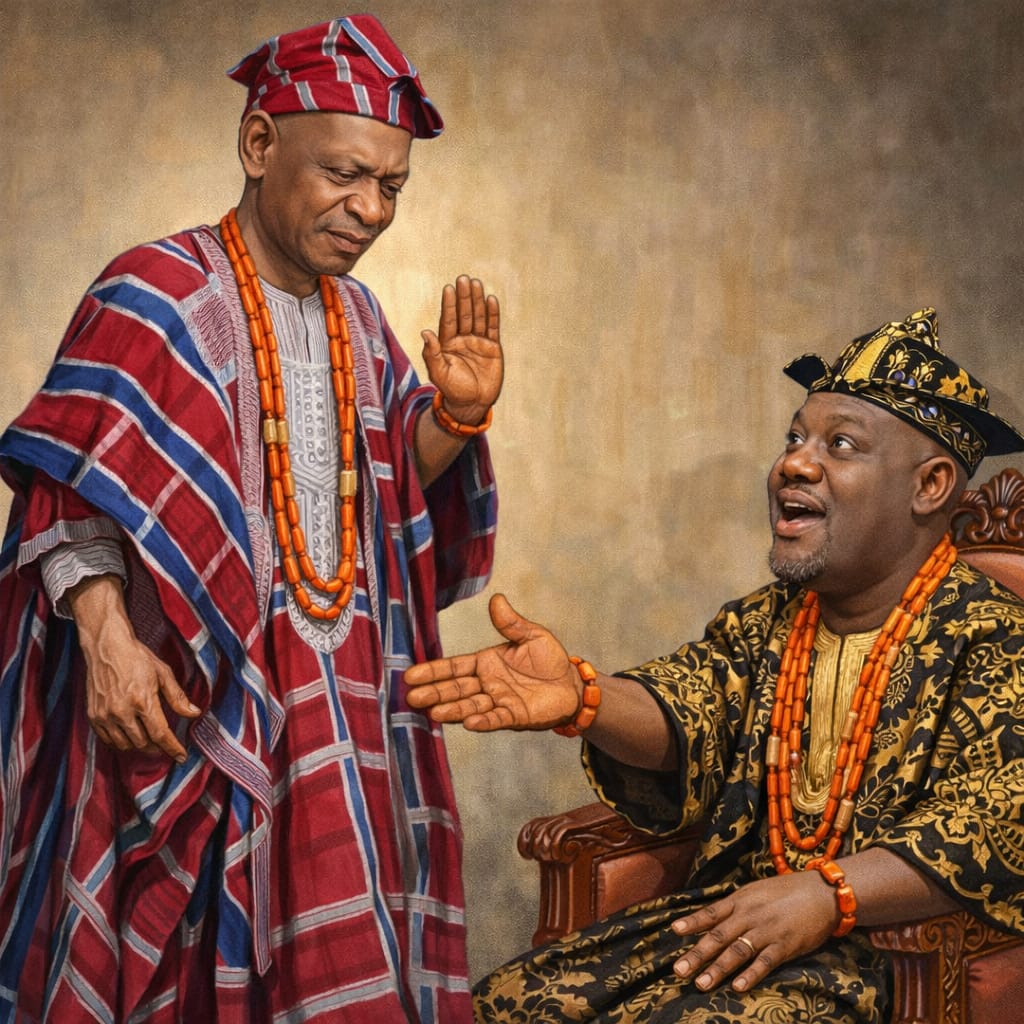
Across Yoruba land—and indeed across the world—it is a settled rule of etiquette that one does not remain seated while offering a handshake to a person who is standing. To do so is universally read as dismissive or ill-mannered.
In this case, the breach was compounded:
Oba Ladoja was standing.
The other Oba was seated.
Oba Ladoja is senior in age.
Oba Ladoja is senior in rank, being the Oba of Ibadan, the capital city of Oyo State.
Both monarchs are Co-Chairmen of the Oyo State Council of Obas.
Protocol, hierarchy, royal order, and global etiquette all converge on a single conclusion:
the seated monarch ought to have stood first.
To offer a hand while seated to a standing senior is not greeting; it is discourtesy disguised as familiarity.
It is therefore important to understand why Oba Ladoja’s response was neither impulsive nor theatrical. He is a noble Oba who knows that a king’s hand is not a common utensil. It carries authority, legacy, imprint, and consequence.
He will not allow his royal essence
to be placed in a palm
only for it to be wiped away later
with a spiritual handkerchief
after the cameras are gone.
For he knows what the elders have always taught:
“Ohun tí owo bá fi owo se, okàn ló máa gbà.”
(What the hand agrees to, the soul accepts.)
Ladoja therefore refused to permit his aura to be polluted by a handshake burdened with malice, ego, bitterness, fakery, envy, suspicion, and unresolved personal crisis. He would not soil his hand engaging a temperament defined more by turbulence than tranquility, more by drama than dignity.
This decision must be properly named.
It was not arrogance.
It was discernment.
It was not disrespect.
It was self-mastery.
“Omo Ologbon kì í fi ara re sínú ìjà tí kò se é yorí sí.”
(A wise person does not enter a conflict with no noble end.)
Oba Ladoja remains noble.
He remains sensible.
He remains an Oba of impeccable integrity—one who understands that silence can be cleaner than greetings, and restraint more royal than reflex.
In Yoruba philosophy, the hand is never innocent.
It blesses.
It binds.
It betrays.
That is why the elders warned:
“Owo kì í gbé eni ga ju okàn lo.”
(The hand must never outrun the conscience.)
Let those who fetishize handshakes keep their anxiety.
Let those who see curses everywhere continue their trade in fear.
As for Oba Rasheed Adewolu Ladoja, he chose clarity over choreography, integrity over intimidation, and wisdom over noise.
He acted well—and perfectly so.
E pele o.
E kú àpérò.
-

 Politics23 hours ago
2027: Tinubu’s group to meet Ohanaeze, Anyaoku to beg Obi to step down
-
Politics23 hours ago
Amid Tinubu, Atiku, Obi subsidy debate, Duke calls fuel subsidy a ‘scam’
-
Sports23 hours ago
Barcelona agree deal to sign Gabriel Jesus from Arsenal
-
Politics23 hours ago
2027: Don’t set Nigeria on fire, NILDS boss warns political actors
-
Politics10 hours ago
Tinubu Chose Vacation While Nigeria Burns — Atiku
-
Business23 hours ago
Nigeria records $947m remittances in July, nears $1bn monthly target
-
News10 hours ago
14,500 Missing In N’East As Families Groan
-
Business10 hours ago
Modular Refineries Flop Despite Subsidy Removal