News
We’re still where we were when Tinubu became president — Bishop Kukah

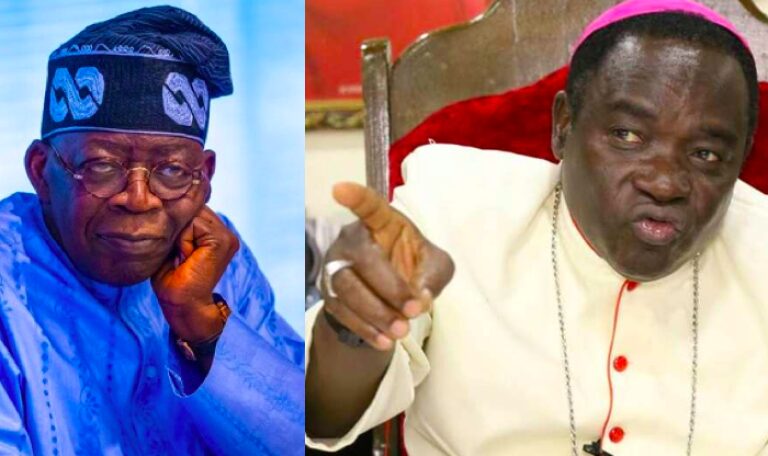
Bishop of the Catholic Diocese of Sokoto, Matthew Hassan Kukah, has noted his unhappiness that the country is still at the level it was more than two years into the administration of President Bola Ahmed Tinubu.
The cleric said almost three years into the current administration, he had expected that issues of high food prices would have been sorted out, also highlighting the upsurge in insecurity as one of the areas of concern.
Speaking during a live Zoom interaction on Boiling Point Arena, a platform for discussion on governance, leadership, accountability and nationhood on Sunday night, which was attended by our correspondent, the fiery cleric said he had expected that given the amount of money available to the government, they could have developed a capacity and imagination to do much more, reports Daily Independent.
“I am quite unhappy that we are still where we were on the issues of hunger, the sufferings, the mass sufferings in the land,” he said.

“I would have expected with the amount of resources that are available, that we could develop enough capacity and imagination to do much more than just pushing money to governors, that money that is still endlessly being wasted with very little impact on the ground.
“So the persistence of poverty, amid what I consider to be plenty, is alarming because like joke, like joke, Nigerians are now finding it difficult to talk about millions. We’ve jumped from billions that we were talking about only two years ago. Increasingly, we are becoming familiar with trillions. Like joke, like joke.
“But it’s not in the hands of the people but I know. I’m just saying that, obviously, the places are washed with money. But like water, water everywhere, there isn’t a drop of it. So to answer your question, I am unhappy that people are still suffering. People are still poor.
“I had hoped that by now, food prices would probably have come down drastically to less than what it is today. I would have expected to see, although people will tell you two and a half years are not enough.
“But like the Muslim beggar will say, if Friday is going to be good, I will see it on Wednesday. So it is to say that the government very urgently requires, I mean, needs to develop a greater sense of urgency in dealing with the very basic issues of livelihood and the quality of lives of Nigerians,” he said.
Kuka also lamented the issue of insecurity, challenging the government to put back hand on the plough.
“The second, and perhaps even far more important, is the persistence of the tragedy that has engulfed us in terms of our inability to rid ourselves of this banditry, the endless killings, and how life in Nigeria has become just so worthless,” he said.
“Those two critical issues make me sleepless and they make me very uncomfortable. So I would still like to see and encourage the government to take them much more seriously. And I’ve been saying this for a very long time, you cannot grow without having timelines.
“I think that those are areas that we need far more aggressive planning to end banditry because Nigeria has the capacity. The intelligence community can root out the murderers among us, as somebody will say, because the security agencies in the eyes of the public have become so severely compromised.
“So how to deal with these problems together, the restoration of social order, the restoration of national cohesion, and the end to the sufferings of ordinary Nigerians.”
The Bishop also responded to allegations in some quarters that he denied what has been called Christian genocide in the country, saying he has never said there is no Christian killings going on in the country.
“I have never denied the killings of Christians in Nigeria. I don’t know where, maybe I shouldn’t say I don’t know where it came from that I denied it,” he said.
“And if you read a text that I have on what my response to this problem, which is the result of a lecture I delivered in Rome, when they were receiving a report, a global report of 1,270 global persecution of Christians around the world, I raised the issue. And I said, we may be victims of language. When there is persecution, when there is genocide, by God, this thing ought not to have happened.
“Now, I don’t want to go into the details of the mischaracterisation of what I said, but it shocked me that Christians were going around saying that I said there is no persecution of Christians in Nigeria. Well, those who are about to appreciate that this has been my life, you know, my only clarification I can give is that I’ve never denied the persecution of Christians in Nigeria.
“I would like you to call out one single Nigerian, whether it’s a religious leader or whatever, that has spoken, that has written as extensively about this topic as I have,” he said.
He also said against this backdrop, Nigeria can seek help anywhere as long as banditry and other forms of criminality are nipped in the bud.
“Wherever we can get help from, Trump, whatever, we should get it; these killings ought not to have happened in the first place. But the point that we must never miss is that today we lose who we are as citizens of Nigeria.
“The day our grief or our concern is only for ourselves, that day we cease to be Christians. So, for me, it’s not about anything, my argument has always been that Nigerians are dying, our country is broken, we need to fix our country and fix it very quickly. And as I’ve said, Nigeria as it is today, whether you’re a military officer, whether you’re a policeman, whether you’re a male, whether you’re a female, whether you’re black or white, this country’s capacity to protect its citizens has been severely constrained.
“And it’s not because we are Christians or we are Muslims, it is that we are citizens of Nigeria. And the challenge is for him to very quickly fix our country so that no enemy can return to us,” he noted.
-

 Opinion17 hours ago
Sanwo-Olu: From a promising start to a troubling finish
-
 News18 hours ago
FAAC bonanza: Govs face questions as payouts hit N47tn
-
Sports18 hours ago
‘Osimhen can end Man United’s woes
-
Politics17 hours ago
Tinubu Withdraws APC Campaign Team List Amid Controversy Over 2027 Council
-
Business18 hours ago
NUPRC gives 31 oil block winners payment deadline
-
News18 hours ago
New ‘Phantom’ Agency Courts SGF, Govs
-
 Metro18 hours ago
How My Husband, 2 Children Died After Eating Amala – Widow
-
 Politics18 hours ago
Concerns Over Inclusion Of Betta Edu, Others In Tinubu’s Campaign Council