News
NEF Opposes Location Of ‘National Gold Refinery’ In Lagos

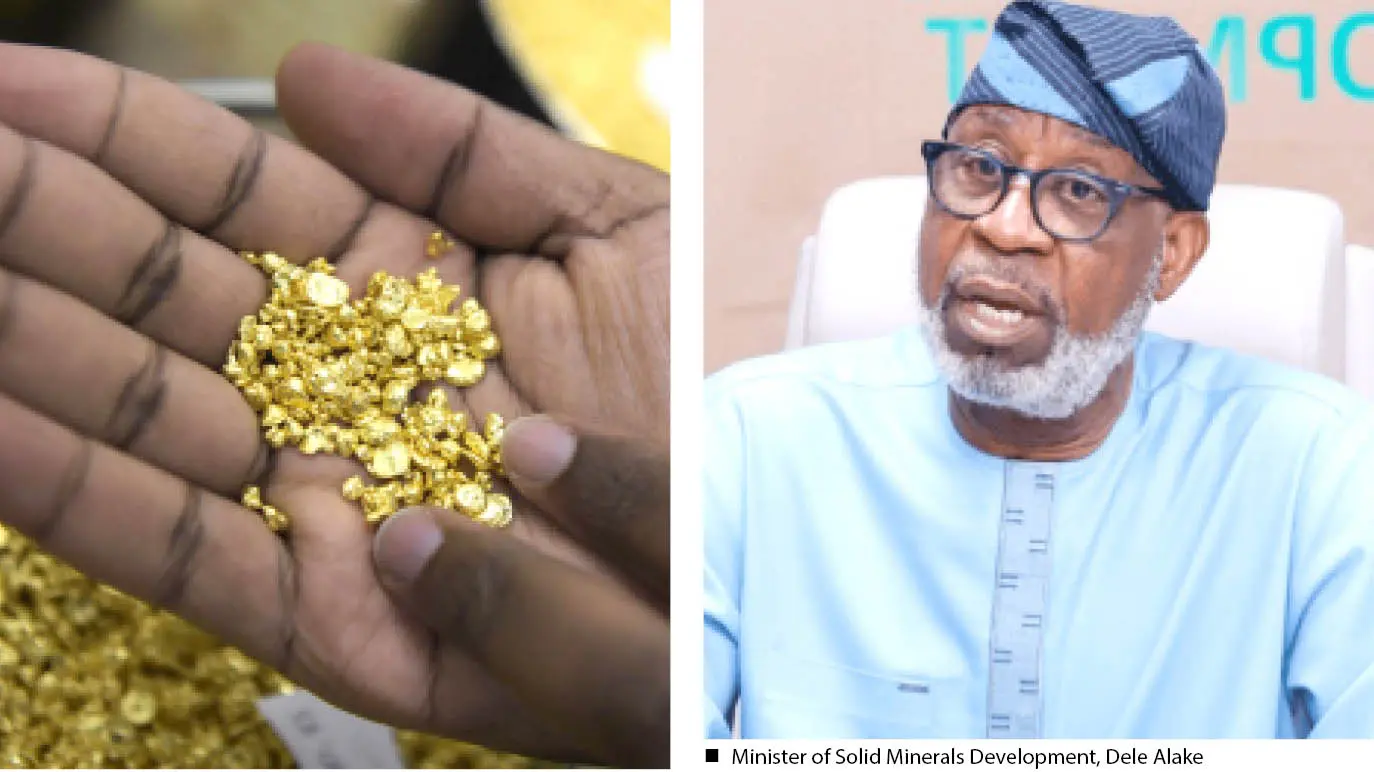
The Northern Elders Forum (NEF) yesterday accused the federal government of locating “the National Gold Refinery” in Lagos State.
But the federal government said it was unfortunate that the NEF was framing a private sector–driven initiative in the mining sector as a regional agenda.
The NEF, in an open letter signed by its spokesperson, Professor Abubakar Jika Jiddere and addressed to President Bola Ahmed Tinubu and members of the Federal Executive Council, alleged that the location of the gold refinery struck at the heart of Nigeria’s constitutional commitment to equity, federal balance and inclusive economic development.
The letter, dated 18th January 2026, was titled ‘Open Letter to the Federal Government of Nigeria on the Location of the National Gold Refinery, Federal Character, Derivation and the Deepening Crisis of Structural Inequality”.

The Minister of Minister of Solid Minerals Development, Dele Alake, had, on Tuesday during a meeting with the Saudi Arabian Minister of Industry and Mineral Resources, Ibrahim Al-Khorayef, held ahead of the Future Minerals Forum in Riyadh, Saudi Arabia, announced the commencement of operations at a high-purity gold refining plant in Lagos.
The minister, in a statement by his media aide, Segun Tomori, had also said three additional gold refineries that were at different stages of development across the country, and that a $600 million lithium processing plant located in Nasarawa State was ready for commissioning.
The NEF, in its letter, said the decision to locate the gold refinery in Lagos must be interrogated beyond administrative convenience.
The letter read, “Your Excellencies, the Northern Elders Forum (NEF) issues this open letter not as a rhetorical protest, but as a constitutional, economic, and political intervention necessitated by the Federal Government’s decision to locate Nigeria’s gold refinery in Lagos State, notwithstanding the well-established fact that Nigeria’s commercially viable gold deposits are overwhelmingly located in Northern Nigeria. This decision must be interrogated beyond administrative convenience.
“Section 14(3) of the Constitution of the Federal Republic of Nigeria, 1999 (as amended), enshrines the federal character principle, mandating that the composition and conduct of government affairs must reflect Nigeria’s diversity and prevent the dominance or exclusion of any group or region. While often narrowly applied to appointments, the spirit of Section 14(3) is broader: it is intended to prevent structural concentration of national advantages in ways that marginalise sections of the federation. Strategic economic infrastructure is as consequential to federal balance as political office.
“Furthermore, Section 16(1)(b) obliges the State to control the national economy in such a manner as to secure ‘the maximum welfare, freedom and happiness of every citizen on the basis of social justice and equality of status and opportunity.’”
The forum said a policy that extracts mineral wealth from one region while systematically locating value addition, industrial jobs, and capital accumulation elsewhere fundamentally contradicts this directive.
It said most critically, Section 162(2) of the Constitution recognises the principle of derivation, affirming that resource-bearing areas are entitled to a fair share of the benefits arising from the resources extracted from their land.
“While derivation has often been framed in fiscal terms, its underlying philosophy is unmistakable: resource origin must matter in the distribution of economic benefits,” the letter added.
The forum stressed that to deny gold-producing regions the industrial and developmental benefits of refining is to hollow out the derivation principle and reduce it to a token accounting exercise.
Part of the letter also read, “International best practice in extractive economies is unequivocal. In jurisdictions such as Australia, Canada, South Africa, Ghana, and Chile, primary processing and refining facilities are deliberately located proximate to mining sites. This approach minimises logistical inefficiencies, strengthens regulatory oversight, curbs smuggling, integrates artisanal miners into formal value chains, and most importantly anchors regional industrialisation.
“Nigeria’s decision to refine gold far from its source is therefore not merely unconventional; it is economically regressive. To again remove the locus of value addition from these communities is to perpetuate an extractive model reminiscent of colonial economics, where raw materials are sourced from the periphery and wealth is accumulated at the center. Such a model is incompatible with modern federalism, incompatible with constitutional equity, and incompatible with Nigeria’s stated development objectives.
“Northern Nigeria, particularly states such as Zamfara, Kebbi, Niger, Kaduna, Katsina and adjoining areas, has absorbed the environmental degradation, social dislocation, insecurity, and criminal networks associated with unregulated mining. Yet, when the moment arises to locate refining infrastructure that would create skilled employment, stimulate technology transfer, and catalyse industrial clusters, the region is once again bypassed. This is not an abstract policy choice; it is a lived injustice.”
The forum said the federal government must also confront the political implications of this decision, stating that Nigeria already suffers from acute spatial inequality, where strategic federal assets, industrial concentration, and economic power are disproportionately clustered in Lagos and its environs.
“This persistent imbalance has fuelled political resentment, weakened trust in the federal compact, and reinforced the perception of deliberate economic marginalisation of the North. Each additional decision that deepens this imbalance pushes the federation closer to a legitimacy crisis. It is instructive that successive governments have insisted correctly that oil refineries should be sited near crude-producing regions, partly in recognition of host-community justice and operational efficiency. The refusal to apply the same logic to gold exposes a troubling policy inconsistency that Nigerians cannot ignore,” the letter further read.
The forum, therefore, demanded that Nigeria must adopt a decentralised, resource-proximate refining framework, ensuring that at least one primary gold refinery must be located within Northern Nigeria’s gold-producing corridor, with Lagos limited, if necessary, to trading, certification, or export functions.
Anything short of this, the NEF said, constitutes structural exclusion masquerading as national policy.
“This letter is not an appeal to sentiment. It is a constitutional warning. Federations that ignore economic justice in the distribution of strategic assets eventually confront political consequences far more destabilising than the cost of policy correction. We urge the federal government to act not out of concession, but out of constitutional duty, economic reason, and commitment to national cohesion.”
In its direct message to northern elites, political leaders, and stakeholders, NEF said history would not honour those who saw injustice clearly and chose comfort over courage, while describing the decision to locate Nigeria’s gold refinery in Lagos while gold is mined from Northern soil as neither a policy error nor an oversight but a deliberate act of economic dispossession.
The forum added that history would not absolve leaders who mistook silence for wisdom and access for influence, stressing that “The record is being written now. Silence will not be misunderstood. It will be remembered as betrayal.”
The letter also read, “There comes a moment when silence ceases to be strategy and becomes collusion with injustice. That moment is now. Anything said after this, without action, is deception. It (the decision) strips value addition from Northern communities, exports opportunity to the already privileged center, and condemns the source regions to poverty, unemployment, and perpetual insecurity. To again remove the locus of value addition from these communities is to perpetuate an extractive model reminiscent of colonial economics where raw materials are sourced from the periphery and wealth is accumulated at the center. This is not development. It is internal colonialism. This injustice is systemic, not accidental.
“For decades, Northern Nigeria has been reduced to a triple extraction zone: the supplier of raw minerals, the supplier of agricultural produce, and the supplier of cheap labour, while processing, branding, financing, and industrial infrastructure are consistently sited elsewhere. Northern farmers produce the bulk of the nation’s food, yet agro-processing plants, commodity exchanges, logistics hubs, and export value chains are concentrated outside the region. Grains, livestock, tomatoes, cotton, hides and skins leave the North in raw form, only to return as finished goods priced beyond the reach of the very communities that produced them. This is not inefficiency; it is designed underdevelopment.
“Every refinery sited away from the resource zone deepens youth despair. Every agro-processing plant denied to the North accelerates rural collapse. Every lost industrial anchor strengthens the conditions that breed banditry, kidnapping, and mass poverty. These outcomes are not mysterious. They are predictable consequences of structural exclusion. What makes this moment unforgivable is not only federal insensitivity but elite cowardice. Where are the Northern governors who invoke unity while accepting economic strangulation? Where are the senators, ministers, party chieftains, and traditional power brokers who enjoy proximity to power but cannot defend the economic dignity of their people?
“If Northern elites cannot speak when their region is systematically excluded from mineral and agricultural value chains, history will record that today’s leadership traded regional dignity for access to political favour and power. No rhetoric about national cohesion can survive sustained economic humiliation.
“The North is not asking for favour. It is demanding constitutional fairness. If derivation justifies benefits for oil-producing regions, it must apply to gold and solid minerals. If federal character restrains political appointments, it must restrain economic concentration, industrial siting, and agro-industrial monopolisation. Anything else is hypocrisy masquerading as policy. This is not merely an economic dispute. It is a security crisis in slow motion, a justice failure with predictable consequences.
“A region denied value addition will not remain calm forever. A population locked into extraction without prosperity will not produce stability. You cannot manage economic injustice indefinitely with sermons, slogans, or force. This is a defining test of leadership. To fail it is to accept a future where Northern Nigeria remains: a zone of mineral and agricultural extraction without prosperity, a zone of sacrifice without reward, a population without economic power, pacified only through neglect and repression.”
FG says gold refinery project private sector-driven, denies regional agenda
Reacting, the federal government described as unfortunate the claims by the NEF that a private sector–driven initiative in the mining sector was being framed as a regional agenda, insisting that it has zero equity in the gold refinery and only provides an enabling environment for investors.
Speaking to Daily Trust last night, Segun Tomori, spokesman to the Minister of Solid Minerals Development, said the gold refinery was neither initiated nor established by the Federal Government.
“The gold refinery is not a Federal Government initiative. It was not established by the Federal Government. It is a private sector initiative by a company called Kian Smith Company FZE,” he said.
Tomori dismissed suggestions that the administration was concentrating industrial projects in Lagos, describing such claims as wrong and unfair. He said several mining and processing facilities were located in the northern part of the country.
“As we speak, we have three lithium factories. The first two are operational, while the third, a $600 million lithium factory in Nasarawa State, is ready for commissioning. In Kaduna, there is a multi-million-dollar iron ore processing plant operated by African Natural Resources Mining Limited,” he said.
He explained that Kian Smith initially began construction of the refinery in Ogun State before relocating to Lagos in 2021 after identifying a more favourable business climate, completing the project in 2025. He added that the company operates across the country, including partnerships with Kaduna State on mineral exploration, and activities in Kano and Niger states.
Tomori said the chairman of the Asba Lithium Factory in Abuja had also confirmed that the plant would soon be commissioned.
He stressed that the Minister of Solid Minerals Development, Dr Dele Alake, had extended collaboration to all 36 states under a cooperative federalism framework that encourages states to participate in mining.
“The Federal Government does not control Kian Smith. Our role is to create an enabling environment for private investment,” he said, adding that contrary claims were based on ignorance or mischief.
Northern govs to meet over issue
In its reaction yesterday, the Northern States’ Governors Forum noted that on matters of regional importance and other national policy issues, the forum would convene to discuss and agree on a unified stance before making any public pronouncement.
Ismaila Uba Misilli, spokesman to the chairman of the forum and governor of Gombe State, Muhammadu Inuwa Yahaya, told Daily Trust that the forum had not yet deliberated on the matter, “and therefore has no collective position at this time.”
According to him, the forum remains committed to protecting the interests of the people of the region in all matters of national significance.
Zamfara govt alleges bias
The Zamfara State’s Commissioner for Information, Mahmud Muhammad Dantawasa, in a chat with one of our correspondents yesterday, alleged that the decision to locate the gold refinery in Lagos was unjust and unfair.
“So, if the federal government is sincere about this issue, that refinery should be located in Zamfara state, not Lagos. In fact, no state in the whole federation is more suitable to host such a refinery than Zamfara because the state is sitting on gold. So, the position of Zamfara state is simple because if you are talking of solid mineral resources gold in particular, no state in the whole federation can compete with Zamfara.
“Though we are facing security challenges, that shouldn’t be an excuse to neglect the state from what it deserves. The federal government is bigger than any terrorist group.
“If the federal government goes ahead with its decision, the gold refinery will not see the light of the day because it will only cause more harm than benefits to the government and other stakeholders than providing the expected results. Miners and dealers of gold will face serious difficulties in transporting the raw materials to Lagos state from Zamfara,” he said.
Also speaking the Zamfara State’s Commissioner for Commerce and Industry, Abdulrahman Tumbido, said the state aligned itself with the position of the Northern Elders Forum, urging the federal government to, as a matter of fairness, review its decision. We are not happy with the federal government,
“The NEF said the truth and if the federal government is willing and fair in its decision, the refinery should be relocated to Zamfara State. Even Kebbi, Niger and Kaduna States cannot compete with Zamfara as per as gold deposit is concerned.
“I could remember when we went to Abu Dabi, the authorities of Dubai Chamber of Commerce had during our business discussions promised to build a gold refinery in Zamfara State knowing full well the capacity of Zamfara sin gold producing and processing. So, if other countries can indicate interest in building a gold refinery in Zamfara, why should our government ignore it? This is a clear indication that the federal government has a hidden motive in the whole issue,” he said.
-

 Business18 hours ago
Dangote increases petrol price despite crude price decline
-
Business19 hours ago
19 oil block licences to expire this year
-
News19 hours ago
Governors spend N512bn on travels, offices
-
 News19 hours ago
States’ IGR soars 34% to N2.43tn despite economic hardship
-
Business19 hours ago
FG raises N7.62tn from bond market in eight months
-
Politics17 hours ago
Obi Camp Knocks Tinubu Over Absence From Key Events
-
Business17 hours ago
Crude imports by domestic refineries jump 151.5% in July — NMDPRA
-
World News16 hours ago
US Suspends Immigrant Visa Processing Worldwide