News
The job scam syndicate luring Nigerians into Ukraine-Russia war

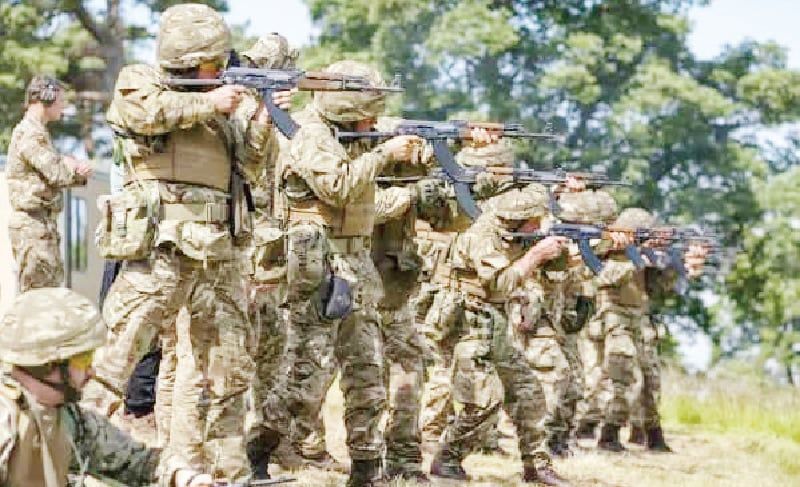
They boarded planes believing they were heading to work sites, supermarkets or security posts. Instead, they arrived at military camps, where refusal to fight meant intimidation, detention or abandonment. As the Russia-Ukraine war grinds on, young Nigerians are emerging as disposable foot soldiers — recruited not by ideology, but by hunger, writes WALE AKINSELURE
Thirty-one-year-old Benjamin Oloko, who sold wares at Aleshinloye Market in Ibadan, Oyo State, believed he was set to japa for good when a friend asked him to check out a recruitment agency he found on Facebook last year. On the page was a lucrative job offer — a security job promising $1,500 monthly and a $20,000 sign-up bonus. The job was in Russia, a 15-hour flight from Nigeria.
Fearing that family and friends might not let his destiny shine, Oloko began the process discreetly. His worry was that they might persuade him not to seek greener pastures by pointing to the ongoing Russia-Ukraine war, which began in 2022. Desperate to escape Nigeria’s economic hardship, he borrowed money, convinced that repayment would not be a problem once he began earning his lavish pay in Russia.
He paid the agent’s fee, bought his ticket and processed his visa, spending about $1,000 in all. By mid-September 2025, Oloko arrived in Russia brimming with excitement and ready to achieve his dreams of a beautiful life.

Upon arrival, airport officials collected his passport and phone after instructing him to notify his “handler” to pick him up and take him to the hotel booked for him. After about eight hours at the airport, a Belarusian man arrived to pick him up. He was immediately asked to pay $500 to be handed over to the main agent in Russia to sort out accommodation, which he promptly did.
At the hotel, Oloko was lodged alongside four other Africans. One was another Nigerian, who turned out to be an Amotekun personnel from Oyo State who had abandoned the outfit for the better-paying Russia job offer. The other three were from Uganda, Kenya and Sudan.
Oloko stayed at the hotel for five days. It was during his interaction with his fellow Africans that he began to realise he might not be in Russia for a private security job after all, but a Russian Army assignment. It was at this point that he called family and friends to reveal where he was and what awaited him — that he had been lured to Russia to join the military.
When he contacted his Nigerian agent for confirmation, the narrative changed from a private security job to claims that he would only work in the kitchen at the war camp and would not be deployed to the frontline. While awaiting transfer to the military camp, his family warned him against signing any contract.
“I was warned that signing the contract meant signing my death warrant,” Oloko said.
Frontline reality
After more than a week, he and the others were moved to the military camp for training. On arrival, three of them signed the contract, while Oloko and the Amotekun officer refused. The three who signed began taking pictures and videos, which they sent to the Russian agent to show they were living their best lives. This put pressure on Oloko and his newfound ally.
Initially, they were enticed with promises of several goodies. This lasted two weeks. By the third week, enticement gave way to threats to sign the contract.
“We were threatened and put under serious pressure to sign the contract,” Oloko said.
The Russian agent, a middle-aged woman, warned that our refusal to sign the contract would make her lose money. When they remained unyielding, she said they would not be allowed to leave the camp until they refunded all the money spent on lodging and feeding them. This amounted to $500, which they paid before being released.
After collecting the money, she instructed her driver to take them away from the camp and return them to the hotel. Angry over the failed mission, Oloko said that after about two hours of driving, the driver suddenly stopped, asked them to pick up their belongings and get out of the car.
“The driver, after about two hours, asked us to get down and dropped us in the bush. He collected our wallet and passport. We had to walk for several hours, till dawn, before we got help,” Oloko said.
They found themselves in the middle of nowhere — foreigners in a strange land. Oloko said they trekked for seven hours before encountering a Belarusian truck driver who helped them to town.
“We arrived at the airport, but our passports were not released. Even with the involvement of the Nigerian embassy, the Russian agent refused to release our passports.”
Oloko said he had to call home to borrow money to return to Nigeria. His Amotekun ally also returned home. He added that he kept in touch with the other three who signed up for the war.
Presently, Oloko said two of them have died in the war, while one escaped with injuries from a bomb blast and is still hospitalised. He said he saw many Africans during his stay at the military camp, many forced to continue training despite sustaining injuries.
“My saving grace was heeding my family and friends who insisted that I should not sign the contract. If not, I would have died by now, just like the other Africans I met,” he said.
Similarly, 36-year-old Nigerian mechanic, Bankole Manchi, left Lagos to secure a Russia security job that promised N500,000 monthly. An agent handled the travel process, requesting minimal personal information. Unlike Oloko, Bankole informed his family of his plans to travel to Russia to make ends meet. He travelled through Addis Ababa to Moscow.
Upon arrival, Bankole said he was handed over to men who assured him everything was fine. Instead of being taken to a workplace, he was transported to a military-style camp where he met recruits from Nigeria, Ghana, France, Brazil and China.
He said many struggled to communicate due to language barriers and relied on translation apps. According to him, they were told there was “no way out” once inside the facility. Training began with basic drills before progressing to weapon handling, grenade practice and night operations. Several recruits were injured during training but were still forced to continue.
Bankole said they were later moved at night to what they realised was Ukrainian territory. Shortly after arriving at the frontline, heavy gunfire broke out and he was shot in the leg. He added that food was extremely scarce, with recruits surviving mainly on water for days before receiving medical attention. He described African recruits as “disposable fighters”.
Dominant among the jobs used to lure Africans to Russia are private security roles, supermarket work, airport jobs or housekeeping. Leaving their countries with promises of well-paid civilian employment, they arrive only to be detained and dumped in military camps, trained as soldiers and deployed to the frontline after signing contracts.
The recruitment network targets young Africans in their 20s and 30s, pressuring them into military service upon arrival. Oloko and Bankole are among many Nigerians lured into serving as mercenaries in the Russia-Ukraine war, which began in February 2014, with Russia’s full-scale invasion of Ukraine commencing on February 24, 2022.
Russian President Vladimir Putin hinged the invasion, after years of tension between Russia and Ukraine, on Kyiv’s growing ties with the West, which he viewed as a threat to Russia’s influence. Putin cited alleged genocide against Russian speakers in the Donbas as justification. However, these claims were widely discredited, with the invasion largely seen as an attempt to reassert Russia’s influence over Ukraine and prevent its deeper integration into the European Union and NATO.
At the outbreak of the war, both Russia and Ukraine openly invited mercenaries from across the world to join their forces. Ukraine’s invitation, titled “Join the Brave,” listed units such as the 3rd Assault Brigade, 60th Separate Mechanised Brigade, 53rd Separate Mechanised Brigade, Compania Serpente, Able and Omega Company.
Requirements included an age limit of 18 to 60 years, no criminal record, no chronic illnesses, physical fitness, ability to legally enter Ukraine and relevant experience. Applicants were required to submit personal details, links to social media accounts, marital status, preferred unit, medical conditions, military experience and the duration they were willing to serve — between six months and “until victory”.
Grim reality
In terms of casualties, a report released by the Office of the United Nations High Commissioner for Human Rights in June 2025 revealed that more than 13,300 civilians had been killed and over 31,700 injured since February 2022.
Similarly, the Centre for Strategic and International Studies, based in Washington, D.C., estimated that Russian military deaths and injuries would reach one million by the summer of 2025. It also estimated Ukrainian military casualties since 2022 at about 400,000, including roughly 100,000 soldiers killed.
In 2022, Russia’s Defence Ministry claimed that 38 Nigerian fighters had been killed in Ukraine since the start of the war. According to the ministry, 85 Nigerians had enlisted as foreign mercenaries, of whom 38 were killed while 35 returned home.
The ministry faulted Kyiv’s claim that 20,000 foreign mercenaries were supporting Ukraine’s defence, insisting that it monitored and recorded every foreign national who entered Ukraine as a mercenary or trainee.
“Recent empty statements about almost 20,000 foreigners fighting against the Russian Armed Forces are just plain lies,” the ministry said.
By November 2025, however, Reuters quoted Ukraine’s Foreign Minister as saying that more than 1,400 citizens from 36 African countries were fighting alongside Russian forces in Ukraine. Ukrainian officials claimed that Russia bolstered its troops by recruiting fighters from various countries, sometimes through deception.
Ukraine’s Foreign Minister, Andriy Sybiha, said Russia was enticing Africans to sign contracts he described as “equivalent to a death sentence”.
“Foreign citizens in the Russian army have a sad fate. Most of them are immediately sent to the so-called meat assaults, where they are quickly killed,” Sybiha said.
He added that the number of African recruits could be higher than the 1,436 identified from 36 countries, noting that most foreign mercenaries in Ukrainian custody were captured during their first combat mission.
Following these revelations, the South African government said it would investigate how 17 of its citizens joined mercenary forces after the men sent distress calls seeking help to return home. Similarly, Kenya said some of its citizens had been detained in military camps across Russia after “unknowingly” getting caught up in the conflict.

Govt warning
At the outbreak of the war, the Nigerian government evacuated about 1,000 citizens, most of them students. The spokesperson for the Nigerians in Diaspora Commission, Abdur-Rahman Balogun, said the Federal Government had since March 2022 repeatedly warned Nigerians against remaining in Ukraine.
He described it as baffling that any Nigerian would take up employment in Russia or Ukraine while war was ongoing, though he noted that individuals were free to make personal decisions, as the commission could only offer counsel.
Balogun cautioned, “Any Nigerian there being recruited for whatever reason is on his own. Two years ago, we evacuated Nigerians at the expense of the Federal Republic of Nigeria. The Federal Government hired aircraft to evacuate especially students.
“As far as Nigeria is concerned, we have completed the process of evacuating Nigerians from danger zones — Ukraine, Russia and Sudan. Whoever decides to stay does so by choice. We can’t force anyone. But we advise Nigerians to think twice. Russia and Ukraine are still at war. If you get recruited into any of their armies and get caught, you will face the consequences, and Nigeria may not intervene.”
He confirmed that NiDCOM was aware of the case of final-year student, Kehinde Oluwagbemileke, who was recruited into the Russian military and captured by Ukrainian forces in July 2025.
“The mother reached out to us. You were sent to study, but you enlisted yourself into the army. He said he was promised many goodies. Whoever gets recruited into the army does so by choice. The military is a profession. Nigerians have risen to the pinnacle of their careers in the American Army. So there is nothing wrong with military service — but not in a war situation like this,” Balogun warned.
Relatives of Nigerians who enlisted in either the Russian or Ukrainian army also warned of grave consequences. Oyetunde Philip said the outcome was often fatal.
“My younger brother left the Nigerian Air Force to join them last September and died in December. I will never advise anyone to do this. It is far deeper than what we see online,” he said.
Similarly, Akin Olaoye recalled hearing about six mobile police officers who enlisted as mercenaries. “They were reportedly contracted for $1,500 monthly — about N2.25m. That is two years’ wages earned in one month,” he said.
Military sources, however, maintained that any police or military personnel who abandoned Nigeria to fight in the Russia-Ukraine war did so voluntarily, as the Nigerian government did not officially deploy troops to the conflict.
Governments of Russia and Ukraine had yet to respond on recruitment of Africans into the war by some agents linked to its nationals under the guise of helping to secure civil jobs.
Experts speak
Experts in international relations also said Nigerians who joined the war did so of their own free will. Prof. Olufemi Otubanjo of the Nigerian Institute of International Affairs said many Nigerians had lost hope in the country’s economic and social situation and were desperate to seek livelihoods elsewhere.
He noted that Nigerians were daring, mobile and willing to take risks for better pay.
“There is no law in Nigeria that prevents citizens from travelling anywhere in the world,” Otubanjo said. “What can stop you is only the destination country’s visa policy. Nigerians are facing severe economic hardship. Young people, in particular, feel abandoned by a society that has failed to prepare opportunities for them. So they are ready to go anywhere and do anything.”
He added that many Nigerians abroad worked jobs far below their qualifications just to survive, making it unsurprising that some would accept offers in war zones.
“I don’t know how they are recruited, whether they are promised jobs that turn out to be industry jobs. But basically, I don’t think that anybody who is being recruited to go to Ukraine should be under the illusion that he is going to do an office job.
“Everybody knows that they are recruiting mercenaries to supplement their own broken military population, which has been severely depleted by a war that has gone on for almost three years, with thousands of soldiers have been killed and thousands more have been injured.
“Most Nigerians abroad are doing many jobs. Many of them are working far, doing jobs that are far below their qualifications, in order to survive. And therefore, I’m not surprised that people are willing to take offers of jobs in the war zone. If Nigerians can cross the Sahara Desert and the Mediterranean Sea and die in thousands trying to reach Europe, then there is nowhere they will not go,” he said.
A Professor of Political Science at Lagos State University, Prof. Sylvester Akhaine, said Russia and Ukraine had suffered heavy casualties, hence the global recruitment drive.
“The war has been described as a meat grinder. Casualties on both sides are massive. Ukraine’s youth are fleeing. Russia faces sensitivity around compulsory conscription. When recruitment was announced, many young Russians fled through Finland and other Eastern European borders. Putin cannot afford domestic uprising,” Akhaine said.
He added that Ukraine relied heavily on mercenaries and volunteers from Western allies, while Russia had also received support from North Korea. “Both countries need manpower as long as the war remains conventional,” he said.
However, the Deputy Executive Director of Media Rights Agenda, Mr Ayode Longe, urged NiDCOM to explore diplomatic channels to stop Russia from recruiting Nigerians.
“It is worrying that people would agree to fight in a war they have no part in,” Longe said. “From what we have seen, many are deceived or coerced. NiDCOM and Abike Dabiri should use diplomatic channels to stop Russia from recruiting Nigerians.”
Oloko, Bankole and the Amotekun officer are back in Nigeria, counting their survival as a blessing after a japa gamble that turned into a brush with death. (Punch)
-

 News2 hours ago
Tinubu extends 3-week vacation
-
Metro2 hours ago
Protest as hoodlums break into female hostel, rape student
-
Politics2 hours ago
I’ll never support Uzodimma to be senate president, says Wike
-
Opinion19 hours ago
All politics is indeed local
-
News18 hours ago
Hardship: Civil servants write Tinubu, demand N500 pump price, wage award
-
Business1 hour ago
Nigerian stock market valuation hits all-time high of N162.39trn
-
News2 hours ago
‘They’ve tasted its money’ — Umar Bago says boys are abandoning schools for mining in Niger state
-
World News1 hour ago
US TV networks suspend Trump coverage after White House’s ban on three media outlets