News
NSA cites high cost of maintaining presidential air fleet abroad, seeks supplementary funding

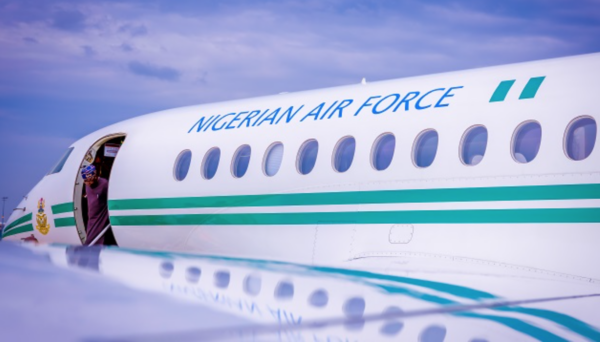
The Office of the National Security Adviser (ONSA) on Wednesday informed lawmakers that the cost of maintaining the Presidential Air Fleet has risen significantly.
The Permanent Secretary at the ONSA, Mohammed Sanusi, disclosed this while appearing before the Senate Committee on National Security and Intelligence to defend the agency’s 2026 budget proposal.
Mr Sanusi explained that the cost of servicing the Presidential Air Fleet has grown significantly because maintenance is carried out abroad rather than locally.
The 2026 budget proposal covers the Office of the National Security Adviser and its affiliated centres, including the National Counterterrorism Centre, the National Cybersecurity Coordination Centre, the National Centre for the Control of Small Arms and Light Weapons, and the Presidential Amnesty Programme.

However, Mr Sanusi did not disclose how much the government spent on maintaining the fleet in 2025 or since the beginning of the current administration.
Aside from maintenance costs, the permanent secretary listed several operational challenges facing the intelligence community, including inadequate operational vehicles for covert missions, irregular release of overhead funds, non-implementation of the 2025 capital appropriation, shortfalls in funding for foreign service personnel, and the impact of foreign exchange fluctuations on service-level agreements.
“There is irregular releases of the overhead cost, non-implementation of the release of the 2025 capital appropriation, irregular release of foreign service personnel shortfall, high exchange rate in respect of the service level agreement used by most of these agencies, inadequate operational vehicle and effective efficient covert to ensure effective and efficient covert operations, increased cost of foreign exchange or maintenance of presidential air fleet abroad instead of our own hangar,” he said.
Nigeria’s Presidential Air Fleet is a collection of aircraft dedicated to transporting the President, Vice President and other top government officials on official assignments within and outside the country. The fleet operates under the supervision of the ONSA, which is responsible for its funding, maintenance and overall administration.
The fleet exists primarily for security, strategic mobility and continuity of government operations. As Commander-in-Chief of the Armed Forces, the president requires secure, reliable and readily available air transport for domestic engagements, diplomatic missions and emergency national security responses. Commercial travel is generally considered unsuitable due to security risks, scheduling constraints and protocol requirements.
However, over the years, the Presidential Air Fleet has attracted public scrutiny, particularly over its uses and maintenance costs. In October 2023, Seyi Tinubu, the son of President Bola Tinubu, flew to Kano in a presidential jet to watch the finals of the year’s edition of the Kano International Polo Tournament. His use of the presidential plane for a private event to satisfy his personal passion generated criticism.
Meanwhile, a significant portion of the presidential aircraft is serviced and maintained abroad due to limited in-country capacity for specialised aviation maintenance. This reliance on foreign facilities exposes the fleet’s upkeep to fluctuations in foreign exchange rates and increases overall operational costs.
Call for supplementary budget
Mr Sanusi appealed to the committee to consider additional funding through a supplementary budget, particularly in light of the president’s recent declaration of a state of emergency on national security.
“Mr. Chairman, I wish to recommend that this esteemed committee, with the recent declaration of a state of emergency on national security by the President, it is our humble prayer that adequate funding should be provided through supplementary budget to the intelligence committee to ensure a timely and speedy response to issues of national security. We all agree that no nation can grow without adequate security, Mr Chairman,” he said.
He assured lawmakers that the intelligence community would remain committed to transparency, accountability and effective resource management, adding that budgetary provisions would align with the government’s national security objectives.
“Mr Chairman, in conclusion, I wish to state and reiterate to the distinguished members that the intelligence community always assures the committee and the entire National Assembly of its commitment, transparency, accountability, and effective resource management by ensuring that the budgetary provisions align with the government’s overall national security objectives,” he said.
Committee Chairman responds
In a brief interview with journalists after the session, the Chairman of the Committee, Yahaya Abdullahi, said the National Assembly leadership would deliberate on the complaints and requests.
“After receiving reports from the various committees, the National Assembly leadership will sit down to review the issues and work out appropriate solutions, particularly those that have arisen in the current financial year. We also discussed the recent declaration by the president of a national emergency on security. If such an emergency has been declared, there must be adequate funding to support it,” he said.
Mr Abdullahi, who represents Kebbi Central Senatorial District, added that the committee may advise the leadership of the National Assembly to seek a meeting with the president to present the concerns of the security and intelligence agencies directly.
“As a result, we will develop a strategy to ensure that the president’s declaration does not become merely symbolic. If necessary, we will engage the leadership of the National Assembly to seek a meeting with the president. We intend to present the concerns of the security and intelligence agencies directly to him so that appropriate steps can be taken to provide them with sufficient funds to carry out their constitutional responsibilities,” he said.
He further noted that 2026 would be a critical year for Nigeria’s democracy, warning that inadequate funding of security agencies could pose serious challenges as the country approaches another election cycle.
The committee, he said, has concluded its budget defence session and is preparing its report for submission to the Appropriations Committee and the leadership of the National Assembly, after which further engagement with the executive arm is expected.
“We also emphasised that 2026 is a very critical year for the survival of the nation’s democracy. Given the current security situation, failure to adequately fund these agencies could create serious challenges as we approach next year’s elections.
“For now, the committee has concluded its work and is preparing its report for submission to the Appropriation Committee and to the leadership of the National Assembly. The National Assembly, in collaboration with the House of Representatives and the relevant Senate committee, will then approach the president with concrete suggestions on how to address the challenges confronting these institutions,” Mr Abdullahi said.(Premium Times)
-

 Politics14 hours ago
Atiku’s Lobbyist Deletes Post On Purported Trump Commission Appointment
-
Business13 hours ago
Nigeria’s syndicated loans jump 21-fold to $2.86bn
-
Politics13 hours ago
Tinubu’s policies improving student welfare, says NANS
-
News13 hours ago
Lab test showed my wife’s fresh orange juice unfit for consumption – Osinbajo
-
Politics14 hours ago
World Igbo Congress warns politicians against threatening Igbos over support for Obi
-
Politics13 hours ago
I am confident I will become Lagos governor next year – NDC gov candidate, Doherty
-
Metro13 hours ago
Nigerian-British businessman dies after penis enlargement procedure in Thailand
-
Metro13 hours ago
Kogi chief allegedly impregnates teen, damages womb