Business
Middle-East War Pushes Up Petrol, Food Prices

Escalating tensions in the Middle East are beginning to ripple across Nigeria’s economy as rising global crude oil prices push up the cost of petrol, triggering increases in transport fares and food prices in several parts of the country.
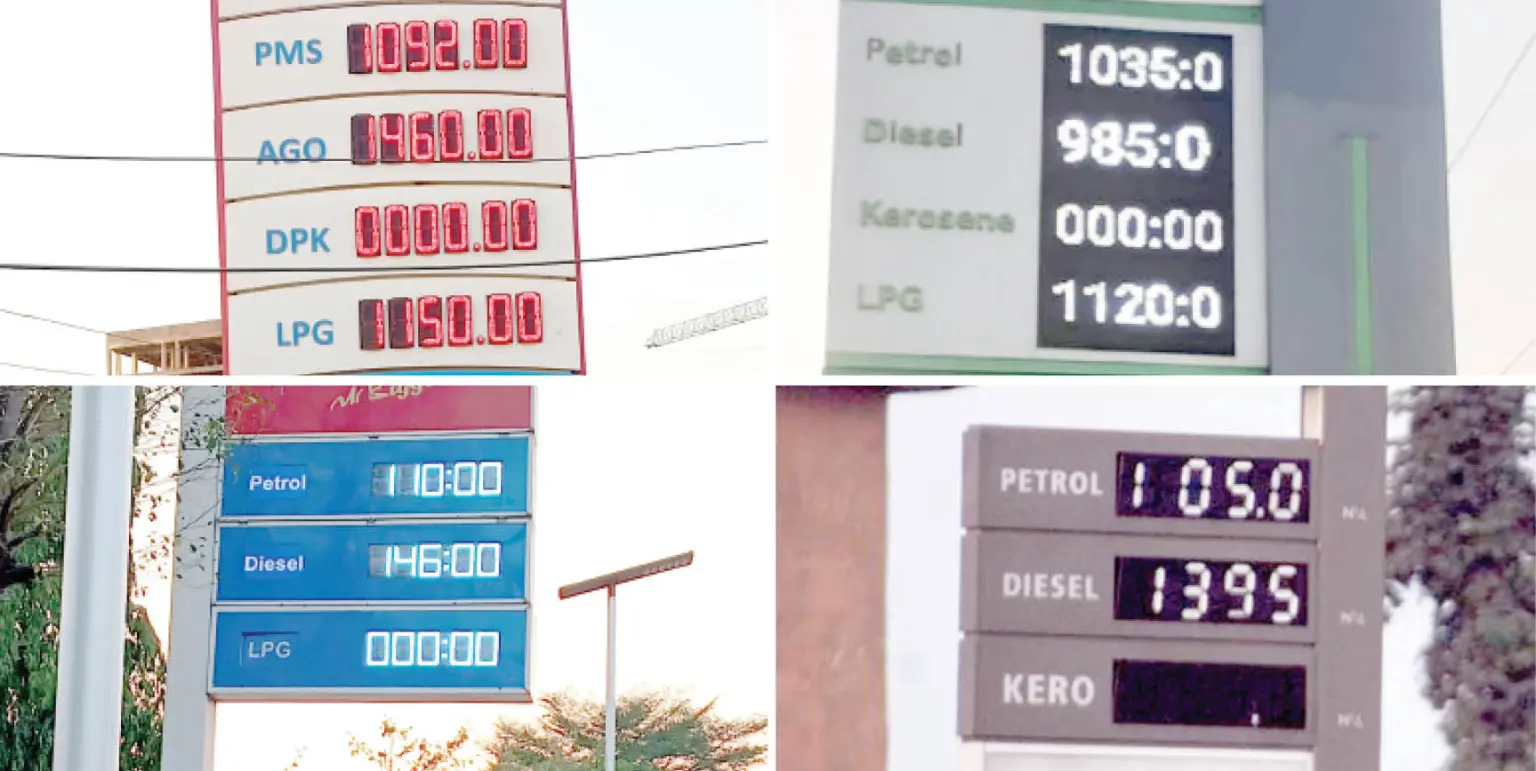
Across major cities, including Lagos, Abuja, Kano, Kaduna, Port Harcourt and Yenagoa, motorists and commuters are grappling with a fresh round of petrol price adjustments, with the pump price of Premium Motor Spirit (PMS), popularly known as petrol, climbing to between N1,020 and N1,100 per litre at many retail outlets.
The development has sparked concerns among residents, transport operators and traders, who fear the increase could worsen the already high cost of living and further strain household budgets.
The latest surge in petrol price is linked to rising global crude oil prices following escalating hostilities involving the United States, Israel and Iran, a development that has disrupted supply expectations in the international oil market.

Prices climb in Lagos, Abuja, Kano, P/Harcourt, others
In Lagos, commuters and households say they are already spending more on transportation and food items following the latest increase in petrol prices.
Checks by Daily Trust at several filling stations showed that PMS now sells between N1,050 and N1,100 per litre, depending on the outlet.
At retail stations operated by Northwest Petroleum, petrol sells for about N1,050 per litre, while TotalEnergies dispenses at N1,055 per litre.
Stations belonging to MRS Oil Nigeria Plc sell at around N1,057, while Mobil outlets charge as high as N1,100 per litre.
The rise in fuel prices has triggered a ripple effect across the transport and food sectors, pushing up daily spending for commuters and households already grappling with rising living costs.
Commercial transport operators have begun adjusting their fares in response to the rising cost of fuel.
Ekundayo Oladimeji, a commercial bus driver who operates between Ogba and Ikeja, confirmed that transport fares have already increased from N400 to N500 following the rise in petrol prices.
“There is no doubt about the possibility of increased transport fare. We have started charging N500 from Ogba to Ikeja.
“On Monday, it may increase to N700. I bought fuel at N935 on Friday, but yesterday morning (Saturday) I bought it at N1,057, and the price may keep increasing,” he said.
Some other transporters said they were struggling to maintain current prices due to passengers’ resistance.
Nelson, who plies the Ogba–Agege route, said: “We have not increased the price because passengers are already complaining about the current fares. But the increase in the price of fuel has affected our expenses and reduced our profit.”
The impact of the fuel price increase is also being felt in food markets across Lagos, where the cost of transporting agricultural produce has pushed up prices.
Traders said prices of pepper and tomatoes had risen sharply within a short period, blaming higher transportation costs.
A small bag of pepper now sells for about N82,000, compared to N18,000 previously. A medium bag has increased to about N122,000 from N22,000, while a large bag now costs around N172,000 compared to about N70,000 earlier.
Similarly, the price of tomatoes has surged significantly as a small bag that previously sold for N22,000 now costs about N50,000, while a large bag has increased from about N62,000 to N125,000.
Oyekale Oluwasegun, a Lagos resident who commutes daily to work, said the increase in fares has already affected his monthly expenses.
According to him, a trip from Powerline to Ogba that previously cost N200 now costs about N300.
“I already have my budget planned, but this increase has affected it,” he said.
“I understand that the economy is facing pressure from external factors, but the government needs to act quickly before the situation gets worse.”
At outlets operated by the Nigerian National Petroleum Company Limited (NNPC), petrol was selling for as high as N1,084 per litre, while AMMASCO filling station on Court Road was dispensing at N1,104 per litre yesterday.
A resident, Abubakar Danzaria, described the situation as alarming, warning that repeated increases in fuel prices could spark panic among citizens if the trend continues.
“We are observing Ramadan and suddenly fuel prices are increasing again and again,” he said.
Transporters in the state have hiked their fares in response to the rising cost of fuel.
Saifullahi Rabiu, a commercial tricycle operator in Kano, said he purchased petrol at N1,060 per litre at a filling station over the weekend.
“When fuel prices increase, we naturally have to adjust fares,” he said. “If we continue charging the same amount, we will run at a loss,” he said.
In parts of Abuja, petrol is now sold between N1,050 and N1,080 per litre, depending on the location, unlike before when it was between N845 and N875.
The sharp increase within a short period has left motorists uncertain about what the coming weeks may bring.
Motorists like Sabiu Mustapha and others who spoke to Daily Trust said they were not sure about what the coming weeks would bring.
In Abeokuta, Ogun State, the price of petrol has risen to N1,300 to N1,400 per litre at filling stations at the border areas.
Ismaila Ahmed, a Community Development Association (CDA) chairman in Iwoye-Ketu, in Imeko-Afon LGA, told our correspondent that a litre is sold for N1,300 at the filling station.
“A bike from Iwoye to Imeko before was N2,000 per head; it is now N7,000, now N10,000,” he said.
A civil servant said: “The hike in fuel price has started affecting transportation cost. For instance, this morning I went to visit someone at Redwood Hospital and normally bike men would charge me N500, but this morning they insisted on N800 – N1,000.”
In Yenagoa, the Bayelsa State capital, and Port Harcourt, Rivers State, traders and residents said the cost of food items had risen as transport operators adjusted their fares, as petrol price is now between N970 and N1,050 per litre at many filling stations.
Destiny Udo, a tricycle operator in Yenagoa, said, “If I buy fuel at the new price, pay levies to government agents and still charge the old fare, then I will be out of business.”
Food vendors are also beginning to feel the pressure from rising fuel costs.
At the Swali Market in Yenagoa, traders said prices of certain food items, particularly fish, had gone up.
Madam Evilyn Tamuno, a fish seller at the market, explained that fishing activities rely heavily on fuel-powered engines.
“When the price of fuel goes up, fishermen will increase the price of fish,” she said.
A housewife, who spoke after shopping at the market, said the money that previously sustained her family for a week could no longer buy the same quantity of food items.
The situation was not different yesterday in Kaduna, where residents said petrol price had risen above N1,000.
They said the hike in petrol price had led to higher costs of transportation and food items.
Aliyu Lere, a resident of Hayin Bello, Rigasa New Extension, said: “There are still queues in some filling stations, especially at the gas units, because people are still buying even though they are not finding things easy.”
Aliyu Abubakar, CEO of Alfatima Laundry Services along Charanchi Road in Tudun Wada, Kaduna, said: “We expect the cost of transportation and foodstuffs to rise due to the increase in fuel price. We just pray it will not be too high because life is already difficult for many ordinary citizens.”
A housewife, Halima Mu’azu, said the prices of beans and other foodstuffs had increased even before the fasting period.
“Some people are complaining that prices have increased again due to the rise in fuel price. Some people have also complained that transport fares have increased,” she said.
She also added that the price of charcoal had increased “from N2,000 to N2,300. We have no choice but to mix it with gas because depending on gas alone will not be easy.”
How Middle East conflict drives oil prices
The latest fuel price increases coincide with a surge in global crude oil prices triggered by the escalating conflict in the Middle East.
The confrontation, involving the United States, Israel and Iran, has heightened fears of supply disruptions in one of the world’s most important oil-producing regions.
Already, the Strait of Hormuz, a narrow waterway bordering Iran considered the world’s most critical energy artery, which controls one-fifth of the world’s oil and natural gas, has been shut daily.
Following the escalation of hostilities, global crude oil prices climbed to about $93 per barrel as of yesterday from $69 at the start of the war.
Analysts warn that prices could rise further if the crisis deepens or disrupts production and export routes in the region.
Some projections suggest crude oil prices could reach as high as $130 per barrel if tensions continue to escalate.
Given Nigeria’s reliance on international oil markets for refined petroleum products and pricing benchmarks, fluctuations in global oil prices often translate quickly into domestic fuel price adjustments.
Dangote Refinery had on Saturday raised its ex-depot price to N995 from N874 per litre in response to the surge in crude oil prices.
It had also defended its decision to adjust the pump price when challenged over the existing naira-for-crude arrangement for which it is getting crude in naira.
Dangote explained that it receives five cargoes of crude monthly, which are paid for in naira.
However, it stated that this falls significantly short of the 13 cargoes required each month to meet domestic demand.
Dangote Refinery further explained that the shortfall of eight cargoes was bought from other sources outside the country.
In addition, it stated that the NNPC cargoes were priced at international market rates plus a premium.
As a result, the company said it was compelled to source additional crude from local and international traders, procuring foreign exchange at prevailing open market rates to complete the purchases.
Prepare for the worst, expert tells Nigerians
Speaking to Daily Trust, an economist and oil and gas analyst, Dr Marcel Okeke, said that as long as the war rages, Nigerians should prepare for the worst in terms of high fuel prices and inflation.
He said, “As for how long this is going to last, nobody knows because it depends on when the conflict in the Middle East goes down. So, as long as it is on and the price of crude oil keeps rising in the global market.
“As we are talking now, it is over $90 per barrel. So it transmits into our economy, you know, either because some people are importing refined products directly from the global market, and Dangote Refinery is still buying part of its crude oil from outside.
“So all of this will now translate to the pump price here going up, and it will also translate into some scarcity because those who are importing — it means they have to pay more now for them to import, and when they pay more to import, they have to sell at a higher price.
“So when the prices of fuel go up, straight away it goes into the cost of transportation and that has started happening. And once it goes into the cost of transportation, it goes into food items. It goes into all kinds of logistics, it goes into house rents, it goes into all items, and that will translate into higher inflation that Nigeria has been manipulating and celebrating that Nigeria has come out of it.”
Fuel price changes driven by market forces – NMDPRA
The Nigerian Midstream and Downstream Petroleum Regulatory Authority (NMDPRA) says fluctuations in fuel pump prices are a direct result of market dynamics under Nigeria’s deregulated downstream petroleum sector.
The authority’s spokesperson, George Ene-Ita, said this in an interview with the News Agency of Nigeria (NAN) while reacting to the recent increase in fuel pump prices linked to the ongoing Middle East crisis.
Ene-Ita said the variations in pump prices across the country were not due to regulatory interference but were driven by supply and demand forces within the market.
“Nigeria has been operating a fully deregulated downstream petroleum regime since the inception of the current administration.
“Therefore, pump price vagaries are purely as a result of market dynamics,” he said.
He explained that under a deregulated framework, petroleum product prices responded to prevailing market conditions.
He added that the policy direction was aimed at allowing market forces to determine prices while encouraging competition, efficiency and increased investment in Nigeria’s downstream oil and gas sector.
-

 Politics17 hours ago
‘I’ve never stolen government money’ — Dino Melaye reveals how he became rich
-
Metro17 hours ago
Builders unearth €9m gold loot sealed in walls of Belgian property
-
Business17 hours ago
NUPRC moves to introduce domestic crude, gas swap arrangement
-
 Business24 hours ago
Nigerians are betting millions on the Osun State election — and the majority are backing Adeleke
-
News8 hours ago
Lakurawa terrorists kill four soldiers in Sokoto
-
Politics20 hours ago
BREAKING: Atiku sues Tinubu over ‘NYSC certificate forgery’, seeks disqualification from 2027 election
-
News17 hours ago
Abiodun completes 108-unit Buhari estate in Ogun
-
Politics8 hours ago
Osun poll: APC, Accord wage N20,000-per-vote war