Business
Fresh fuel import licences trigger Dangote export threat

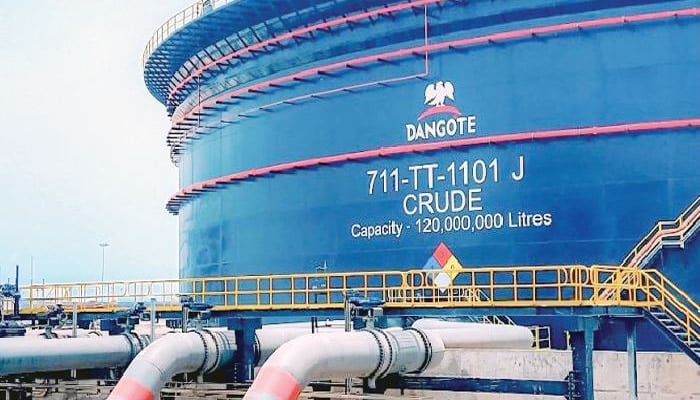
The Dangote Petroleum Refinery is planning to export all the petrol, diesel, and jet fuel produced at the 650,000-barrels-per-day facility located in Lekki, Lagos State, a plan that may plunge Nigeria into fuel scarcity.
This comes amid reports that South Africa and other African countries were lobbying the Dangote refinery for improved fuel supplies.
Impeccable sources at the refinery said the Dangote Group is considering the export option because the Nigerian Midstream and Downstream Petroleum Regulatory Authority is still issuing licences for the importation of petrol.
The allegation persists despite a series of denials by the NMDPRA that no licence had been issued for the importation of petrol from January 1, 2026, to date.

Speaking in an exclusive interview with our correspondent, a very senior management official at the Dangote Group said the refinery would resort to exporting all its products, since the Federal Government has continued to issue import licences for petroleum products.
“Well, since import licences are still being given, we will as well export all our productions,” the source, who pleaded for anonymity due to the lack of authorisation to speak on the matter, told The PUNCH.
Our correspondent reminded the official that the NMDPRA had repeatedly debunked claims that it granted import licences to marketers this year, but the source insisted that import licences were still being issued.
According to the official, the President of the Dangote Group, Alhaji Aliko Dangote, had said import licences were recently granted to six marketers to import Premium Motor Spirit (petrol) into the country.
“I’m sure that you saw my president’s statement that at least six companies have been given import licences. I know for sure that import licences are still being granted,” the source insisted.
When the official was reminded that the total export of all Dangote refinery’s output would throw the country into a deep energy crisis, as fuel scarcity would return queues to filling stations, the top official queried why the Nigerian government was not protecting its industry amid the ongoing war in the Middle East.
The official stated that the United States President, Donald Trump, is fighting for his country while the world is resisting him to protect their industries.
“If they know there will be fuel scarcity, why are they giving import licenses when the whole world is trying to protect their local industries? Trump is fighting for the US, and the rest of the world is resisting him to protect their own industries. I know Nigeria cannot afford another energy scarcity, especially at a time when a global scarcity is building up because of the war,” the source stated.
Asked for the way out to prevent sending all output to foreign countries while Nigerians struggle for fuel, the source replied, “The government can decide as they wish.”
A report by Bloomberg on Friday stated that several African governments, most notably South Africa, have begun aggressive outreach to the Dangote refinery. The refinery is seeing a significant surge in enquiries as traditional supply routes from the Middle East face unprecedented disruptions.
“Right now, it is not about pricing; it’s about availability. I think the situation will continue for a while,” Aliko Dangote reportedly stated in a recent interview with The Economist.
South Africa, one of the continent’s largest energy consumers, was said to be among the first to formally signal its intent to diversify its sources. The government is moving to mitigate the risks associated with instability in the Persian Gulf by looking toward West Africa.
“The government is actively coordinating with industry stakeholders to secure both crude oil and refined petroleum products from a diversified range of sources,” a spokesperson for the South African government told Bloomberg.
Beyond South Africa, other African nations are reportedly “scrambling” to secure supply contracts that ensure their local markets remain stable despite the global turmoil.
The Dangote refinery has served as a major fuel supply lifeline for Nigeria and West Africa, shielding the country from the external shocks caused by the Middle East crisis, though a litre of petrol has jumped from N839 per litre to N1,336 since the war started on February 28.
NMDPRA speaks
Meanwhile, the NMDPRA has insisted that the country has not issued any import licence this year, debunking allegations that six marketers got licences to bring in petrol. The agency asserted that vessels bringing petrol into the country this time were from licences issued in the last quarter of 2025.
February figures show that the Dangote refinery produced an average of 36 million litres per day, while national consumption was about 56 million litres per day, leaving an apparent gap.
A source within NMDPRA, speaking on condition of anonymity due to the lack of authorisation to speak on the matter, explained that the refinery’s unsold stocks were rolled over due to weather-related export delays in Europe at the end of 2025, closing the supply gap in February.
“The shortfall rolled over from previous stocks. These things are simple. Our fact sheets are published monthly. There were rollover stocks. Dangote didn’t export for a long time towards the end of last year. So, it was those rolled-over stocks that it supplied. Both marketers and Dangote are only jostling for market shares. Has there been a shortage? No!” the source said.
The regulator also refuted claims by Dangote that new licences had been issued to six companies to import petrol, noting that licences are granted quarterly.
“Those that were issued towards the end of last year were still being used. A licence for importation is not like taking money to the supermarket to buy something off the shelf. It takes time for vessels to arrive. We have not issued any import licence this year. You can choose to believe whoever you want. We are the regulator, but if you want to believe something different from what we report, you are free to. But I will advise you to stick to our fact sheets, which come out monthly,” the NMDPRA source said.
Nigeria has historically relied on imported refined petroleum products due to limited domestic refining capacity. However, the operational Dangote refinery, producing 650,000 barrels per day, has shifted the downstream dynamics. NMDPRA confirmed that domestic refineries supplied 36.5 million litres per day in February 2026, with imports contributing just three million litres, representing roughly 92 per cent of the national daily supply.
Earlier, the Chief Executive of the NMDPRA, Saidu Mohammed, stressed that the agency is ending an era of heavy petrol importation, saying the country must sustain the gains made in domestic refining.
Mohammed said some interests were still pushing for the continuation of large-scale fuel importation despite the country’s progress in boosting domestic refining capacity.
“Today, we have a refinery that meets our requirements. But there are still people who want us to remain in phase three of importation. I must tell you. So, we have to do all we can to make sure that what has been achieved is sustained. That is the hard work and the hard part of our job,” he said.
The NMDPRA boss explained that Nigeria’s petroleum sector has historically passed through different phases, from early domestic refining to the long period of import dependence caused by the collapse of state-owned refineries.
“We have a history of moving through phases. Phase one was very, very good. Most of us were not born then. We understood that there was only one refinery and that the products were being moved by rail. When we grew up, we saw waggons of different colours, and we were told those were petroleum products,” he said.
According to him, the second phase emerged with the establishment of the Nigerian National Petroleum Company Limited and the construction of additional refineries and pipeline infrastructure that improved fuel distribution across the country.
However, he explained that the situation deteriorated when Nigeria’s refineries gradually stopped working, forcing the country into almost total reliance on imported petrol.
“Until we entered the bad phase, phase three, when the refineries went down one by one, and we were faced with this bad phase of importation, almost 100 per cent. It was a bad phase, but good for some businesses. That is how we ended up lining up tank farms between Calabar and Badagry,” Mohammed stated.
He noted that more than 200 tank farms sprang up along Nigeria’s coastline during the period, reflecting the country’s heavy dependence on imported fuel.
“Over 200 tank farms were relying on importation because Nigeria is a very big market, and that created business opportunities for some people. Until the big bang came, which is phase four. Today we have a refinery that meets our requirements,” he said, referring to the Dangote refinery.
He regretted that “there are still people who want us to remain in phase three. So we must do everything possible to sustain what has been achieved.”
Speaking with our correspondent, the Vice President of the Independent Petroleum Marketers Association of Nigeria, Ahmed Fashola, said the country should prioritise domestic refining. According to Fashola, Nigeria’s growing reliance on local supply represents progress for the downstream petroleum sector.
“If today we are able to achieve 90 or 92 per cent of our supply locally, I think we are doing well. We should give it to Dangote,” he stated.
Fashola added that the emergence of the refinery has helped shield Nigerians from potential spikes in fuel prices amid global geopolitical tensions in the Middle East. With the fight among the US, Iran, and Israel, Fashola argued that the price of petrol would have risen to N3,000 or N4,000 per litre.
“If not for Dangote, with the little disruption and the crisis between the United States and Iran, by now we would have seen a lot of queues and petrol selling maybe for N3,000 or N4,000 per litre,” he said.
He also expressed support for the suspension of import licences, describing it as necessary to encourage domestic refining capacity.
“We should be grateful to Dangote. And we have to support it. We have to encourage him to do more. And we equally support stopping import licences. It’s the way to go. We have to support our local production. We have to encourage the refiners. We have to support them in any way for them to succeed. When they succeed, the country also succeeds,” Fashola added.
If the refinery proceeds with exporting all its output, industry players warned that the immediate impact could be a tightening of domestic supply, potentially triggering fresh fuel shortages, long queues, and upward pressure on pump prices.
Such a scenario, they noted, would not only strain households and businesses but could also reverse recent gains in stabilising the downstream sector at a time when global supply disruptions are already heightening energy security concerns. (Punch)
-

 News21 hours ago
Lakurawa terrorists kill four soldiers in Sokoto
-
Politics21 hours ago
Osun poll: APC, Accord wage N20,000-per-vote war
-
Sports21 hours ago
Gala reject £111m, insist Osimhen not for sale
-
World News21 hours ago
Ex-Cambridge professor accused of plagiarism found dead
-
Politics21 hours ago
Atiku, Obi, others’ summit shifted to August 31
-
Metro21 hours ago
Family, friends celebrate Wigwe
-
Metro20 hours ago
Man Allegedly Beheads Woman In Adamawa Hotel
-
News21 hours ago
Helpless! Borno families sell houses to pay ransom