Politics
Concerns as consensus plot robs parties of internal democracy

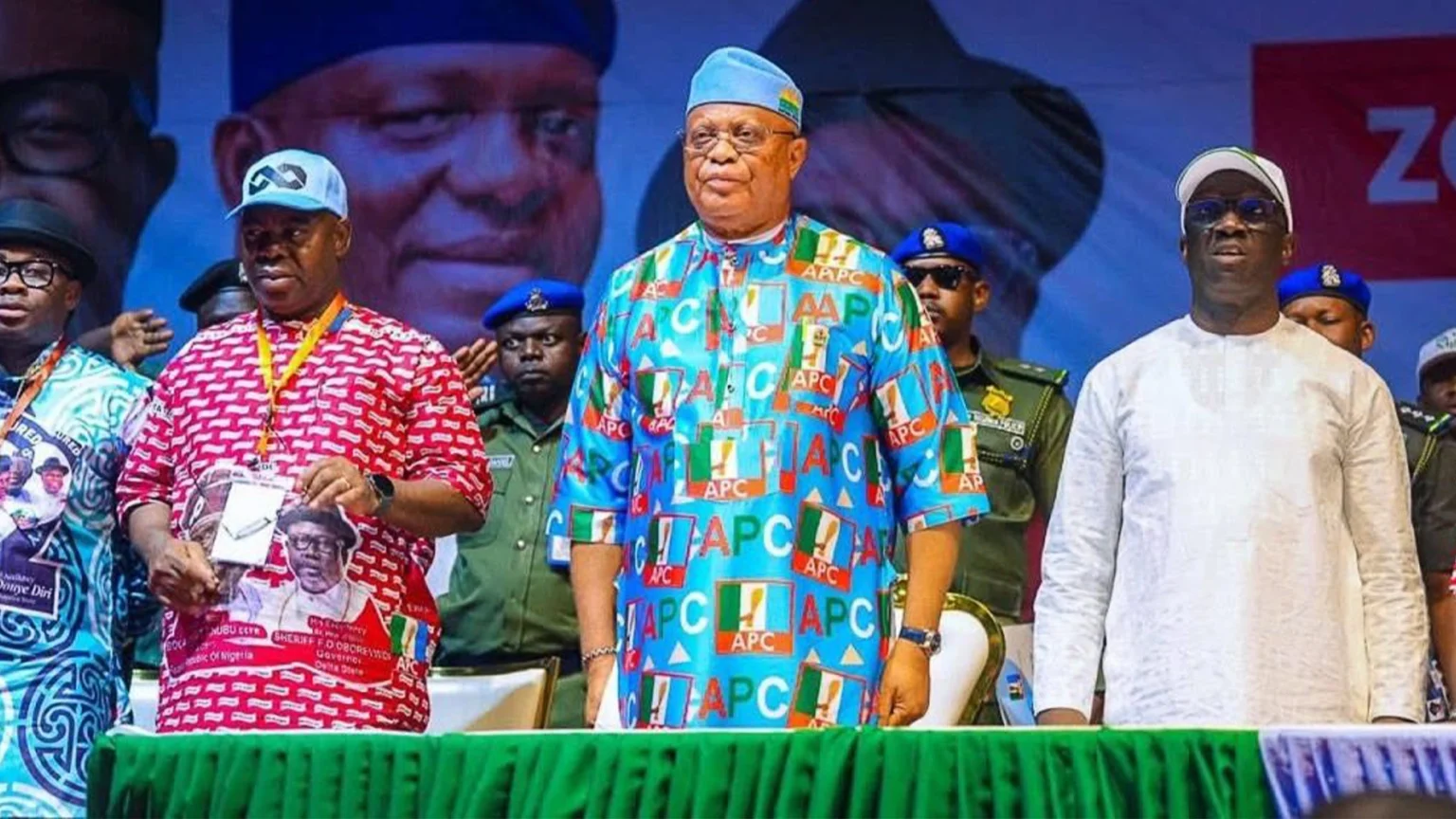
• Diri: Consensus fosters unity in APC
• APC North Central stakeholders adopt Tinubu as sole candidate
• Akpabio, South-South govs vow to actualise President’s re-election
As the ruling All Progressives Congress (APC) holds its second national convention tomorrow, the adoption of a consensus approach for selecting its national leadership during the party’s convention scheduled for March 27–28, in Abuja, has set the tone for other political parties ahead of next month, when parties are expected to start their selection of candidates.
With the Electoral Act 2026 abolishing the delegates system in selecting candidates and narrowing the options to consensus arrangement or direct primaries, where all party members pick candidates to stand for election, the logistical bottleneck of conducting a direct primary within the tight election timetable released by the Independent National Electoral Commission (INEC) has made consensus the easier choice of adoption by parties.

And in what may well lead to a groundswell of bandwagon effect, the consensus option, which political watchers have termed ‘Coronation of anointed candidates’, will likely shape the party primaries,
The practice may further weaken internal party democracy and stifle the political space, with politicians unable to test their popularity at the primaries. It also enthrones the ‘godfather’ system.
A foretaste of what is to come emerged yesterday when the Secretary to the Government of the Federation (SGF), Senator George Akume, led North Central governors and delegates from the geo-political zone to affirm President Bola Tinubu as the sole candidate of the APC for the 2027 presidential election.
According to a statement by Yomi Odunuga, Special Adviser, Media and Publicity to the SGF, Akume made the declaration in Lafia, the Nasarawa State capital, during the North Central Zonal Congress of the APC.
The statement read: “Motion for the President’s adoption as the sole presidential candidate of APC, was moved by Akume and seconded by the Governor of Nasarawa State, Abdullahi Sule, with a thunderous affirmation from all the delegates.
“All the governors from the North Central zone, as well as most former governors and their deputies, serving National and state Assembly members, Ministers, and a host of other former and current political office holders, who graced the epoch-making event, all endorsed the motion.”
Nasarawa governor, who doubles as the Chairman of the North Central Governors Forum, while seconding the motion, cited the economic reforms of the Tinubu administration as the primary reason North Central governors were throwing their weight behind the President.
He added that at a meeting of APC governors in Lagos two days before the congress, the party now counted 31 governors among its ranks, a development he attributed to the Tinubu administration’s record of governance.
Akume, however, admonished party members not to rest on their oars ahead of 2027, warning that while victory was within reach, it must be worked for. “Don’t sleep. You can win elections, but you must work and sweat as though you are contesting with your strongest opponent, so that our victory will be huge. Nobody would dispute our results,” he told delegates at the congress.
The APC National Chairman, Prof. Nentawe Yilwatda, represented by the Deputy National Secretary, Prof. Abdulkarim Abubakar Kana, commended the zone for its loyalty to the party and to the agenda of President Tinubu. He congratulated the newly elected zonal executives, reminding them that their emergence was not a victory of one faction over another but a call to service and also used the occasion to formally invite all delegates and party stakeholders to the APC National Convention slated for Friday and Saturday at Eagle Square, Abuja.
EARLIER, the party had announced it would adopt a consensus arrangement to elect its national leaders at the party’s convention. Assistant Secretary, Media and Publicity, of the APC National Convention 2026, Mrs Mary Ikoku, disclosed this on Channels Television’s Sunrise Daily on Wednesday.
Speaking on elective positions at primaries, she said she could not provide a definite answer, as politics is local and party leaders might adopt different approaches when the time comes.
Governor of Bayelsa State, Senator Douye Diri, described the party’s adoption of the consensus mode of electing its officials as the best way of fostering unity and consolidating the party ahead of the 2027 general election. Diri stated this at the APC South-South Zonal Congress held at Asaba, Delta State.
The Bayelsa governor expressed satisfaction that politically, the South-South region now speaks with one voice under the APC, stressing the need for the region to be part of the decision-making process at the national level.
Diri, who is chairman of the South-South Governors’ Forum, recalled that when he contested for the governorship in 2019, the delegate selection process for primaries in the political parties made the exercise rancorous. He said the slogan then was that without delegates, there will be no governor, noting, however, that today, that has changed to consensus building.
The President of the Senate, Godswill Akpabio, charged stakeholders in the South-south to mobilise massively and deliver the highest votes in the country for the re-election of President Tinubu in 2027. He commended the national vice chairman, Victor Giadom, for working relentlessly to woo all the governors of the region into the party.
In their goodwill messages, the host governor, Sheriff Oborevwori, and his counterparts from Rivers, Akwa Ibom, Edo, and Cross River all spoke on the unity of purpose to be able to re-elect President Tinubu for a second term. All the governors in their remarks vowed to work for the president’s re-election. Giadom was returned as the party’s zonal chairman alongside seven other zonal executives of the party.
MEANWHILE, the gains from recent sporadic defection of some state governors from the opposition into the party’s fold have brought about a mixed bag of benefits and obstacles.
Putting its power of incumbency into good use, the ruling effectively corralled the party faithful, especially with some political aspiration to accept the consensus option, thereby averting the possibility of recriminations.
Speaking after he was cleared by the screening panel, both the national chairman and secretary, Yilwatda, and Basiru, described APC as a youth-friendly party, stressing that the party has institutionalised due process, internal democracy, transparency, and inclusivity in its administrative system.
The national chairman, who is seeking a substantive term after completing the remainder of the first term allotted to the North Central geopolitical zone, disclosed that in the emerging new APC under his watch, “everybody is a subject of the system and how it operates, (because) the system prevails over individuals.”
Although Prof Yilwatda gave kudos to the party’s stakeholders, particularly the state governors, National Assembly members and those of the Executive arm, the political interest of the state governors that recently joined the party has become an issue of concern.
Recall that in a bid to sustain the relative peace and harmony within the National Working Committee of the party, the APC leaders retained the subsisting zoning arrangement in the distribution of officials of the party.
However, the entry of incumbent governors like those of Delta and Enugu states has thrown up some discontent in their states, which produced national officers like Emmanuel Eneukwu (the Deputy National Chairman (South) and Felix Morka, the National Publicity Secretary, respectively.
Barely two months after Governor Sherriff Oborevwori of Delta State left the embattled Peoples Democratic Party (PDP) and joined the APC, his Enugu State counterpart, Governor Peter Mbah, followed suit. Before the two governors crossed over to the broom corner, Imo State governor, Hope Uzodimma, and the former Deputy President of the Senate, Augustine Omo-Agege, were not only overseeing the affairs of Enugu and Delta, but also nominated Eneukwu and Morka for their NWC positions.
For Enugu, the governor is backing the former acting State Chairman of the party, Dr Ben Nwoye, to replace Eneukwu as Deputy National Chairman, even though both men were screened for the position.
On the other hand, Morka’s decision to quickly align himself with Governor Oberevwori and the Delta State governor’s politics of accommodation has resolved what would have been a showdown at the convention ground through balloting.
At a meeting with President Bola Tinubu in Lagos on Tuesday, it was gathered that a lot of disagreements flared up regarding the issue of zoning and retention of the present occupants of national offices.
In Abia State, where the APC does not have a governor, the Deputy Speaker, Benjamin Kalu’s candidate, Donatus Enyinnaya Nwankpa, has been endorsed to retain his office of National Welfare Officer in the NWC.
Returning APC National Scribe, Ajibola Basiru, had declared after his screening that the party was committed to deepening cohesion, fairness, and institutional efficiency, arguing that the progress made under his leadership since August 2023 deserves retention.
As the APC prepares for its national convention tomorrow, the party’s governors are emerging as decisive power brokers in determining both the leadership outcome and future direction of the party. Indications from within the party suggest that the governors’ collective position may ultimately shape the convention’s resolutions, particularly on zoning and leadership continuity.
In a series of closed-door consultations held in recent weeks, governors reportedly agreed to uphold the prevailing zoning formula as a strategy to promote stability, equity and political balance across Nigeria’s geopolitical zones. Sources familiar with the deliberations disclosed that the governors view continuity as critical to maintaining cohesion within the ruling party, especially at a time when political alignments ahead of 2027 are gradually taking shape.
Key issues expected to guide decisions at the convention include zoning arrangements, leadership succession, internal party democracy and mechanisms for strengthening party structures nationwide. Observers note that beyond leadership selection, the convention will serve as an important test of the APC’s capacity to manage internal interests while projecting unity to the electorate.
Political analysts believe the convention may ultimately produce consensus candidates for most positions, reflecting the governors’ preference for negotiated outcomes rather than open contests. According to analysts, consensus arrangements have increasingly become a conflict-management tool within major political parties, helping to minimise factional disputes while reinforcing elite agreements.
Meanwhile, a senior party source disclosed that the convention is likely to proceed largely by consensus, as state chapters have already aligned their expectations with decisions reached during pre-convention consultations.
“There is nothing extraordinary that will happen on Friday and Saturday because each state already knows what it is bringing,” the source said, suggesting that negotiations had effectively concluded before delegates converged on the venue.
The source further explained that retaining the existing zoning formula means aspirants are already aware of the positions available to them, thereby reducing the likelihood of last-minute surprises or contentious voting processes. “The convention will be by affirmation,” he added.
If the anticipated consensus holds, the APC convention could reinforce the growing influence of governors within the party’s power structure, underscoring their role not only as regional political leaders but also as central actors in shaping the ruling party’s strategic direction ahead of the next electoral cycle.
IN the Southwest, the party yesterday re-elected Dr Isaacs Kekemeke as the Zonal Chairman. Kekemeke emerged through a consensus arrangement ratified by a voice vote alongside other members of the zonal executive committee during the exercise, which attracted 3,188 delegates from Lagos, Ogun, Osun, Ondo, Ekiti and Oyo states.
The congress was held at the Mobolaji Johnson Arena, Lagos Island, and attracted several APC dignitaries, including Governors Babajide Sanwo-Olu of Lagos State, Dapo Abiodun of Ogun State, Biodun Oyebanji of Ekiti State and Lucky Aiyedatiwa of Ondo State.
In his acceptance speech, Kekemeke expressed confidence in the party’s strength in the South-West, assuring members of improved performance by the zonal leadership and projecting victories for the APC in the 2027 governorship elections in Osun, Ekiti and Oyo states.
It was the same with the consensus option in the Southeast region. At the zonal Congress, held at the Presidential hotel premises in Enugu, the party returned its zonal Chairman, Dr Ijeoma Arodiogbu, to continue for another four years. The congress, attended by top party leaders and stakeholders from across the region, saw the dissolution of the outgoing zonal executive and the seamless emergence of new officers through consensus, in line with the party’s constitution and the Electoral Act.
Uzodimma, also Chairman, Southeast Governors’ Forum, set the tone for the exercise, emphasising unity and progress within the party. He added that the leadership of the party had agreed to conduct the congress through consensus, “in line with Article 20.1 of our constitution, we have agreed to move our zonal congress by consensus”, stressing that it was to ensure unity and allow members to return home on time.
Governor Francis Nwifuru of Ebonyi subsequently moved a motion for the dissolution of the existing zonal executive, which was seconded by Senator Patrick Ndubueze.
Following the dissolution, Deputy Speaker of the House of Representatives, Benjamin Kalu, moved a motion presenting the list of consensus candidates for adoption.
He also moved two additional motions adopting the use of consensus as the mode of the congress in accordance with Section 84(2) of the Electoral Act, and ratifying the outcomes of ward, local government, and state congresses across the region.
Speaker of the Enugu State House of Assembly, Eugene Uchenna Ugwu, seconded the motions, which were overwhelmingly endorsed by delegates. Host governor, Peter Mbah, described the congress as a demonstration of unity and strength within the APC in the Southeast.
At the Northwest Zone Congress held in Kaduna, Governor Uba Sani used the opportunity to project himself as a unifying force within the ruling party, while strongly defending the reform agenda of President Tinubu and consolidating political gains in the region.
Besides, a key highlight of his remarks was the high-profile reception of new entrants into the APC, particularly Governors Abba Kabir Yusuf of Kano State and Dauda Lawal of Zamfara State.
In a move aimed at easing tensions within party ranks, Sani reassured new and old members alike that the APC operates on equality rather than hierarchy. (Guardian)
-

 Politics17 hours ago
‘I’ve never stolen government money’ — Dino Melaye reveals how he became rich
-
Metro18 hours ago
Builders unearth €9m gold loot sealed in walls of Belgian property
-
Business17 hours ago
NUPRC moves to introduce domestic crude, gas swap arrangement
-
News8 hours ago
Lakurawa terrorists kill four soldiers in Sokoto
-
Politics20 hours ago
BREAKING: Atiku sues Tinubu over ‘NYSC certificate forgery’, seeks disqualification from 2027 election
-
News18 hours ago
Abiodun completes 108-unit Buhari estate in Ogun
-
Politics8 hours ago
Osun poll: APC, Accord wage N20,000-per-vote war
-
Sports8 hours ago
Gala reject £111m, insist Osimhen not for sale