Opinion
Time for Joash Amupitan to be humble, honest in social media handle row

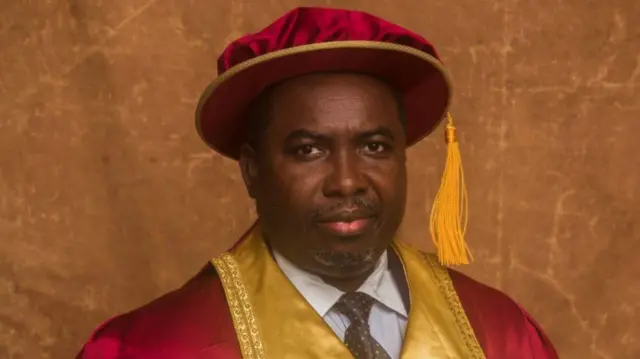
The statement issued by the spokesman of the Chairman of the Independent National Electoral Commission, Professor Joash Amupitan, denying that the electoral umpire maintains any presence on X, would have passed as a routine rebuttal in calmer circumstances. It would perhaps have been read as a necessary intervention against the plague of impersonation and digital fraud that afflicts public life. Circumstances, however, are far from calm, and the facts now circulating in the public domain have complicated what should have been a straightforward denial. Evidence, which includes metadata analysis, has called into question the electoral umpire’s categorical disavowal, thereby shifting the matter from a question of misinformation to one of credibility.
The burden that now rests on him transcends the narrow issue of a social media handle. The deeper moral question that emerges touches the core of public trust and the ethical demands of high office. At stake lies not merely the authenticity of an account, but the integrity of the electoral umpire. The exalted office of the electoral umpire does not permit ambiguity in matters that border on partisanship, nor does it tolerate the luxury of evasion when confronted with evidence that challenges what the spokesperson passes off as official narratives.
When I wrote, on October 27, 2025, shortly after his appointment, I did so in the spirit of careful optimism, anchored in personal knowledge and a long acquaintance with the man who is my former lecturer. I recall my words with a clarity that now weighs heavily upon reflection. I wrote that “the appointment of Professor Joash Ojo Amupitan, SAN, as Chairman of the Independent National Electoral Commission is a development that warrants careful optimism. In a country where electoral credibility has often been questioned, his selection offers a measure of hope that integrity and diligence might guide the nation’s electoral processes”.
Those words were not offered lightly. They emerged from memory, shared history, and a conviction formed over decades.

I went further, affirming that “it is no exaggeration to say that, in our political imagination, INEC has often been seen as a graveyard of reputations. Yet the selection of Professor Amupitan, a scholar of unimpeachable integrity, offers a rare opportunity to restore public trust in a critical national institution”. The phrase, “unimpeachable integrity”, now returns with a sting; and not as a tribute, but as a question. What becomes of such an assertion when conduct appears to diverge from the standard it proclaims?
In that same piece, I invoked personal experience, recalling that “having known Professor Amupitan as a student at the University of Jos in the late 1980s and early 1990s, I can attest to his intellectual calibre and character”. I described him as “industrious, honest, humble, and deeply grounded in principle”. Those words were written in good faith, informed by years of observation, and animated by the hope that the qualities of the scholar would endure in the crucible of public office. To say they were animated by hope is to suggest that hope was not merely present, but active and generative, breathing life into the judgment itself. It was the quiet conviction that learning refines character, that the discipline of mind can translate into discipline in conduct, and that the habits formed in scholarship, rigour, humility before facts, and fidelity to truth, might withstand the distorting pressures of power. This hope did not arise from naivety, but from a considered belief that intellectual formation can shape moral steadiness even in public life. It also reflects an expectation that the transition from the ivory tower to public governance need not entail a surrender of principle. Rather, it assumes that the scholar’s virtues could be carried into office as a shield against totalising power. To be animated by hope, then, is to have hope written with an underlying faith that public office would not erode those qualities; but test, reveal them at their strongest, and harden them into visible ethics of service.
The present controversy has cast a long shadow over those convictions. The allegation that the social media account linked to Professor Amupitan celebrated the electoral victory of President Bola Ahmed Tinubu in 2023 strikes at the heart of the neutrality expected of an electoral umpire. The subsequent denial, couched in absolute terms and accompanied by threats of legal consequences against unnamed perpetrators, compounds the difficulty. Where contrition might have softened the edges of the crisis, defiance has hardened it.
The language of the spokesman’s statement for Professor Amupitan warrants scrutiny. It speaks of “malicious and coordinated campaigns of calumny”, of “figments of imagination”, of “cybercriminals” and “impostors”, and of the “full wrath of the law”. Such language projects strength, but in this context, that strength risks being mistaken for defensiveness. Public confidence does not thrive on threats. It grows from candour, from accountability, and from the willingness to confront uncomfortable truths without resort to institutional intimidation. For an office as sensitive as that of the Chairman of INEC, perception holds equal weight with reality. Even the appearance of partisanship, however remote, erodes the delicate balance upon which electoral legitimacy rests. When that perception becomes entangled with contradictions between denial and evidence, the erosion accelerates. The question then ceases to be whether a particular account exists or not, and becomes whether the occupant of that office commands the moral authority required to preside over elections in a deeply divided polity.
A moment such as this calls for both introspection and truth-telling. It also calls for a recognition that the trust deficit afflicting Nigeria’s electoral system cannot be bridged by puerile statements alone. Silence, in some circumstances, damages credibility; in others, a statement that appears disconnected from verifiable reality inflicts even greater harm.
The choice before Professor Amupitan demands a careful weighing of these realities.
The tragedy of the present moment lies in the dissonance between expectation and the actions of a scholar once held up as a symbol of integrity, but who now finds himself at the centre of a needless controversy that interrogates that very integrity. Such dissonance does not merely diminish an individual; it reverberates across the institution he leads. INEC cannot afford the luxury of reputational ambiguity, particularly at a time when public faith in democratic processes stands on shaky ground.
There exists, in public life, a point at which denial ceases to persuade and begins to undermine. When that point arrives, the path of honour narrows, and the options available to a public officer become stark. Ownership of error, where error exists, offers a path toward redemption. Persistence in denial, in the face of contrary evidence, deepens the crisis and prolongs the damage. The title of this intervention speaks to that imperative. The time has come for Professor Amupitan to own up, to confront the questions that have arisen with honesty and humility, and to place the integrity of the institution above personal defence. Such an act would not diminish him. On the contrary, it would affirm the very qualities that once inspired my confidence in his appointment.
Nigeria’s democracy stands in need of institutions that command trust, not merely through constitutional mandate, but through the moral authority of those who lead them. The office of the Chairman of INEC demands nothing less. Where doubt persists, leadership must dispel it, not through rhetoric, but through truth. The disappointment that accompanies this episode does not arise from hostility. It arises from the betrayal of expectation, from the distance between what appeared as a promise and what now appears. A scholar who once stood as a beacon now confronts moments that will define his legacy. Whether that legacy inclines toward restoration or decline rests upon the choices made in the days ahead.
History offers few comforts to those who evade responsibility. It reserves its kinder judgments for those who, when confronted with the weight of their own contradictions, choose the harder path of honesty. For Professor Amupitan, that moment has arrived. When one finds oneself in a hole, wisdom counsels restraint rather than further excavation. There comes that moment when persistence ceases to be a virtue and becomes folly. At such a moment, the more honourable course is to pause, to lift one’s hands from the tools of self-justification, and to speak plainly: I erred. After all, to err is human. Failing that, there is dignity in stepping aside, in recognising that the office one holds is larger than the individual who occupies it, and that its integrity must not be diminished by obstinacy. To resign, in such circumstances, is not an admission of weakness but an affirmation of character. It signals an understanding that public trust is both fragile and sacred, and that accountability is the price of its preservation. The more conscious decision is to place principle above pride, and to allow institutions to breathe again, unburdened by the weight of avoidable controversy.
History is rarely persuaded by stubborn defiance. To withdraw with grace is to leave behind some measures of respect, to ensure that one’s legacy is not defined by the misstep itself, but by the courage to confront it and the humility to make amends.
Abdul Mahmud, a human rights attorney in Abuja, writes weekly for The Gazette
-

 News22 hours ago
Tinubu approves Lagos-Ibadan expressway reconstruction with concrete pavement
-
Celebrity Gist23 hours ago
30-Year Jail Term: R. Kelly begs Trump for clemency
-
Business23 hours ago
Importers set to increase depot petrol price to N1,350/litre
-
Business23 hours ago
Diaspora remittances set to hit $1 billion monthly – CBN Gov
-
Sports22 hours ago
Pele’s World Cup jersey fetches $4.9 million at US auction
-
Sports23 hours ago
World Cup 2026 winners to receive historic first championship rings
-
News23 hours ago
Ex-Rivers governor Rotimi Amaechi loses 89-year-old mother
-
News24 hours ago
Court bars FRSC officials from state roads