Metro
Inside Story Of Househelps From ‘Hell’

A growing number of Nigerian families are raising the alarm over troubling experiences with domestic workers, with reports ranging from theft and negligence to allegations of abuse and violent incidents. While house-helps remain an essential part of many homes, a review of recent cases and personal accounts reveals a pattern of distrust and fear.
“Over a period of two months, I noticed that lots of my kitchen utensils had broken and appliances around the house had gone bad. When I asked, Sarah told me that it was my children and I ended up scolding them. I caught her breaking a plate, and when I asked, she blamed it on my kids, not knowing that I witnessed the incident.
“Sarah did not only make me scold my children, she stole from me. While searching her bags on the day I asked her to leave, I saw a pair of my nightwear, one of my wigs and a small clutch bag. These were items I had been looking for all around the house and she claimed she had no idea of their whereabouts,” Mrs Seyitan Adeyemi said while sharing a harrowing experience with her housemaid.
Mrs Adeyemi further said that when she was asked why she had been lying on the children while stealing from her boss, Sarah said, “I didn’t think my madam would notice the things I took because she has many of the wigs and bags.”

She added that she was really disappointed in her maid’s behaviour, most especially because she had planned to enroll her in an entrepreneurial class – either tailoring or making of nails. Mrs Adeyemi also said she had taken her on a shopping spree when she was employed, bought her new cloths, basic skincare items and even a small phone that she could use to communicate with her family as she had none when she was newly employed.
This is just one example of what many Nigerians face in the hands of their house-helps.
For many families, domestic workers are more than employees. They become part of the household, caring for children, managing homes and often gaining access to the most private aspects of family life. Yet, a review of reported incidents across the country reveals how this partnership can sometimes end in betrayal, violence and tragedy.
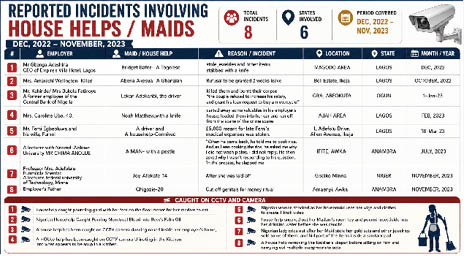
Data collated by Weekend Trust showed that between 2022 and 2024, many high-profile cases involving house-helps, drivers and other domestic workers made headlines, creating a public concern about safety within Nigerian homes.
In December 2022, a Lagos-based hotelier, Mr Gbenga Adeshina, accused his Togolese house-help of stealing jewellery and other valuables from his residence in Magodo. Just two months later, another employer in Ajah reported that a domestic worker allegedly disappeared with valuable household items.
In 2024, a house-help identified as Blessing Effiong was arrested for allegedly stealing $51,000 from her employer just three days after being employed in Lekki, Lagos State. Blessing commenced her duties as a domestic staff on December 23, 2023. However, within three days of her employment, she reportedly absconded with the substantial sum belonging to her employer and fled to Cross River State along with her husband.
The trend was not limited to theft as other cases took a far more disturbing turn.
In October 2022, residents of Bell Estate in Ikeja were shocked by the death of a woman allegedly killed by her Ghanaian house-help following a dispute. In Minna, Niger State, a university lecturer, Professor Adefolalu Funmilola Sherifat, was reportedly killed by her teenage domestic worker after the latter was allegedly dismissed from service. In Anambra State, the police investigated a case involving a young domestic worker accused of participating in the ritual killing of his employer’s father.
Beyond the incidents reported to law enforcement agencies, the social media has become flooded with viral videos allegedly showing domestic workers engaging in shocking acts. Some clips have shown house-helps being accused of contaminating food, mishandling children, stealing personal belongings and secretly using their employers’ property.
On an Instagram page, @househelpreviews, where many come to share their various experiences with house-helps, a Lagos-based woman recounted how she returned from maternity leave to discover that her house-help had allegedly stolen cloths, designer bags, shoes, perfumes and other personal belongings worth more than N2.7 million. According to her account, some items were recovered from the house help’s room, but many were never found. The matter was reported to the police and later taken to court, although the case was eventually dismissed after a series of adjournments.
In another post, a mother narrated how a disagreement between her son and a house-help nearly turned violent. She said the argument escalated after both exchanged insults and the domestic worker allegedly chased the teenager with a knife. The woman said she intervened and took the knife away before anyone was hurt. The incident left her shaken and concerned about what could have happened had they been alone in the house.
Another employer alleged that her house-help was caught on CCTV engaging in inappropriate contact with a baby but allegedly showed no remorse when confronted. The employer described her help as slow in carrying out duties, spending unusually long time on personal tasks like bathing, and frequently using her phone to talk to men. She further accused her of presenting herself as caring around children while maltreating them in private.
In a post on X, a house-help was seen using her feet to mash the eba meant to serve her employers. In the video, the employer stood watching through a small hole in the door as the girl placed the garri on the floor and began stepping on it with her bare feet, then putting it back on the plate.
Although not all of these allegations have been officially confirmed, they have increased public worry and contributed to negative stereotypes of domestic workers.
Sharing her story with Weekend Trust, Mrs Inem Atim told our correspondent that it wasn’t until she spent more time with her kids that she realised that her maid had been molesting her six-year old son over a period of time.
She said, “I took some break off work and decided to spend more time with my children. Occasionally, I will always teach my children about their private parts and let them know to report anyone who fondled or played with them.
“On this particular day, while showering my son, he asked about my own private part as a woman. And when he was shown, he asked: ‘Why is Aunty always making me touch her own private part?’ I suddenly broke down in tears while my son told me that this had been going on for a while and she told him not to mention it to me so that ‘mummy will not be angry.’
“When the maid was asked why she did it, she just stared at me. I ordered her to leave my house and had the estate security pack all her things.”
Mrs Atim said that one week after, the help called to apologise, saying that her actions was due to a spiritual attack.
In another riveting experience, Mrs Oyinda Odina said, “In 2023, I was pregnant with my last child and decided to get a help because I needed support at home. That period was really challenging, I had about three helps within four months. Some were manageable, others were difficult, but two experiences really stayed with me.
“The first was a 19-year-old who said she wasn’t interested in schooling, only working so she could ‘take her money and go.’ At first, I was relieved to have someone around the house. But I began noticing bloodstains in the bathroom. My young son also kept pointing it out, saying there was something red on the floor.
“When I asked her, she confirmed that she was on her period. I asked why she wasn’t properly using and cleaning the toilet area, especially since the stains kept appearing and she said it was because she didn’t have a pad. I bought her sanitary products, but the situation didn’t improve.
“Things escalated when I checked her belongings and realised that she had come with wigs and different outfits, mostly immodest ones but had no underwear at all. When I offered to get her some, she insisted that she didn’t need them. Eventually, it became too uncomfortable to continue and I had to let her go.
“A few months later, I hired another young girl whose mother said she needed someone to ‘train her’ because they couldn’t afford school fees. I enrolled her in a nearby secondary school, paid her fees and took care of her basic needs.
“One evening, I got home around 6pm with my husband and discovered that she was missing. Her belongings were gone and she had left while my four-year-old son was asleep in the house. The food she had been cooking was still on fire, the generator was on and the doors were left open.
“It was a frightening moment. I was pregnant and all I could think was how easily something worse could have happened. We reported the case and involved local vigilantes, who later found her at a gateman’s house. She said she didn’t want to return to school and wanted to get married.
“I returned her to her family immediately. That experience broke something in me. Since then, I have stopped employing domestic staff.”
Speaking to Weekend Trust, a woman who simply identified herself as Evelyn and is involved in the house-help recruitment business, said that many of these girls would not display the tendencies to act out until they get to their employers, and all of a sudden, it is as though you can’t speak on their behalf.
“I have had some girls returned to me over the period of time I provided the service. One thing I have come to realise is that many of them either come from broken families, are victims of abuse or just highly discontent with the life they have and decide to punish those they believe have what they want: luxurious cars, designers wears, even the love that spreads in a family. And some of them are just possessed; it is unbelievable some of the things they do,” she said.
Evelyn said that in 2022, an employer had returned one of the girls she sent to work as a help as she was caught spitting into the tea she was to serve her employer’s children.
She said, “When they brought the girl and I asked why she did it, she said the children were spoilt and spoke to her in a manner she considered rude.”
A common denominator among the girls who work as helps is that they are brought from villages or rural areas to the cities. According to Evelyn, getting these girls to come to the city is not very difficult as many of them are looking for means to elope.
“For many of these girls, domestic work is just a step into the reality they want to live. Some of them leave their parents with actual intention to work, hopefully get trained in school or a skill by their employers and build better lives for themselves, while some are just looking to get rich quickly.
“They agree with their parents and agents that they are willing to work, but when they get to their employers, they start to misbehave so that they can be asked to leave and get the opportunity to venture into whatever they want to do; in the case of some of the girls, sometimes prostitution,” she added.
Asked how she gets the girls, Evelyn said, “If I go to my community, I go to employers of labour like salons, shops and speak to the people who work there. Most times they have ground knowledge of who is looking for work. Once an introduction is made, I find out the basics, such as the whereabouts of their parents, level of education and if they can do the proposed job at the salary offer. If they agree, the next step is to meet their parents to give consent. But recently, I started drafting contractual agreements as I don’t want anyone to claim that I took their child under false pretence or without their knowledge.”
Psychologist gives insights
According to a clinical psychologist, Dr Francis Fame Ikorhishor, abusive or exploitative behaviour by domestic workers is often the result of a complex mix of psychological, social and environmental factors rather than simple “wickedness.”
He explained that childhood experiences could shape how people relate to others in adulthood.
“Some individuals grow up in homes where abuse, neglect, intimidation, manipulation or violence are common. As a result, they may learn unhealthy ways of relating to others and unconsciously repeat these patterns in adulthood,” he said.
Ikorhishor noted that feelings of resentment could also contribute to problematic behaviours. Domestic workers who perceive themselves as underpaid, overworked, disrespected or unfairly treated may develop anger and bitterness that manifests in passive-aggressive actions, such as deliberately performing tasks poorly, damaging property or neglecting responsibilities.
He added that personal struggles outside the workplace may also play a role. Financial hardship, family conflicts, illness and other stressors can lead to displaced aggression, causing some workers to react harshly to employers or children who are not the source of their frustrations.
“Beyond these psychological factors, broader social and environmental circumstances often play a significant role. Extreme poverty, financial hardship, social isolation, burnout, excessive workloads, poor working conditions and lack of supervision can all influence behaviours,” he added.
The psychologist further observed that some individuals may struggle with empathy, making them indifferent to the suffering of others. In such cases, they may show little remorse after causing harm or neglecting those under their care.
While certain mental health conditions and personality disorders may increase the likelihood of problematic behaviours, he stressed that mental illness is not usually the primary explanation.
“Many individuals with mental health conditions are not abusive, and many abusive individuals do not have a diagnosable mental illness. In most cases, the behaviour is more accurately explained by a combination of personal history, psychological factors, environmental stressors, personality characteristics and individual choices than mental illness alone,” Dr Ikorhishor also said.
He added that in rare cases, abusive conduct may be linked to deeply ingrained personality traits, such as manipulation, chronic dishonesty, hostility and lack of conscience, leading some individuals to repeatedly exploit the trust placed in them despite understanding the consequences of their actions.
According to him, victims of abuse, neglect, theft or betrayal by domestic workers often experience psychological distress that extends beyond the immediate incident. He said one of the most damaging aspects was breach of trust as domestic workers were often given access to private spaces, children and sensitive aspects of family life.
“Common reactions include shock, anger, anxiety, fear, guilt, sleep disturbance, hyper-vigilance, difficulty trusting others and feeling of betrayal,” he added.
He noted that severe cases may trigger trauma-related symptoms, such as intrusive memories, nightmares and persistent emotional distress that interfere with daily functioning.
To aid recovery, Ikorhishor advised affected individuals to seek support from family members, friends, religious leaders and mental health professionals. He explained that therapeutic approaches, such as trauma-focused therapy, could help people process their experiences and regain emotional stability.
The psychologist added that some victims found closure through legal action, while others rebuilt their sense of safety through practical measures, such as conducting background checks, installing security systems and implementing stricter household safeguards.
“Spiritual coping, including prayer and faith-based counselling, is also common and can help individuals manage anger and find meaning in the experience,” he said.
He further observed that one of the greatest challenges after such incidents is learning to trust again. Victims may become suspicious of future domestic workers or caregivers. He, however, noted that confidence could gradually be restored through positive experiences and careful screening processes.
“Recovery from such traumatic experiences is not about forgetting the experience but reducing its emotional dominance, allowing individuals to regain stability, trust and normal functioning over time,” he said.
What to do before hiring helps – Police
Meanwhile, in an interview with Weekend Trust, Force Public Relations Officer Anthony Placid explained that officers would take actions on any accused housemaid based on the nature of alleged crime committed.
Placid, a Deputy Commissioner of Police, maintained that cases against any accused persons could either be civil or criminal provided it is not terrorism-related, adding that the personnel of the Force are well-trained to handle both.
He said, “It is only when you have committed a crime that the police can deal with you based on it. There could be elements to prove an offence against you if they have been identified. For instance, if you have committed an offence relating to terrorism, it is those elements that are going to determine police action – whether it is going to be civil or criminal.
“There is no single definition that fits all because in those days, there was nothing like terrorism, only banditry and kidnapping. So, it is based on the offence the house-help has committed, it is not because he or she is answering the name ‘house-help’.”
The DCP advised that aside dealing with the agents, employers should do more findings on the helps they intend to hire, as well as set up certain preventive measures for themselves.
He said, “Before hiring them as helps, do some in-depth research on them – their names, family background, faith, morals. Taking it further, you can secure your house and family members by putting CCTV at home to monitor their behaviours. Parents should also teach their children to speak up when they feel maltreated by the helps at home.” (Daily trust)
-

 Metro23 hours ago
Govt Bans ‘After-Party’ At Weddings
-
African News23 hours ago
Chad moves to withdraw from ICC over alleged bias against Africa
-
News23 hours ago
20th Funso Williams memorial: Bode George, Doherty renew call for truth, justice
-
Business23 hours ago
‘The Odyssey’ soars to another dominant weekend at box office
-
News23 hours ago
BREAKING: Kidnappers demand N200m to free abducted Kebbi High Court Judge
-
Politics23 hours ago
Osun governorship poll can’t be rigged – Gov. Adeleke
-
Metro14 hours ago
Woman cuts off boyfriend’s private part in Kano hotel
-
Politics6 hours ago
Fubara has corrected his mistakes – Wike