News
State police: UK backs reforms as Abbas, Bamidele list safeguards

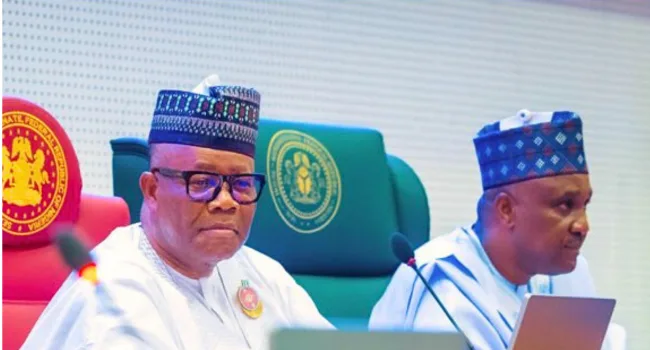
The United Kingdom on Wednesday threw its weight behind Nigeria’s ongoing efforts to establish state police, describing the National Assembly’s security reform initiative as a major step towards building a more accountable, responsive and community-focused policing system,
Similarly, the Speaker of the House of Representatives, Tajudeen Abbas and the Senate Leader, Opeyemi Bamidele, assured Nigerians that the proposed constitutional amendment contains strong safeguards to prevent abuse by governors and other powerful interests.
The endorsement came at the National Security Roundtable held as part of the 2026 National Assembly Open Week in Abuja, where lawmakers, security chiefs, governors, ministers and development partners converged to deliberate on legislative reforms aimed at addressing Nigeria’s worsening security challenges.
The roundtable, supported by the United Kingdom Government-funded Strengthening Peace and Resilience in Nigeria Programme, focused on state policing, security sector reforms, inter-agency collaboration, institutional accountability and the legislative framework required to strengthen Nigeria’s security architecture.

The discussions come at a critical period for the country as the National Assembly considers what many observers have described as one of the most far-reaching constitutional amendments since the return to democratic rule in 1999.
The proposal to establish a state police has dominated national discourse for more than two decades, with supporters arguing that decentralising policing would improve intelligence gathering and response to local security threats, while opponents have consistently warned that governors could deploy state-controlled police against political opponents.
The debate has gained renewed momentum under President Bola Tinubu following the transmission of an executive bill seeking to amend the Constitution to allow states to establish their own police services.
The proposal is widely seen as part of broader efforts to tackle persistent insecurity across the country, including banditry, kidnapping, terrorism, violent farmer-herder clashes and attacks on rural communities.
In a statement issued ahead of the roundtable, the British High Commission said the engagement was expected to shape legislative reforms, particularly the ongoing constitutional amendment process on the establishment of a state police.
The Head of Development Cooperation at the British High Commission, Cynthia Rowe, stressed that meaningful security reforms must be anchored in institutions that are accountable to citizens and capable of responding effectively to emerging threats.
He said, “Sustainable security requires strong, accountable institutions that are responsive to the needs of the people.
“The UK Government remains committed to supporting Nigeria’s legislative frameworks to ensure that security interventions are transparent, well-resourced, and firmly rooted in respect for human rights.
“This roundtable is a commendable step towards codifying reforms that will protect vulnerable communities and foster long-term stability.”
The British High Commission noted that the meeting brought together key actors in Nigeria’s security sector, including the National Security Adviser, the Chief of Defence Staff, the Inspector-General of Police and the Ministers of Defence, Interior and Police Affairs, alongside relevant committees of the National Assembly responsible for security oversight.
Governors from Kaduna, Katsina, Plateau and Benue, the four focal states under the SPRiNG Programme, as well as those of Kwara, Zamfara, Niger and Borno, also participated in the engagement to provide perspectives on the evolving security situation in their states.
According to the organisers, the objective was to assess the country’s current security landscape and identify legislative and budgetary measures capable of strengthening security institutions while supporting the proposed state police framework.
Speaking on the significance of the initiative, the Team Leader of the SPRiNG Programme, Ukoha Ukiwo, said experience from the programme’s peacebuilding interventions had demonstrated that lasting security reforms require a solid legal foundation.
“Our work across our state compacts has continually highlighted that operational peacebuilding must be backed by robust legal frameworks. The focus of this roundtable on state policing, security funding, and accountability is incredibly timely.
“By bridging the gap between grassroots realities and legislative action, we can ensure that informal and formal security architectures work cohesively to build formidable resilience in communities across Nigeria,” he stated.
The organisers added that discussions at the roundtable also centred on responses to banditry, kidnapping and farmer-herder conflicts, while exploring how technology, intelligence sharing, community engagement and improved inter-agency collaboration could enhance Nigeria’s response to emerging security threats.
The meeting is expected to produce a communiqué outlining priority reforms and recommendations to guide the implementation of state policing and other legislative initiatives aimed at strengthening public safety.
Also speaking at the event, the Speaker of the House of Representatives, Abbas, assured Nigerians that the proposed constitutional amendment would contain sufficient safeguards to prevent state police from becoming instruments of political intimidation.
Abbas described the proposal as one of the most consequential constitutional reforms currently before the National Assembly, noting that it marked the first time a sitting President had formally transmitted an executive bill seeking to establish state police.
He commended President Tinubu for taking what he described as a historic step after decades of national debate on the issue.
“For the first time in our history, a sitting president has made state police a central part of national reform. He has done so not with words alone, but with a bill that now sits before the House of Representatives.”
Continuing, Abbas acknowledged widespread concerns that governors could exploit state police for partisan purposes but insisted that the proposed legislation deliberately incorporates constitutional safeguards to prevent such abuse.
“I understand the concern that many people bring to this discussion, and it is a reasonable one. It is the fear that state police could become the private army of a governor or a political godfather,” he said.
According to the Speaker, Nigeria’s growing population and increasingly complex security environment had exposed the limitations of a centrally controlled policing system.
He argued that a country of more than 200 million people could no longer rely solely on a single national police force to tackle increasingly localised security threats, citing banditry, kidnapping, violent farmer-herder clashes and attacks on schools as examples of crimes requiring local knowledge and faster response.
“A country as large and as varied as ours cannot be policed forever by one central Force run from the capital.
“More than 200 million people live across our forests, our farmlands, and our borders, and a single force cannot know every community or watch every road,” he added.
Abbas explained that under the proposed constitutional amendment, the Nigeria Police Force would be renamed the Federal Police Service, while states willing to establish their own police organisations would be empowered to do so through laws passed by their respective Houses of Assembly.
He stressed that no state police service would become operational until it satisfied national minimum standards to be prescribed by the National Assembly.
The Federal Police, he said, would continue to retain exclusive responsibility for terrorism, border security, federal offences and policing the Federal Capital Territory.
The Speaker further explained that Commissioners of Police would be appointed based on the recommendation of the National Police Council and confirmed by state legislatures.
He added that such commissioners could only be removed by a two-thirds majority of the relevant House of Assembly for just cause.
Abbas also disclosed that the proposed amendment empowers the federal police to intervene where a state police service collapses or is unlawfully deployed, but only under clearly defined constitutional conditions, with legislative notification and judicial oversight.
“If a state police breaks down, or falls into the wrong hands, or turns against the very people it should protect, the Constitution allows the federal police to step in,” he added.
The Speaker advocated a phased implementation of state policing, warning against allowing all 36 states to establish police services simultaneously without adequate institutional preparation.
“We should move step by step, state by state, learning as Germany and Canada learned, rather than switching on 36 new forces on the same day,” he counselled.
He also emphasised the importance of sustainable funding, warning that states should not establish police services they lack the financial capacity to maintain.
“We must settle the question of money from the very beginning, so that no state creates a police force it cannot pay, and no unpaid officer becomes a threat to the citizen he has sworn to protect,” he added.
Drawing lessons from federal systems such as Germany, Canada, India and the United States, Abbas argued that decentralised policing can only succeed where there are uniform national standards, effective intelligence sharing and robust accountability mechanisms.
He further advocated legislation to establish a national criminal and biometric database, strengthen intelligence sharing among security agencies, improve border security and enhance the welfare, training and equipment of security personnel.
Reaffirming the House of Representatives’ commitment to the reform process, Abbas said lawmakers would ensure that the legislation strikes the right balance between strengthening internal security and safeguarding democratic institutions.
“Let us build a police service that protects the citizen in the smallest village as faithfully as it protects the powerful in our cities.
“That is the country we owe our people, and it is the country the House of Representatives is determined to help build,” he said.
Also on Wednesday, the Leader of the Senate and Vice Chairman of the Senate Committee on the Review of the 1999 Constitution, Bamidele, provided further insight into the constitutional safeguards being considered by the National Assembly to shield state police services from undue political influence.
In a statement issued by his Directorate of Media and Public Affairs, Bamidele acknowledged that many of the concerns raised by Nigerians over state policing were legitimate and rooted in the country’s constitutional history.
“Nearly all public concerns on the state police proposal are well founded and obviously cannot be swept under the carpet considering their weight and enormity.”
According to him, much of the apprehension stems from Nigeria’s experience during the First Republic, when the 1960 and 1963 Constitutions empowered regional governments to establish police forces that were sometimes accused of serving partisan interests.
He said the National Assembly was, therefore, developing a comprehensive framework of constitutional safeguards that would strengthen institutional independence, enforce professional discipline and guarantee financial autonomy for state police services.
Bamidele disclosed that one of the key proposals under consideration is to make funding for state police services a first-line charge, similar to the constitutional funding arrangement currently enjoyed by the judiciary.
“That is why we called it a first line charge. In other words, the Commissioner of Police and State Police Service Commission must have a guaranteed source of funds provided for in the 1999 Constitution in a way that the police chief will not be subject to the whims and caprices of a state governor,” he said.
He argued that guaranteeing financial independence would prevent governors from starving state police services of funds whenever disagreements arise between elected officials and security agencies.
“Part of the critical issue we must resolve, even in amending the 1999 Constitution, is to guarantee the financial independence of state police services.
“In other words, it should not be at the discretion of a governor of a state entirely whether he wants to fund state police service or not.
“If a state police service is not responding well to the directives of a governor, he may choose not to fund it. We must prevent such a situation.
“We are, therefore, under the obligation to make provision for a certain percentage of a state budget specifically for the operations of state police services. Access to funds must be clearly spelt out,” he noted.
Bamidele said the proposed financial safeguards were intended not only to prevent political interference but also to shield state police services from manipulation by wealthy individuals, criminal syndicates and other vested interests.
While acknowledging that many critics of state policing had focused largely on the possibility of governors abusing the system, the Senate Leader argued that inadequate funding could expose the new security outfits to even wider forms of influence.
He said, “Business class can also abuse it. Some other organisations, even criminals or cabals, can abuse the state police service because it is a question of ‘he who pays the piper dictates the tune.
“If a state police service is not well funded by any means, we have a situation where it may as well be a highway to nowhere. That is one thing all of us must prevent.”
He assured Nigerians that the National Assembly remained committed to creating a state police service that would be accountable to the people, adding that concerns raised by stakeholders would be reflected in the ongoing constitutional amendment process.
Bamidele stressed that addressing the issue of funding was critical to the success of the proposed reform, warning that poorly funded police services would struggle to discharge their constitutional responsibilities effectively.
He explained that the objective of the constitutional amendment was to move policing from the Exclusive Legislative List, where it is currently vested solely in the Federal Government, to the Concurrent Legislative List, thereby empowering states to establish their own police services through legislation.
According to him, the amendment seeks to create a framework that balances operational independence with constitutional oversight while ensuring that state police services remain professionally managed and financially sustainable.
The Senate Leader maintained that the ongoing constitutional review presents an opportunity to address longstanding structural weaknesses in Nigeria’s internal security architecture, particularly as insecurity continues to evolve across different parts of the country.
The renewed push for state police follows years of growing concern over the capacity of the Nigeria Police Force to effectively respond to increasingly localised security threats in a federation of more than 200 million people.
In recent years, Nigeria has witnessed persistent attacks by bandits in the North-West, terrorist activities in parts of the North-East, widespread kidnappings for ransom, violent farmer-herder clashes across the North-Central and increasing communal conflicts in several states.
Security experts, governors, traditional rulers and civil society organisations have repeatedly argued that decentralising policing would improve intelligence gathering, strengthen community engagement and enable faster responses to emergencies because officers recruited from local communities are often more familiar with the terrain, language and social dynamics of their areas of operation.
However, the proposal has remained one of the country’s most contentious constitutional issues since the return to democratic rule in 1999.
Opponents have consistently warned that granting states control over police formations could expose security institutions to political interference, particularly during elections, recalling allegations of abuse associated with regional police structures during the First Republic.
Those concerns have featured prominently in previous constitutional amendment exercises, preventing successive administrations from securing the political consensus required to establish a state police despite repeated calls for decentralisation.
Tinubu’s decision to transmit an executive bill seeking the creation of state police has, however, placed the issue at the centre of the current constitutional review process, marking the first formal attempt by a sitting President to initiate such an amendment through an executive proposal.
Wednesday’s National Security Roundtable formed part of activities marking the 2026 National Assembly Open Week, an annual engagement designed to deepen public participation in legislative activities and promote dialogue on major national policy issues.
Beyond state policing, participants examined broader security sector reforms, including institutional accountability, security funding, intelligence sharing, technology-driven policing and improved collaboration among security agencies.
Discussions also focused on legislative and budgetary measures considered necessary to strengthen Nigeria’s security institutions and improve responses to banditry, kidnapping, farmer-herder conflicts and other emerging threats.
The organisers said the meeting would culminate in a communiqué outlining priority reforms and recommendations to guide the implementation of state policing and other legislative initiatives aimed at strengthening public safety.
The Strengthening Peace and Resilience in Nigeria Programme, which supported the event, is a United Kingdom-funded initiative that promotes conflict prevention, peacebuilding and institutional resilience in selected states through stronger community security structures, improved governance and collaboration between formal and informal security institutions.
With the House of Representatives and the Senate Constitution Review Committees expected to continue work on the executive bill in the coming months, the debate over state police is set to intensify as lawmakers seek to balance demands for decentralised policing with safeguards designed to protect democratic governance, institutional independence and the rule of law. (Punch)
-

 News10 hours ago
NBA presidency: Senior advocates endorse Badejo-Okusanya, seek transformative leadership
-
 News10 hours ago
Fake agency scandal: Atiku, Presidency clash as Senate rejects fresh probe
-
News10 hours ago
ADC Demands Probe Of Physiotherapist’s Death, Asks Umahi To Step Aside
-
Business10 hours ago
Reps panel asks customs to name beneficiaries of N34trn import duty waivers
-
News10 hours ago
Poverty threatens 79% of Nigerians despite reforms – World Bank
-
Opinion10 hours ago
Nigeria’s Recovery Has Begun; Why Doesn’t It Feel Like One?
-
News24 hours ago
Alleged Fraud: Court Grants Ex-Code Of Conduct Tribunal Chair N100m Bail
-
Sports10 hours ago
Argentina stage dramatic comeback against England to reach consecutive World Cup finals