Politics
Who inherited Ike Ekweremadu’s political machine in Enugu?

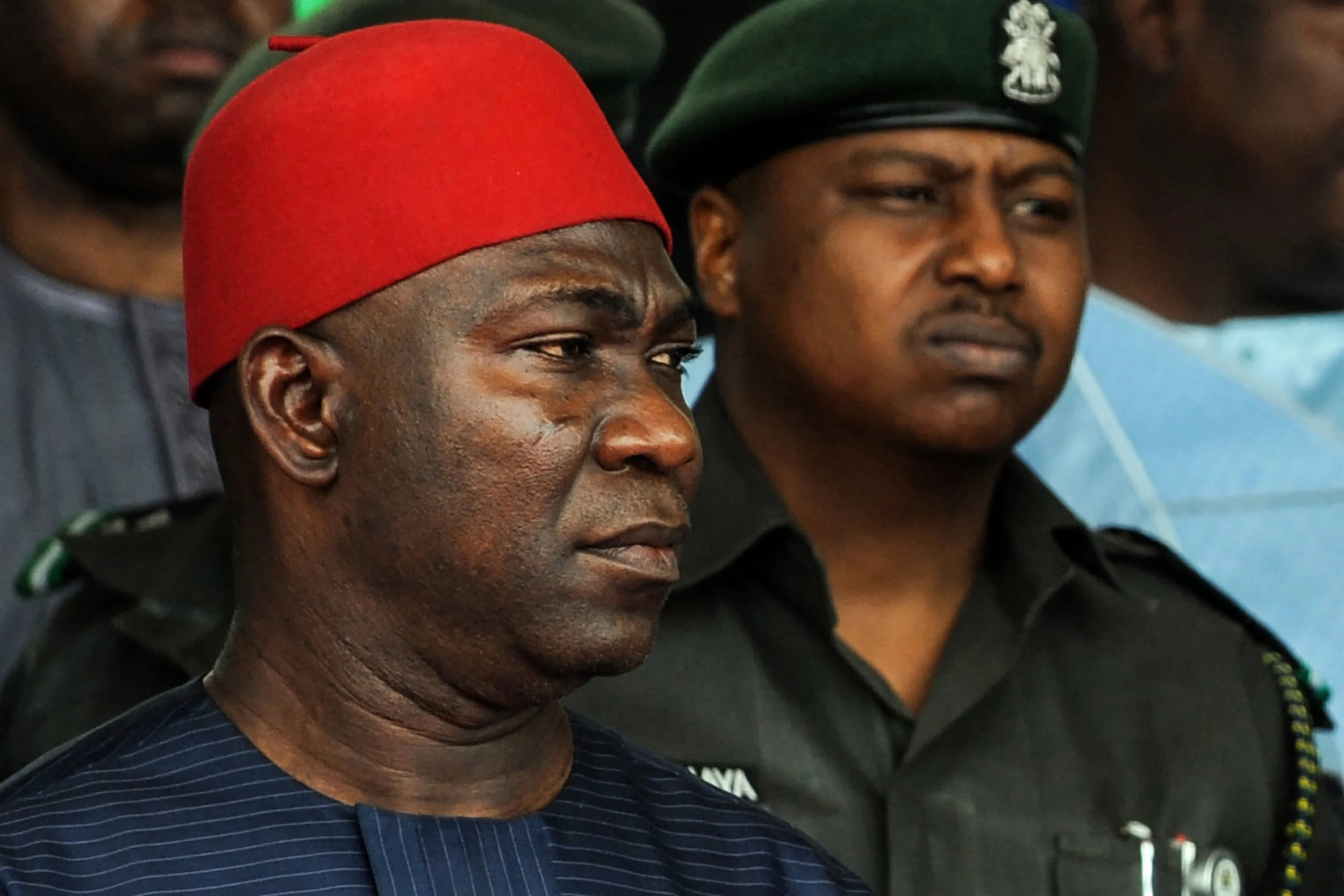
On 12 May, Nnamani Arinze Dalington, a media aide to Enugu State governor Peter Mbah, marked Ike Ekweremadu’s 64th birthday with an extravagant tribute.
“On this special day, I celebrate the enduring structures of leadership, political mentorship and selfless public service that you have nurtured,” he wrote.
Elsewhere in Enugu, supporters gathered to celebrate the former deputy Senate president, who is serving a nine-year-and-eight-month prison sentence in the UK. In parts of Enugu West, prayers are still organised for him. Fading campaign posters remain on walls and billboards.
“They celebrated him as if he was around,” says Monday Chukwudi, a kinsman and political ally whose name has been changed. “You cannot come to Enugu West to campaign without talking about Ekweremadu.”

Yet the political order Ekweremadu left behind has not survived intact. His arrest in London in June 2022 removed one of the main brokers of Enugu’s long-ruling Peoples Democratic Party just as Peter Obi’s insurgent presidential campaign was gathering force.
Four years later, Mbah has taken the state government into the ruling All Progressives Congress, Obi has moved to the Nigeria Democratic Congress and the remnants of the PDP are struggling for relevance.
The question is no longer whether Ekweremadu retains admirers. It is who can turn what remains of his network into votes in 2027.
The broker goes missing
Ekweremadu represented Enugu West in the Senate for 20 years and served as deputy Senate president from 2007 to 2019. His importance lay not only in his offices but in his ability to manage the rivalries that repeatedly threatened the Enugu PDP.
His supporters point to the crisis ahead of the 2015 election, when Ekweremadu and then governor Sullivan Chime fought over Senate and governorship tickets. President Goodluck Jonathan brokered a truce: Ekweremadu kept his Senate seat, while Chime’s camp retained much of its influence over the succession. The party stayed together and kept control of the state.
That history lends weight to the claim that Ekweremadu’s absence mattered in 2023.
“If Ekweremadu was around, there was no way the PDP would have lost Enugu State,” says Alex Ogbonnia, a university lecturer and ally.
But it cannot carry the argument alone. The PDP was also hit by fatigue with the outgoing administration, factional battles and, above all, the Obi wave. Mbah defeated Labour’s Chijioke Edeoga by just 3,343 votes, while the PDP lost most of its federal and state legislative seats.
Ekweremadu might have held the party together more. It is harder to argue that even his machine could have stopped the wider revolt that swept the South East.
How much did Mbah absorb?
The strongest evidence that Mbah had inherited part of the network predated the 2023 election. Ndi Oganiru Enugu, described as Ekweremadu’s main support organisation, formally backed Mbah and said it would merge a structure spanning all 260 wards into the PDP campaign.
Its president, Jude Asogwa, said the group was honouring a commitment Ekweremadu had made after losing the PDP nomination. Mbah also said the two men had agreed that whichever of them secured the ticket would support the other.
There is no public evidence of a fresh, independently authenticated instruction sent from prison. But the endorsement was more than an improvised claim by a lone politician. It was issued by an established Ekweremadu organisation and presented as the execution of a pre-arrest agreement.
Mbah has since drawn several figures linked to the former senator into his orbit. He appointed Ekweremadu’s son, Lloyd, as a commissioner. Dalington, once part of Ekweremadu’s communications operation, now works for the governor.
That demonstrates accommodation and partial absorption. It does not prove that the whole machine changed hands.
Even Ekweremadu’s allies acknowledge that his followers no longer move as a single bloc.
“Some people have gone to seek political progress elsewhere, but it doesn’t mean they have cut ties with the former deputy Senate president,” says Obiora Obasi, a close ally. “He still enjoys a lot of loyalty among former staff and associates.”
Obasi says Ekweremadu’s people can now be found in the Enugu government and in other political organisations. Some may have sought his consent before moving, he says, while others probably acted independently.
“It is not as if the structure is a cult where the leader’s footsteps must be followed at all times,” he says. “People still have the political agency to seek progress elsewhere.”
The result is less an inherited machine than a dispersed network. Its members retain personal ties to Ekweremadu but increasingly make their own political bargains.
Popularity versus machinery
Mbah’s October 2025 move to the APC accelerated that process. Rather than showing weakness alone, the defection gave him access to the federal ruling party while bringing much of Enugu’s government and political class with him.
Obi and the NDC offer the clearest challenge. Obi remains immensely popular in Enugu and across the South East. But presidential appeal is not the same as a functioning state party.
The NDC’s Enugu branch has already been shaken by rival claims to its leadership and complaints over candidate selection. It has yet to show that it can reproduce Labour’s 2023 mobilisation in governorship and legislative races.
The emerging contest is therefore uneven. Mbah controls the state government and is aligned with Abuja. Obi commands the stronger opposition brand but has less proven machinery. The PDP retains old relationships but little of its former authority.
Ekweremadu’s network lies between them. Some of its most visible figures have joined Mbah. Others remain in the PDP or have sought opportunities in emerging opposition groups. Personal loyalty persists, but it no longer dictates a common political direction.
That complicates the belief among some supporters that the structure is simply dormant.
“They are still waiting for him,” Chukwudi says. “They are not satisfied; they are not being carried along. So they are still waiting for their big oga.”
But by 2027, Enugu may discover that Ekweremadu’s legacy is no longer a machine waiting to be reactivated. It may instead be a reservoir of goodwill, divided among politicians who have learnt to survive without him.
(The Africa Report)
-

 Politics10 hours ago
Presidency denies withholding ₦250bn NLNG dividends from states
-
News9 hours ago
5 Security Operatives Killed As B/Haram Attacks Adamawa Communities
-
Politics9 hours ago
2027: APC unveils online portal for support groups
-
News10 hours ago
FG disagrees with World Bank over H1 124% debt servicing/revenue ratio
-
News9 hours ago
Nnamdi Kanu’s Family Accuses UK Of Failing To Protect Its Citizen, Demands Action To Secure His Freedom
-
Metro10 hours ago
Kidnapped Catholic Priest, three others rescued in Benue
-
Politics9 hours ago
AbdulRazaq commends Wike’s inclusion in Presidential Campaign Council
-
Politics9 hours ago
Buhari Saw Tinubu As ‘Bad News’, Resisted His Presidency – Baba-Ahmed